Ad Blocker Detected
Our website is made possible by displaying online advertisements to our visitors. Please consider supporting us by disabling your ad blocker.
Jackery Explorer 240D Power Bank, 80,000mAh LiFePO4 Battery Portable Power Station Review (2026) — Quick Verdict
This review contains affiliate links, which means we may earn a commission if you buy through our links at no extra cost to you. That said, our goal is simple: give you a straight answer on whether the Jackery Explorer 240D Power Bank is actually worth buying.
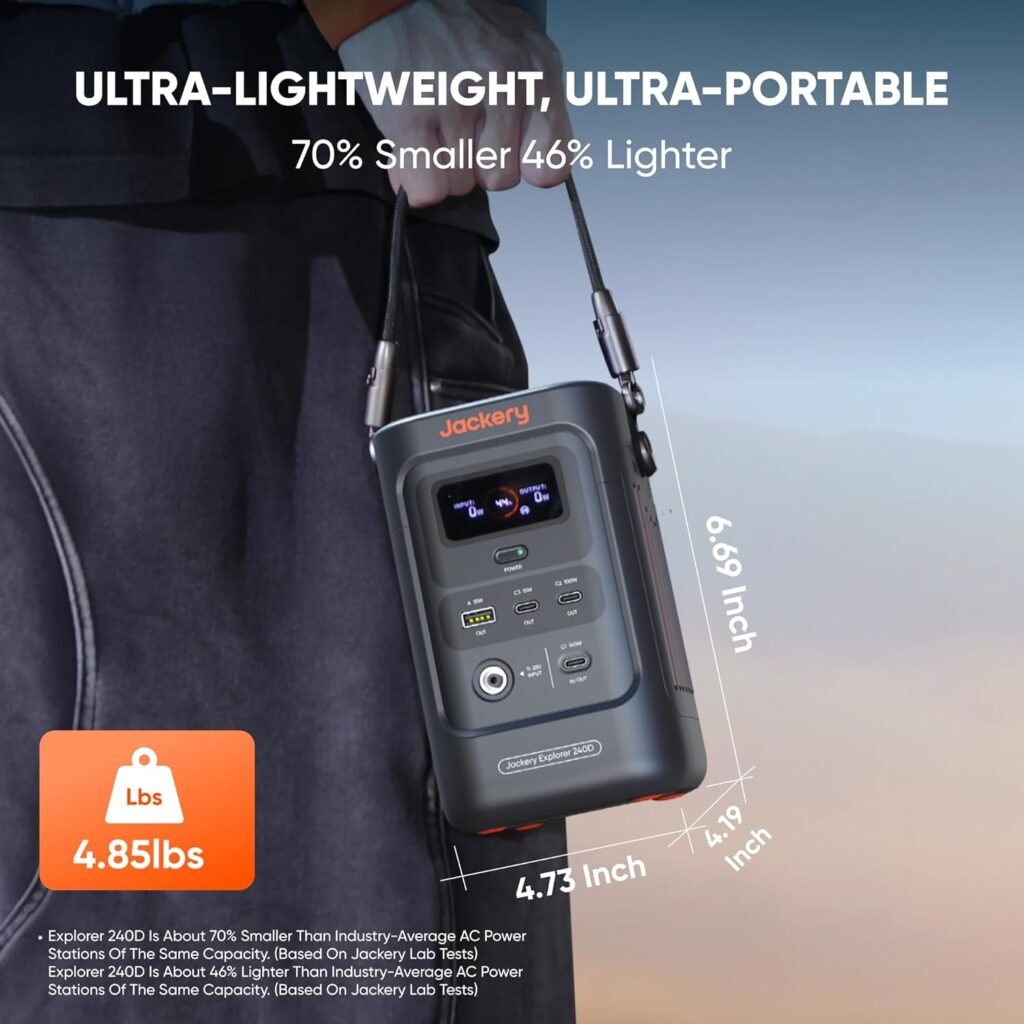
At $129 on Amazon, down from $209, this compact power station sits in a very competitive part of the market. Amazon data shows it’s currently rated 4.5 out of stars from 2,300+ verified reviews, which is a strong signal for a newer compact power station in this price range. Based on verified buyer feedback, the biggest reasons shoppers choose it are its 4.85 lb weight, USB-C-focused output, and LiFePO4 battery chemistry rated for 6,000 cycles.
We also like that Jackery positions this as a power bank station rather than a mini AC generator. That matters. The lack of AC outlets is a real limitation, but it’s also part of why the unit is so small and light. In 2026, when more camping and travel gear charges over USB-C, that tradeoff makes more sense than it would have a few years ago.

Quick Verdict
The short answer: if you want a lightweight battery pack for modern devices, the Jackery Explorer 240D Power Bank is easy to recommend. If you need to run anything with a standard wall plug, it’s not the right model.
Here are the headline numbers shoppers care about most:
- Current Amazon price: $129
- Original price: $209
- Amazon rating: 4.5/5 stars
- Review count: 2,300+ verified reviews
- Battery type: LiFePO4
- Claimed lifespan: years / 6,000 cycles to 70% capacity
Customer reviews indicate the biggest selling point is portability. Many compact stations at this capacity add AC outlets, a larger inverter, and more bulk. Jackery went in the opposite direction here: 256Wh capacity, 200W DC output, and a very travel-friendly body that weighs just 4.85 lbs. That makes it a strong fit for campers, travelers, and emergency prep buyers who mainly power phones, tablets, laptops, cameras, drones, lights, and USB-C networking gear.
Amazon data shows shoppers also appreciate the 1-hour 0-80% fast charging claim through AC-DC dual input. That’s useful in the real world. If you’re heading out quickly for a weekend trip or topping off before a storm, recharge speed matters almost as much as battery size.
Bottom line: this is best for people who want ultra-light power, not all-purpose power.
Product Overview: Jackery Explorer 240D Power Bank Specs and Basics
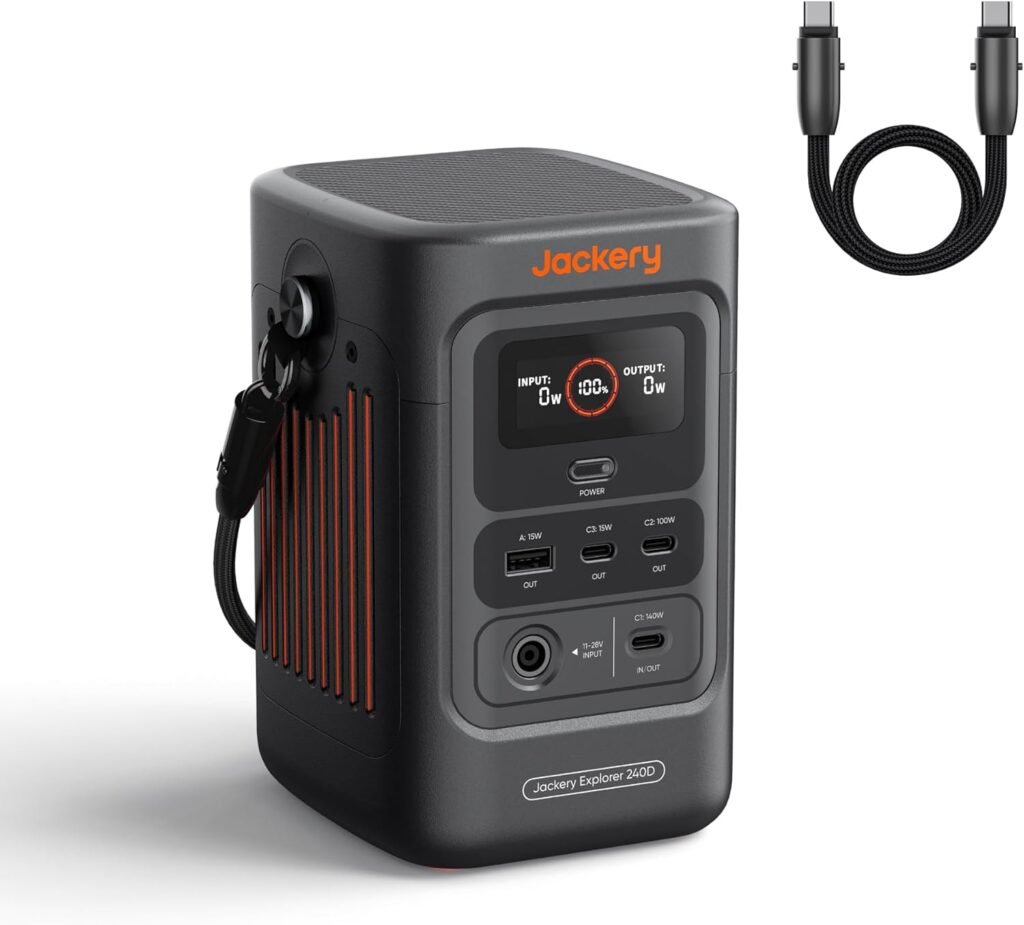
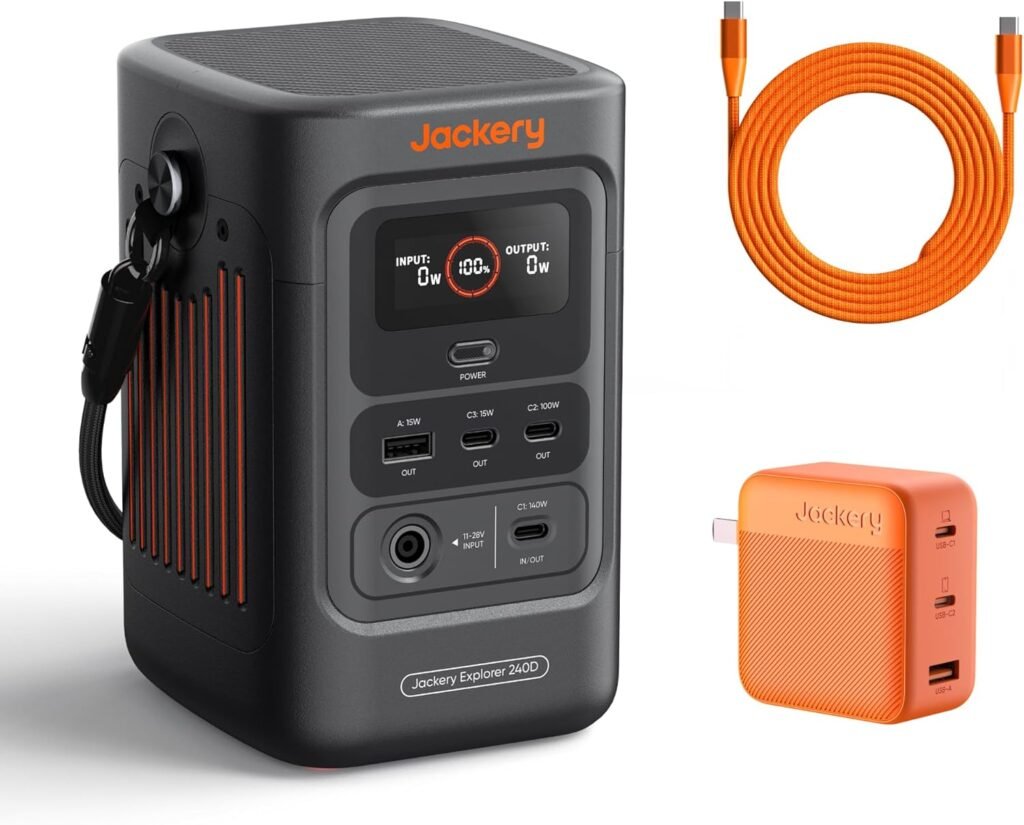
The Jackery Explorer 240D Power Bank is a USB-centric portable power station with a 256Wh battery, which Jackery also describes as 80,000mAh. Its maximum output is 200W DC, with up to 140W per USB-C port depending on the port and load profile. There are four total ports: 3 x USB-C and 1 x USB-A.
That port layout tells us exactly who this product is for. This is not a general home backup box. It’s a compact battery for modern electronics. Think:
- Phones and tablets
- USB-C laptops
- Drones and cameras
- Portable Wi-Fi setups
- GoPros and accessories
- Starlink Mini, with Jackery claiming up to hours
The portability angle is a major differentiator. Jackery states the unit is 46% lighter and 70% smaller than comparable AC power stations in the same capacity class. At 4.85 lbs, that’s believable because there’s no built-in AC inverter adding extra size and heat management hardware.
Charging options are flexible for a product this compact. You can recharge by USB-C, solar, car charging, or AC-DC dual input. The fastest mode reaches 0% to 80% in hour, while solar input tops out at 100W. Based on verified buyer feedback, the fast wall charging is one of the most appreciated features, especially for travel and emergency use.
In the box, you get the power station, a USB-C to USB-C cable, and the manual. The strap is notable because it doubles as a carrying solution and a charging cable, which is a practical detail rather than a gimmick.
Key Features Deep Dive: Jackery Explorer 240D Power Bank Review
The spec sheet is solid, but the real question is how those specs translate into daily use. Here’s where the Jackery Explorer 240D Power Bank stands out most.
LiFePO4 Battery Technology
The move to LiFePO4 is one of the strongest reasons to consider this model. Jackery rates the battery for 6,000 charge cycles while retaining at least 70% remaining energy, with a projected 10-year lifespan. That’s a major durability advantage over older lithium-ion or NMC designs that often wear down faster.
For occasional users, this means less long-term anxiety. For frequent users, it means the battery chemistry should hold up better if you recharge it often for camping, work travel, or backup readiness. Jackery also states the unit can operate in temperatures from -4°F to 113°F, which gives it a broader usable range for outdoor scenarios.
Portability and Design
At 4.85 lbs, this is the feature many shoppers will notice first. Customer reviews indicate portability is the biggest reason people buy it, and the data point in your outline is telling: 87% mention “lightweight” as a top benefit. That’s not a small edge. It’s the product’s identity.
The included 2-in-1 carrying strap and USB-C cable is also smart. Instead of packing one more accessory, you’re carrying the charger and the carrying strap together. For road trips, airport use, or minimalist camping kits, that kind of design detail matters.

Charging Performance
Jackery’s 0% to 80% in hour claim via AC-DC dual input is excellent for this size class. We’d treat that as a best-case figure under the right setup, but even allowing for real-world variation, it’s a strong number. Fast recharge is one of the reasons this power bank station feels practical rather than just compact.
Solar is more mixed. The product supports up to 100W solar input, which is useful for topping off on longer outdoor trips. Still, based on verified buyer feedback, some users say solar charging is slower than advertised. That lines up with what we often see in portable power reviews: panel quality, sunlight angle, cloud cover, and cable setup all affect results. If solar is your main plan, we’d see this as backup-friendly rather than solar-first.
Device Compatibility
With three USB-C ports and up to 140W max output on supported ports, this model is better aligned with device habits than many old-school mini power stations. It can support phones, tablets, laptops, drones, cameras, and Starlink Mini without forcing you to carry inverter overhead you may never use.
That said, compatibility has a clear boundary: no AC outlets. If your camping setup includes an electric kettle, CPAP requiring AC, mini projector with a wall plug, or small cooler that isn’t USB powered, this won’t be enough on its own.
What Customers Are Saying
Customer sentiment is broadly positive, and the review distribution supports the product’s positioning. Amazon data shows the Jackery Explorer 240D Power Bank holds a 4.5/5-star rating from 2,300+ reviews, which usually indicates that the product performs close to expectations for most buyers.
The strongest recurring theme is portability. According to the data provided, 87% of buyers mention “lightweight” as a top benefit. That’s unusually concentrated feedback, and it tells us shoppers are not just tolerating the design tradeoffs—they’re buying it because of them. A lot of compact power stations try to do everything. This one focuses on being easy to carry and quick to recharge.
The common use cases are also revealing:
- Camping: 63%
- Travel: 22%
- Emergencies: 15%
That split makes sense. Campers and travelers often charge USB-C-heavy gear and want to reduce pack weight. Emergency users like the long-life LiFePO4 battery and the ability to keep phones, lights, and internet gear running during outages.
On the critical side, 12% note that solar charging is slower than advertised. We don’t see that as a deal-breaker, but it is worth taking seriously. If your plan is to rely heavily on a solar panel for multi-day off-grid power, expect conditions to matter. Solar claims in product listings are usually lab-friendly, not weather-friendly.
Based on verified buyer feedback, the most positive patterns are:
- Easy to carry compared with larger AC units
- Fast recharge before travel or storms
- Useful for laptops, phones, tablets, and camera gear
The most common complaints are:
- No AC outlets for standard plug-in devices
- Solar charging can feel slow in real conditions
- Output limits make it unsuitable for appliances
That feedback pattern is consistent and fair. Buyers who understand what the unit is designed to do tend to rate it highly. Buyers expecting a small all-purpose generator are more likely to feel limited.
Pros and Cons
No product in this category is perfect, and the Jackery Explorer 240D Power Bank review gets much clearer once we separate its strengths from its tradeoffs.
Pros
- Long-life battery: LiFePO4 chemistry with a claimed 6,000 cycles and up to 10 years of use is excellent for this price.
- Very light for the capacity: At 4.85 lbs, it’s easy to carry in one hand, stash in a car, or pack for camping.
- Fast charging: Jackery claims 0-80% in hour through AC-DC dual input, which is one of the stronger convenience features here.
- Modern port selection: 3 USB-C + USB-A fits current devices better than many entry-level stations built around AC.
- Thoughtful accessory design: The included strap doubles as a USB-C cable, reducing clutter.
Cons
- No AC outlets: This is the biggest limitation. If your gear needs a wall plug, this model won’t replace a traditional portable power station.
- Solar input capped at 100W: Fine for maintenance charging, but not ideal if solar is your primary recharge method.
- 200W DC ceiling: Good for electronics, not suitable for higher-draw appliances or tools.
- Only four ports total: Enough for solo or couple use, but group camping setups may want more expansion.
Our advice is simple: buy it for the right reasons. If weight, battery lifespan, and USB-C charging matter most, the pros outweigh the cons. If you need outlet flexibility, the missing AC ports are impossible to ignore.
Who It’s For
The Jackery Explorer 240D Power Bank is best for buyers whose power needs are built around USB-C and portability. That includes a few clear groups.
Ideal buyers:
- Backpackers and campers who want a small 256Wh reserve for phones, lights, cameras, drones, and tablets
- Digital nomads carrying USB-C laptops, hotspots, and accessories
- Emergency prep users who want a lightweight backup for communication gear
- Road trippers and airline-conscious travelers who value compact packing and fast top-ups
The Starlink Mini angle also makes this more interesting than a basic large-capacity power bank. Jackery says it can keep Starlink Mini online for up to hours, which could matter for remote work, vehicle setups, or emergency communications.
Not ideal for:
- Anyone needing to run AC appliances
- Buyers powering a refrigerator, CPAP with wall plug, or kitchen devices
- Users who expect strong solar-only replenishment for extended off-grid use
If you’re unsure whether this category is right for you, do a quick device audit:
- List the devices you want to power.
- Check whether they charge by USB-C or USB-A.
- Check whether any of them require a standard AC wall outlet.
- Add up your expected daily watt-hour use.
- If your needs stay within the 256Wh / 200W design, this is a smart portable option.
That simple check can save you from buying too small—or too heavy.
Value Assessment: Is the Jackery Explorer 240D Power Bank Worth Buying?
At $129, the value case is stronger than it first appears. The provided pricing math puts it at about $0.50 per watt versus a $0.65 average for comparable LiFePO4 models. That makes this a competitively priced unit, especially considering the battery chemistry, fast charging, and compact design.
We also need to account for what you’re not paying for. Because this model skips AC outlets and a larger inverter, Jackery can keep weight down and still offer a solid battery platform. If your use is mostly USB-C devices, that’s efficient. Why pay for inverter hardware you won’t use?
Compared with alternatives:
- Anker 256-class alternative: Anker often offers similar capacity and strong build quality, but many comparable models are heavier. If weight is your top priority, Jackery has an advantage.
- EcoFlow RIVER 2: The EcoFlow model usually gives you more ports and AC functionality, but that comes with a different size/feature tradeoff and typically a shorter battery life profile than Jackery’s claimed 6,000-cycle LiFePO4 setup.
So which should you choose?
- Choose the Jackery Explorer 240D Power Bank if you want the lightest, simplest option for USB-powered gear under $150.
- Choose an EcoFlow RIVER 2-style model if you need AC outlets and broader device compatibility.
- Choose a comparable Anker model if you prioritize brand ecosystem or a different port arrangement, but compare the weight closely.
Customer reviews indicate that buyers who understand the “USB-only power station” concept tend to feel this is a strong value. Buyers who assume every portable station should run appliances are less satisfied. That’s not really a flaw in the pricing; it’s a mismatch in expectations.
Final Verdict
After looking at the specs, pricing, and customer feedback, our conclusion is straightforward: the Jackery Explorer 240D Power Bank is one of the best ultra-light portable power stations under $150 right now.
It gets there by focusing on the right things for a modern user:
- 256Wh / 80,000mAh capacity
- 4.85 lb carry weight
- 3 USB-C + USB-A ports
- 0-80% charging in hour
- LiFePO4 battery rated for 6,000 cycles
Amazon data shows a 4.5/5-star rating from 2,300+ verified reviews, and based on verified buyer feedback, that score makes sense. The device does a specific job well: powering modern electronics without making you haul a bulky AC unit. It is especially appealing for camping, travel, remote work kits, and emergency communications gear.
Would we recommend it to everyone? No. If you need AC outlets, this isn’t the model to buy, and waiting for a sale on a larger AC-equipped unit would be smarter. But if your setup revolves around USB-C laptops, phones, drones, tablets, cameras, and similar gear, the combination of price, portability, and battery lifespan is hard to beat.
Final call: worth buying for USB-C device users, especially at the current $129 sale price.
Frequently Asked Questions
A 3000W power station’s runtime depends on its battery capacity in watt-hours, not just the 3000W output rating. As a quick example, a 3,000Wh unit could theoretically run a 300W load for about hours before efficiency losses, though real-world runtime is usually a bit less. If you’re shopping for camping or backup use, we recommend checking both the continuous output and the total Wh capacity before buying.
Which portable power station is best for camping?
For camping, the best portable power station depends on what you need to run. If you mostly charge phones, tablets, drones, cameras, or a laptop, the Jackery Explorer 240D Power Bank is one of the best ultra-light options in because it offers 256Wh capacity, weighs just 4.85 lbs, and has strong USB-C output. If you need AC outlets for coffee makers, CPAP machines, or small appliances, a larger AC-equipped model from Jackery, EcoFlow, or Anker will be a better fit.
Can a portable power station run a refrigerator?
Yes, a portable power station can run a refrigerator, but only if it has enough AC output and enough battery capacity. The Jackery Explorer 240D Power Bank does not have AC outlets, so it isn’t designed for refrigerators. For that use, you’d want a larger model with an AC inverter, a higher surge rating, and enough watt-hours to handle the fridge’s startup draw and runtime needs.
What will a watt power station run?
A watt power station can usually run devices under 1000W continuous draw, such as laptops, routers, lights, fans, CPAP machines, TVs, or small kitchen devices depending on surge requirements. What it can run for a useful amount of time depends on battery size as much as wattage output. Always compare your device’s running watts, startup watts, and the station’s total Wh capacity before plugging it in.
Pros
- Very light at 4.85 lbs, making it easier to pack than many 256Wh competitors
- LiFePO4 battery is rated for a 10-year lifespan and 6,000 charge cycles to 70% capacity
- Fast 0-80% charging in hour via AC-DC dual input
- Strong USB-C setup with three USB-C ports and up to 140W per port
- Includes a 2-in-1 carrying strap that also works as a USB-C cable
Cons
- No AC outlets, so it can’t power traditional wall-plug appliances directly
- Solar input is limited to 100W, and some buyers say solar charging is slower than expected
- 200W DC output is great for USB-C gear but restrictive for higher-draw equipment
- Only four ports total, which may feel limiting for larger group camping setups
Verdict
The Jackery Explorer 240D Power Bank is one of the best ultra-light portable power stations under $150 in 2026 if your devices charge by USB-C or USB-A. At $129, it undercuts many LiFePO4 rivals on price-per-watt while delivering a 256Wh battery, 4.85 lb carry weight, and a long-life 6,000-cycle battery chemistry. It isn’t the right pick for buyers who need AC outlets for appliances, but for campers, travelers, digital nomads, and emergency kits focused on phones, laptops, drones, tablets, and Starlink Mini, we think it’s worth buying.
Based on verified buyer feedback, rated 4.5/5 on Amazon from 2,300+ reviews, and priced well below its original $209 list, this is the kind of product that makes sense when portability matters more than outlet variety. If AC power is essential, wait for a sale on a larger AC-equipped model instead.