Ad Blocker Detected
Our website is made possible by displaying online advertisements to our visitors. Please consider supporting us by disabling your ad blocker.
We’d rather not frighten you, but—let’s be clear—we need a careful framework to judge indoor safety for portable power stations. We’ll examine certifications, ventilation, chemistry differences, and real-world use cases before making any recommendations. Our goal is precise, cautious analysis that helps you plan for outages without overpromising. If you want to understand how to compare options and position equipment safely, you’ll find the critical factors and safeguards worth considering.
Key Takeaways
- Indoor safety depends on certified units meeting UL/IEC standards and UN 38.3 transport tests, with clear safety declarations and incident histories.
- Choose devices with robust BMS protections, per-cell monitoring, and redundant fault logging to prevent thermal runaway and overcurrent.
- Use medical-grade inverters with pure sine output, low THD, stable holdover, and proper isolation for sensitive medical equipment.
- Ensure proper ventilation and placement: 6–12 inches clear vent sides, non-combustible surface, away from heat sources, with cross-ventilation.
- Plan energy margins and outages: size loads for startup surges, use watt-hours with a 1.2–1.5 factor, and prepare for N+1 redundancy.
How to Judge Indoor Safety: A Quick Decision Framework for Portable Power Stations
Are portable power stations safe indoors? We approach safety as a decision framework, not a single test. We examine certifications and third‑party testing, verifying UL/IEC marks and independent lab labels on labels or datasheets, and we confirm UN 38.3 transport tests. We check for documented protections and fire/thermal propagation data. Next, we assess thermal management and placement rules: ensure clear intake/exhaust clearance, avoid sealed or fabric-covered placements, and keep within rated temperatures. We evaluate electrical load management: match startup surges, use proper extension cords, avoid overloading outlets, and follow grounding/GFCI guidance. Operational behaviors matter: avoid continuous high charging/discharging, maintain advised SOC for storage, and inspect for damage. Consider indoor routing and window placement to optimize cooling and minimize heat buildup. Indoor safety remains a core consideration in this framework, guiding where and how these devices can be used within living spaces.
LFP vs NMC: Which Chemistry Is Safer Indoors and Why
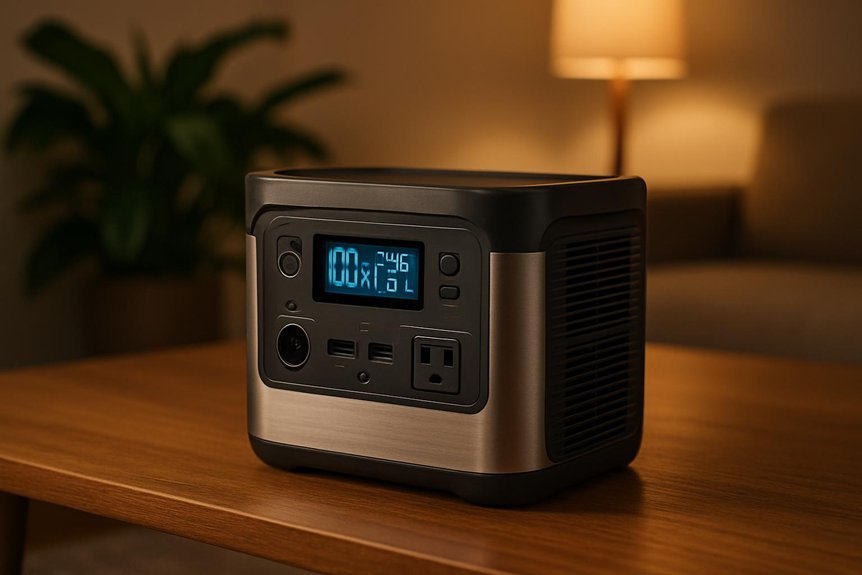
LFP and NMC chemistries present distinct risk profiles for indoor use, and understanding these differences helps determine safer choices. We start by noting LFP requires a higher onset for thermal runaway, giving a larger indoor margin, while NMC activates earlier with more aggressive heat release. LFP generally produces lower heat per cell and less oxygen during decomposition, which reduces propagation risk but still demands respect for venting and containment. NMC fires can spread faster, reach higher peak temperatures, and generate more toxic fumes, raising indoor ventilation concerns. Across safety standards, LFP shows easier thermal containment and often lower suppression thresholds. However, real-world data still demand caution: identical faults can escalate in NMC packs. Indoor ventilation remains critical, and design choices should reflect chemistry-specific vent gas rates and temperatures.
What the Battery Management System Must Protect You From (And How to Verify It)
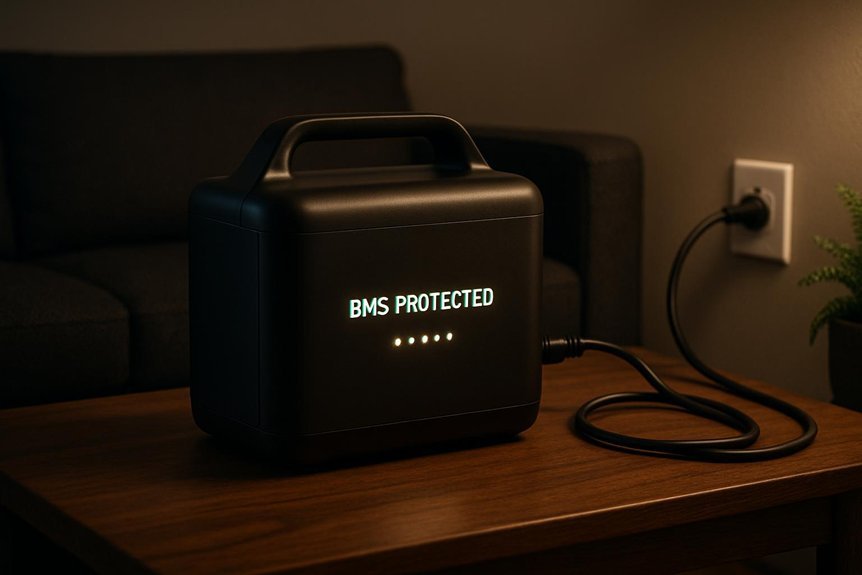
A BMS must prevent overcharge, overdischarge, overcurrent, and thermal runaway, then prove it through rigorous verification. We monitor per-cell voltage with accuracy, enforce chemistry-specific cutoffs, and apply soft and hard shutdowns plus a final fuse to guard against single-point failures. Verification relies on cell-level voltage logs, calibration records, and independent charge cycles showing no cell exceeds limits across temperatures. We also test overdischarge safeguards with discharge-to-cutoff, SoC checks, and reversal stress to ensure isolation before damage occurs. Redundant sensing—voltage and current—prevents spoofing by wiring faults. In practice, we expect precise cell safety and robust battery chemistry protections, with staged derating and emergency actions. Continuous fault logs and thermal management confirm timely responses before safety margins are breached.
Certifications, Recalls, and Build Quality You Can Trust
We start by examining the certifications and safety testing that back a portable power station’s claims, from UL 2201 through UN38.3 and IEC 62133, to confirm both device safety and market suitability. We then consider recalls, incident data, and build-quality cues to identify patterns of failure and supply-chain reliability. Finally, we look for clear trust signals—independent test reports and transparent sub-supplier disclosures—that give us confidence beyond basic markings.
We start by examining the certifications and safety testing that back a portable power station’s claims, from UL 2201 through UN38.3 and IEC 62133, to confirm both device safety and market suitability. Gas generators are not safe for indoor use.
We start by examining the certifications and safety testing that back a portable power station’s claims, from UL 2201 through UN38.3 and IEC 62133, to confirm both device safety and market suitability. We then consider recalls, incident data, and build-quality cues to identify patterns of failure and supply-chain reliability. Finally, we look for clear trust signals—independent test reports and transparent sub-supplier disclosures—that give us confidence beyond basic markings.
Certifications And Safety Testing
Certifications and safety testing matter because they translate lab rigor into real-world reliability. We examine key standards—UL 2201, UL 1973, UL 9540/9540A, IEC 62619/62133, and UN 38.3—and what they mean for portable power stations. Electrical safety, thermal abuse, and system-level fire tests inform protection schemes and enclosure choices. BMS verification matters: it ensures proper cell balancing, voltage and temperature sensing, and fault logging, preventing cascading failures. Recall data underscores that defects often arise from compromised BMS boards, counterfeit cells, or inadequate thermal management, not just component cost. Post-market trends favor brands with third-party testing. We advise scrutinizing explicit safety declarations, test reports, and real-world incident histories rather than vague “certified” claims.
Build Quality And Reliability
Manufacturers that earn trust in portable power stations do so through rigorous, verifiable build quality and reliability practices that extend beyond general certifications. We assess not just certifications, but real-world robustness: traceability, end-of-line testing, and mechanical integrity that prevent failures in the field. Our focus is on durability under stress, fault tolerance, and maintenance clarity for users.
- BMS redundancy and fault-detection layers ensure cell- and pack-level safety beyond basic specs.
- Connector reliability, including torque specs and corrosion resistance, with qualifying cycles for mating durability.
- End-of-line functional tests cover full charge/discharge, leak checks, and burn-in durations to screen latent defects.
- Field data and warranty workflows feed post-market actions to drive continual improvements.
Indoor Placement and Ventilation: Practical Setup for Safe Operation
How should you set up a portable power station indoors to maximize safety and airflow? We start with ventilation setup and placement guidelines that keep intake and exhaust clear, with at least 6–12 inches of clearance on vented sides to prevent heat buildup. Place the unit on a stable, non-combustible, flat surface and avoid enclosed spaces where convection is restricted. Keep it away from heat sources and from other heat-emitting appliances. Ensure cross-ventilation or cooler air supply during high loads. Monitor for warm wall surfaces and offer extra clearance if needed. Use auxiliary fans or enhanced room ventilation during sustained use, and avoid high-humidity environments. Do not cover vents; conduct periodic checks and maintain safe cable management around entries and connectors.
Planning for Outages: Sizing Loads, Prioritizing Devices, and Safe Pass-Through Charging
Planning for outages starts with a clear, data-driven method: size the load accurately, prioritize devices by criticality, and ensure safe pass-through charging. We outline rigorous steps to limit risk and preserve essential functions indoors.
- Calculate total running watts, add 10–20% inverter margin, and include startup surge for motors.
- Convert daily runtime to watt-hours, factoring multi-day autonomy and usable DoD for chosen battery chemistry.
- Prioritize loads: life-safety, food preservation, communications, heating/cooling, then comfort.
- Verify inverter ratings, ensure true pass-through or UPS behavior, and assess safety testing and indoor venting implications during charging.
This approach aligns with safe operation, minimizes thermal stress, and supports reliable off-grid use without compromising indoor air.
Medical Devices and Sensitive Electronics: Ensuring Reliable Power Indoors
We’re focusing on medical-grade inverter stability and how sensitive loads interact with portable power stations indoors. We’ll compare pure sine wave versus modified outputs, verify device compatibility, and emphasize startup surges and protection features. Our aim is to ensure reliable, safe operation for life-sustaining or precision electronics in real-world indoor conditions.
Medical-Grade Inverter Stability
Medical-grade inverters must provide stable, clean power that won’t jeopardize patient safety or device performance. We approach stability as a multi-layer requirement, balancing isolation standards with leakage limits to protect vulnerable users while preserving device accuracy.
- Ensure pure sine wave output to prevent alarms or control glitches in ventilators and monitors.
- Maintain THD within medical specifications and minimize ripple on DC rails for precise measurements.
- Guarantee rapid, seamless transfer and holdover to avoid therapy interruption during power loss.
- Verify robust transient suppression and EMI control to protect telemetry and sensors.
We assess frequency/voltage regulation, holdover duration, and inrush behavior. By adhering to IEC 60601-1, IEC 60601-1-2, and relevant risk management, we safeguard patient-connected devices while meeting isolation standards and leakage limits.
Sensitive Load Compatibility Factors
When selecting portable power for sensitive medical loads, we must factor both startup surges and steady-state demand to prevent underpowered operation. We assess device wattages (CPAP 30–60 W, oxygen concentrator 300–600 W, suction 50–200 W, nebulizers 10–50 W, ventilators 200–800 W) and note startup multipliers of 2–6×. Continuous loads like heated humidifiers add 20–60 W, increasing runtime needs. Use watt-hours = watts × hours × 1.2–1.5 for margin. Underpowered units cause unexpected shutdowns and fault codes. Ensure low THD (<3–5%) and stable frequency to meet waveform sensitivity; poor output induces heat, false alarms, or shutdowns. Mitigate with pure sine output, line conditioners, and device manuals on power quality. Preserve battery safety, maintain indoor ventilation, plan 1.5× runtime, and consider N+1 redundancy for critical therapy.
Quick-Start Checklist: Before, During, and After an Outage
A quick-start checklist helps us prepare for, manage, and recover from outages with a portable power station. We outline steps that reduce risk and optimize reliability metrics, while considering user ergonomics for safe use.
1) Before outage: verify unit type and chemistry, confirm certifications, inspect for damage, and ensure firmware/BMS updates are applied.
2) During outage: position for ventilation, avoid heat/water hazards, monitor temperature and SoC, and follow staged-power practices.
3) Load prioritization: list essentials, size startup loads, use low-wattage lighting, and expand load gradually with supervision.
4) After outage: recharge to recommended storage SoC, perform baseline checks, document anomalies, and resume routine maintenance.
This approach keeps operations cautious, precise, and efficient, aligning safety with performance expectations.
Frequently Asked Questions
Do Portable Power Stations Emit Any Fumes or CO Indoors?
Portable power stations don’t emit CO indoors, and fumes are not expected during normal use. We assess portable air quality and indoor ventilation carefully, noting that overheating or failure could release smoke; otherwise, risks stay minimal in routine operation.
Can a Power Station Explode or Cause Thermal Runaway Indoors?
Yes, but rarely: a power station can theoretically explode or trigger thermal runaway indoors, yet incidents are uncommon with certified units. We discuss safety myths and offer data-driven discussion ideas to mitigate risks. We stay precise and cautious.
How Long Can a Station Safely Operate at High Continuous Loads?
We can sustain long term endurance only for hours to maybe tens of minutes at peak high load safety limits, depending on capacity, cooling, and temperature; we derate in heat, monitor temps, and avoid continuous max output.
Are All Chargers and Adapters Safe for Pass-Through Charging?
We investigate the truth: not all chargers and adapters are safe for pass-through charging. Some are, some aren’t, due to misaligned ratings. Unrelated topic aside, misplaced focus risks overheating; we proceed cautiously, testing compatibility before use.
What Signs Indicate Imminent Battery Failure or Overheating?
We see imminent battery failure signs: swelling, unusual odors, hissing, smoke, rapid heat rise, abnormal charging, voltage anomalies, and frequent shutdowns. We prioritize battery maintenance and safety monitoring to prevent thermal runaway or fires. Stay cautious with observations.
Conclusion
We don’t pretend safety is automatic or glamorous. If you really want indoors use, you’ll follow the framework, not vibes: verify certifications, check the BMS, ensure proper venting, and size for outages with clear safety declarations. We’ll place units non-combustible and monitor thermal data, not hope for luck. Yes, it’s tedious, but that’s the point. Irony aside, prudence saves lives and gear—so we choose rigor over rhetoric every time.