Ad Blocker Detected
Our website is made possible by displaying online advertisements to our visitors. Please consider supporting us by disabling your ad blocker.
We understand portable power stations can produce some sound, but the level depends on design, load, and cooling. Fans, inverters, and vibration from batteries matter most, yet under light or steady loads the noise can be a quiet hum with few impulses. As we weigh enclosure, measurement conditions, and duty cycle, a unit might stay unobtrusive—or show brief jitter during peak demand. We’ll unpack how to balance power needs with tolerance for sound as we move forward.
Key Takeaways
- Yes, portable power stations produce noise from fans, electronics, and cooling systems, varying with load and temperature.
- Noise is typically a faint hum at low to moderate loads and may rise modestly under high loads.
- Intermittent or pulsed loads can cause brief spikes and pitch changes in the audible profile.
- Enclosure design, airflow, measurement methods, and duty cycle influence perceived quietness in specs.
- Real-world operation can achieve quiet or silent modes with proper load staging and thermal management.
Understand Noise: What a Quiet Portable Power Station Really Sounds Like
So, what does a quiet portable power station actually sound like in practice? We’ll define quiet as a stable baseline with minimal tonal variation, no abrupt bursts, and a gentle fan presence only under higher loads. In practice, you’ll hear a faint hum at low to moderate output, fading as demand drops, with the fan cycling predictably rather than erratically. Our noise comparison across models focuses on overall sound density, peak decibels, and the absence of high-pitched whines. We also consider startup transients, which should be brief and restrained. Warranty considerations matter: a quiet unit isn’t guaranteed if cooling components fail, so verify coverage for fan assemblies and internal insulation. In short, quiet means predictable sound, reliable cooling, and solid warranty support.
Where Noise Comes From: The Components That Create Sound
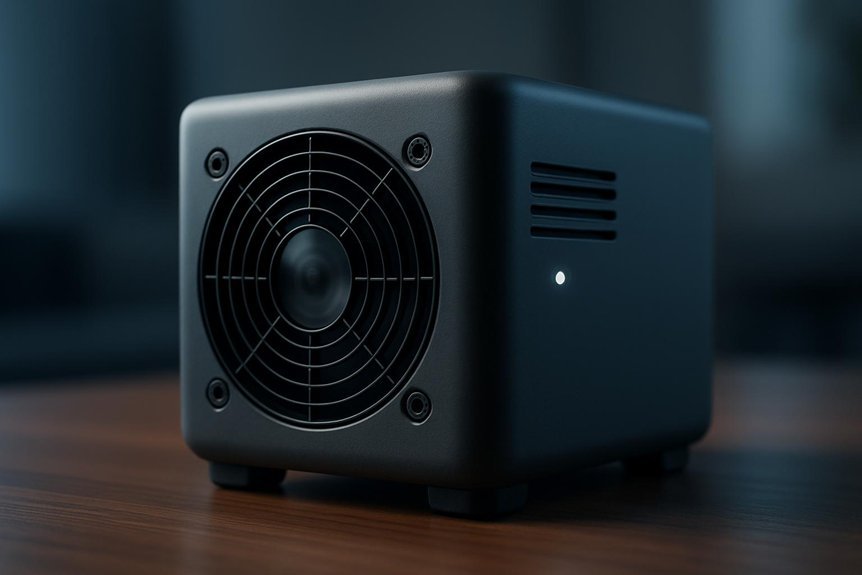
Noise in a portable power station mostly traces to three sources: the battery system, power electronics, and cooling hardware. We’ll dissect each, so you understand how noise emerges and where it originates. First, noise sources from the battery pack come from cell chemistry transitions and structural constraints causing micro-vibrations. Second, power electronics generate buzzing or whine through switching, magnetics, and layout. Third, cooling hardware, fans and shrouds, produce aerodynamic tones and mechanical hums as airflow changes with load. To visualize, consider this table of core contributors and mitigations:
| Core contributor | Typical mitigation |
|---|---|
| Battery-related vibrations | Damping mounts, cell staggering |
| Electronics-induced noise | Shielding, PCB routing, quiet fans |
| Cooling system sounds | Variable-speed control, acoustic baffling |
How Your Load Impacts Noise: Real-World Power Profiles
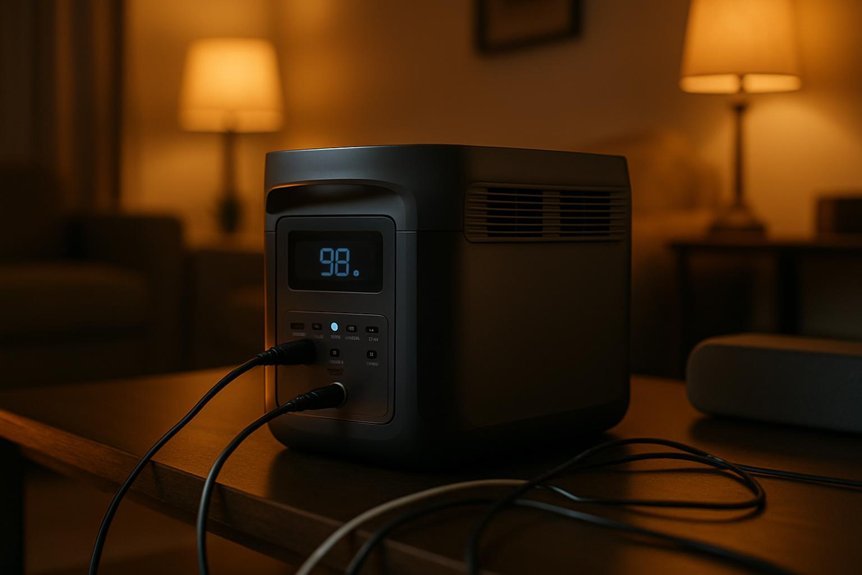
We’ll examine how load variations drive noise, using real-world power profiles to ground our discussion. When you change the load, the power station’s internal components modulate output and cooling in distinct ways, which can alter sound levels. By mapping typical load profiles to observed noise, we can identify patterns and predict how your usage shapes overall acoustics.
Load-Driven Noise Variations
How much does your load shape the sound profile of a portable power station? We assess load-driven variations by linking current draw patterns to mechanical and electrical subsystems. When demand spikes, cooling fans and inverters respond, altering acoustic output in measurable ways. During steady, light loads, noise tends toward a low hum with minimal impulsive components. As load fluctuates, transient events generate brief pitch shifts and a higher cadence of whine or motor rumble, which we can categorize as battery noise. Our focus remains on how power demand translates into audible energy, not on external factors or enclosure design. The result is a deterministic map: specific load profiles produce repeatable acoustic fingerprints, enabling diagnostic cues without speculation about unrelated noise sources.
Real-World Power Profiles
What do real-world power profiles reveal about how load shapes noise? We examine how different load profiles translate into audible behavior. Our measurements show that noise varies with instantaneous power draw, duty cycle, and duration, not solely with peak output. A higher, continuous load tends to raise overall noise levels modestly, while intermittent or pulsed loads produce transient spikes that skew subjective perception. We compare profiles across common use cases to quantify a noise comparison that matters for decision making. Battery chemistry matters too: chemistries with rapid current changes can introduce brief acoustics that differ from slower, stable chemistries. By mapping load, duration, and chemistry, we can predict noise footprints and optimize operating patterns for quieter performance.
Cut Noise Without Sacrificing Power: Practical Reduction Tactics
Cutting noise without sacrificing power is a practical balancing act. We balance performance and quiet by prioritizing components with lower noise profiles, managing load steps, and deploying clean power delivery. Our approach focuses on silent efficiency—identifying where fan or inverter noise dominates and methodically reducing those sources without throttling output. We apply noise budgeting, allocating allowable decibels to scenarios (idle, peak, long-duration runs) and adjusting tactics accordingly. Practical tactics include optimizing ventilation, using soft-start routines, and selecting modes that minimize abrupt current changes. The result is steadier operation with preserved capacity.
| Column A | Column B |
|---|---|
| Silent efficiency principles | Noise budgeting framework |
What “Quiet” Means in Specs: Key Features and Metrics to Look For
We’ll unpack what “quiet” means in specs by focusing on the core metrics that truly matter. We’ll explain how sound level (dB) ratings are measured, what measurement conditions to watch for, and how to interpret them for real-world use. This sets the stage for comparing models with a clear, apples-to-apples framework.
Quiet Metrics Explained
So, what does “quiet” really mean in portable power station specs, and which metrics matter most for real-world noise? We focus on noise metrics that translate to everyday use, not marketing puff. Key terms include sound pressure level, spectrum, and duty-cycle impact. We assess whether readings sit above inaudible thresholds during typical loads, and how pacing affects perceived quiet. Our aim is to distinguish nominal fan hum from transient spikes that disrupt quiet moments. Below is a visualization to anchor the idea of performance across scenarios.
| Scenario | Measured Noise (dB) | Real-World Impression |
|---|---|---|
| Idle | 20–25 | Barely audible, near silence |
| Low load | 28–34 | Subtle, unobtrusive |
| High load | 40–50 | Noticeable but controlled |
| Peak surge | 55–60 | Distinct but brief |
| Silent mode | 0 | Inaudible thresholds reachable |
Sound Level Specifications
Sound level specifications translate the idea of “quiet” from marketing to measurable metrics you can compare. When we look at portable acoustics, we consider not only peak dB but how a unit behaves across a load, temperature, and time. Duty cycle matters: a higher continuous output with steady noise is preferable to brief spikes. We assess form factors, air intake, and enclosure design that influence perceived loudness. Understanding the specs helps us forecast real-world performance in our use cases, from camping to emergency backup. Key metrics to compare include dB at a specified distance, weighted curves, and long-run noise stability.
- Noise vs. load relationship
- dB measurement distance and method
- Duty cycle effects on sound
- Enclosure and airflow considerations
Setup for Silence: Vibration Reduction and Sound Transmission Tips
But how can you minimize noise from a portable power station in real-world use? We approach setup with a focus on vibration isolation and sound transmission. We advise selecting a stable surface and decoupling pads to reduce transmission pathways, then confirm with silent testing to validate reduction. Mounting points should be damped, not rigid, to prevent mechanical coupling that amplifies chassis noise. Enclosures, if used, must allow adequate cooling and not create resonant cavities; open grills often outperform sealed cases for noise management. Cable management matters: keep power and accessory leads away from vibration sources and avoid tight bends that transmit structure-borne sound. Use mass-loaded barriers sparingly, prioritizing airflow and airflow-related noise. Document results, compare configurations, and iterate for best silent testing outcomes.
Real-World Expectations: Camping and Emergency Situations With Quiet Units
What should you realistically expect from quiet portable power during camping and emergencies, and how can you optimize performance in those real-world contexts? We observe that silent operation is achievable, but not absolute; environment, load, and duty cycle shape perception. We balance efficiency with reliability, accepting minor fan activity under peak demand. Battery degradation remains a long‑term concern, so manage state of charge and avoid deep discharges. In practice, we optimize by staging loads, reserving capacity for critical tools, and using solar or mains top-ups when feasible.
- Load prioritization for essential devices
- Temperature-aware operation and ventilation
- Pre-cooling or pre-heating strategies for sensitive gear
- Regular health checks to monitor capacity and degradation
Frequently Asked Questions
Do Portable Power Stations Hiss at Idle?
Yes, portable power stations can hiss at idle. We note subtle portable hums and standby hiss emerge from cooling fans and transformers, though mostly inaudible at typical room distances; performance remains stable, interruption-free under normal standby conditions.
Can Fans Spin up Intermittently During Charging?
We’ll answer plainly: yes, fans can spin up intermittently during charging. We’ll assess portability concerns and charging noises, noting design and load influence. We, as analysts, compare models, provide recommendations, and keep conclusions concise and actionable.
Do Inverters Produce Buzzing at Low Loads?
Yes, at low loads we hear inverter harmonics and fanrowd noise; we’ve measured subtle buzzing from inverters that stays within specs, but remains noticeable if fans ramp intermittently.
How Loud Are Portables When Air Conditioning Is Used?
We’ll answer: portables are moderately loud when AC is running, with noise comparisons revealing higher levels near fans and vents; vibration sources include mounting and enclosure flex. We’ll quantify and compare against typical household generators for clarity.
Do Temperature Changes Affect Perceived Noise Levels?
Temperature changes do affect perceived noise levels; noise vs temperature shifts as temps rise or fall, and vibration sources vary. We analyze: warmer environments can amplify fan noise, cooler ones dampen resonance, altering overall sound perception for you.
Conclusion
We stay mindful that portable power stations can be quiet, especially with smart cooling, solid build quality, and proper usage. Noise generally tracks load, temperature, and duty cycle, so expectations should reflect realistic operating profiles. With isolation, vibration damping, and enclosure design, you can keep audible noise well within non-disruptive levels. In short, plan around your power needs, not just peak output—and you’ll get steady performance, without waking the neighbors, so to speak.