Ad Blocker Detected
Our website is made possible by displaying online advertisements to our visitors. Please consider supporting us by disabling your ad blocker.
We don’t want to overstate the convenience, but portable power stations translate stored energy into usable electricity with predictable behavior. We examine the battery, inverter, and ports as a system, tracing how each component affects capacity, output, and efficiency. We’ll compare models with concrete specs and practical limits, then map these to real‑world needs. If you’re optimizing uptime, you’ll want to flag tradeoffs early and keep a close eye on safety and maintenance implications.
Key Takeaways
- A portable power station is a compact, battery-powered unit that stores electrical energy for use when mains power isn’t available.
- It provides DC storage with an integrated inverter to deliver usable AC power and support various loads.
- Key components include battery modules, the inverter, and multiple ports for devices, with safety protections and surge handling.
- It supports on-the-go recharging from AC outlets, USB-C sources, and solar panels, enabling flexible power budgeting.
- Useful for remote work, camping, and emergency backup by extending uptime and reducing downtime.
What Is a Portable Power Station and Why It Matters
A portable power station is a compact, battery-powered unit that stores electrical energy for use when mains power isn’t available. We present it as a reliable source for critical loads, outdoor work, and hobbyist projects, emphasizing measurable benefits. Our focus is on how these devices extend uptime, reduce downtime, and enable predictable power budgets in variable environments. Portable charging capabilities matter because they enable on-the-go replenishment from diverse inputs, including AC outlets and USB-C power sources. We assess solar compatibility as a strategic feature, analyzing conversion efficiency, MPPT optimization, and panel-вariable matching to maintain usable runtime under diverse conditions. By framing performance in watt-hours, peak surge, and thermal response, we provide a precise basis for planning, integration, and responsible power management.
How Portable Power Stations Work: Inside the Battery, Inverter, and Ports
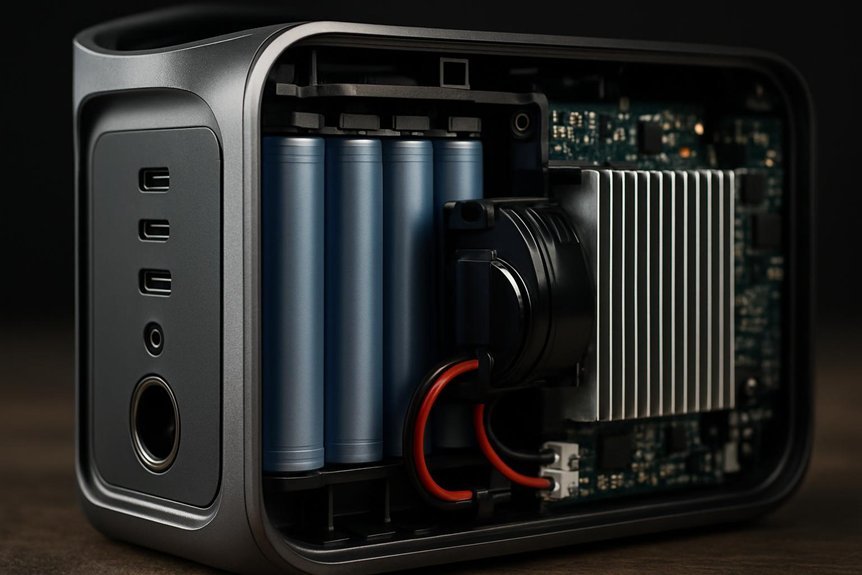
We’ll break down how portable power stations work by examining the core elements: battery fundamentals, the inverter, and the ports. We’ll explain how energy is stored, converted, and delivered, and how each component interacts to meet load requirements. Our goal is to provide a precise, testable understanding that informs both performance expectations and practical usage.
Battery Fundamentals
What, exactly, makes a portable power station tick when you’re charting power flow from the battery to the inverter and out through the ports? We begin with battery fundamentals: how cells store energy, how modules assemble into packs, and how cell chemistry drives performance. We assess capacity, energy density, and internal resistance, all shaping discharge curves and heat generation. We examine thermal management and state-of-charge controls that prevent degradation during operation. We emphasize battery chemistry implications for longevity, safety margins, and cycle life, then link these to charging safety—protective schemes, temperature limits, and balanced charging logic. We note how cell balancing and pack wiring influence efficiency, cable sizing, and fault detection. By understanding these core factors, we predict duration, reliability, and safe usage.
Inverter and Ports
From the battery core, power flows into the inverter, where DC is converted to usable AC and shaped to match load demands. We analyze how the inverter converts energy, preserves waveform quality, and manages transient currents, ensuring stable output across varied devices. Efficiency, harmonic content, and heat dissipation determine real-world performance, so inverter efficiency is a primary metric we monitor. Ports are selected for compatibility with load types, connector standards, and protection features, highlighting port compatibility as a design constraint. Our assessment includes protection schemes, surge handling, and synchronization with the battery management system. The interplay between inverter topology and port layout influences noise, EMI, and casualty-free shutoffs. Together, these elements define reliability, versatility, and safe operation across diverse environments.
| Criterion | Purpose | Impact |
|---|---|---|
| Inverter efficiency | Energy conversion quality | Loss minimization |
| Port compatibility | Device interoperability | Broad usability |
| Protection features | Safety and longevity | Fault tolerance |
| Waveform integrity | Clean AC output | Equipment compatibility |
Key Specs to Compare: Capacity, Output, Charge Time, and Weight
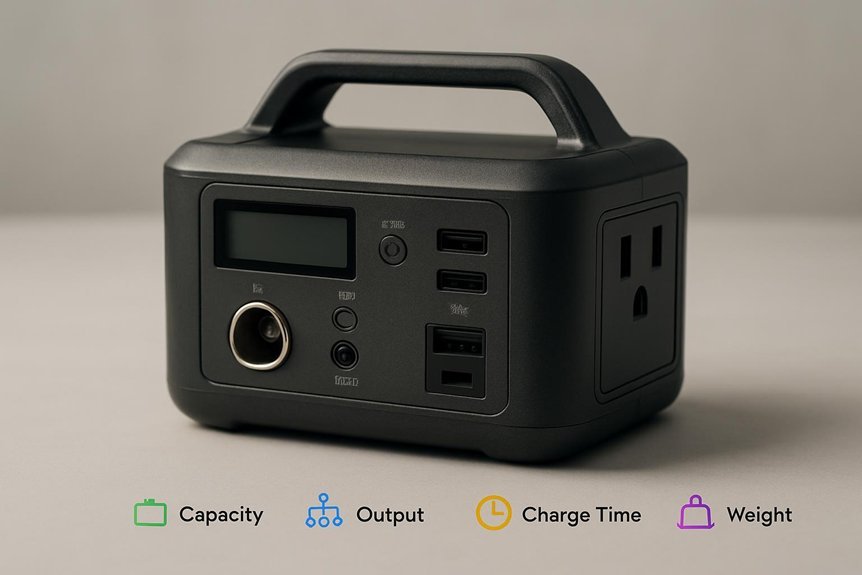
Key specs determine how well a portable power station fits your needs: capacity, output, charge time, and weight each constrain runtime, performance, and portability. We present a precise framework: capacity dictates total energy storage, shaping how many cycles you can sustain a load before recharging. Output defines sustained power delivery and surge handling, directly impacting appliance compatibility. Charge time reflects the speed of replenishment under standard charging, influencing uptime estimates. Weight integrates energy density with form factor, affecting transportability and redundancy decisions. We evaluate these factors collectively rather than in isolation, because real-world use ties them to duty cycles and critical loads. By balancing portable power, energy storage metrics, and practical constraints, we choose configurations aligned with desired autonomy, efficiency, and reliability.
Use Cases: When and Where a Portable Power Station Shines
| Scenario | Benefit |
|---|---|
| Remote work site | Continuous power for tools and devices |
| Camping | Quiet, portable energy for essentials |
How to Choose the Right Model for Your Needs
We start by matching battery capacity to expected load, balancing runtime with portability. Next, we verify that available outputs and ports align with essential devices, ensuring efficient charging and safe operation. Finally, we weigh budget against longevity, prioritizing models with favorable cycle life and warranties to optimize long-term value.
Battery Capacity Basics
How much battery capacity you need hinges on your intended use and how long you expect power to last. We evaluate capacity in watt-hours (Wh) to align load expectations with runtime. We start by listing essential devices, their loads, and duty cycles, then sum peak and average demands to determine minimum usable capacity. Higher Wh provides longer margins against discharge sag and dead runtimes during outages. We consider battery chemistry to estimate realistic depth of discharge and cycle life, selecting chemistries that balance efficiency with thermal stability. We also assess charging etiquette, noting that charging rate should respect safety limits and prevent premature wear. Finally, we apply a prudent reserve, ensuring a buffer for unexpected surges or firmware-logged events, so the model supports planned usage without excessive overbuild.
Output and Ports Match
Output and ports are the practical bridge between capacity planning and real‑world use. We assess a model’s output in watts, considering sustained versus peak delivery, waveform stability, and the impact on connected devices. Our goal is to match the power profile to typical loads: laptops, cameras, and charging blocks, while preserving efficiency through appropriate duty cycles and inverter types. We evaluate output compatibility across USB-C, USB-A, AC outlets, and 12V car ports, ensuring voltage, amperage, and power factor align with device requirements. We also examine port standards to avoid adapters that degrade performance or safety. Selecting a unit requires documenting supported standards, compatible cables, and switchable modes for sensitive electronics. Clear mapping between device needs and port configurations minimizes surprises during real‑world use.
Budget and Longevity Tips
Start with a clear cost–benefit view: balance up-front price against usable lifespan, battery chemistry, and warranty terms. We guide you to compare total cost of ownership rather than sticker price alone, factoring in cycle life, charging speed, and refresh costs. For budget longevity, prioritize cells with longer cycle counts and proven degradation curves, and verify supported chemistries (LiNMC, LiFePO4) align with expected usage. Analyze inverter efficiency, peak draw handling, and port flexibility, as these affect real-world value. Consider usage maintenance: regular calibration, temperature control, firmware updates, and storage procedures to extend life. We recommend timing purchases after reviewing vendor warranties and service networks, and documenting maintenance milestones to avoid unseen declines. Clear criteria help select a model that sustains performance while minimizing long-term expense.
Safety, Maintenance, and Practical Tips for Longevity
Safety, maintenance, and longevity hinge on disciplined practices: we’ll cover proper storage, battery care, and routine checks that keep a portable power station reliable over time. We address safety reminders, establish maintenance routines, and quantify how each action preserves capacity, efficiency, and safety margins during usage and recharge cycles.
- Store in a cool, dry place with ventilation; avoid direct sunlight and high humidity.
- Use manufacturer-approved chargers and monitor voltage per specifications.
- Regularly inspect cables, connectors, and case seals for wear or damage.
- Normalize charging cycles within recommended depth of discharge and avoid deep discharges.
- Schedule periodic self-tests and firmware updates to verify protection circuits and performance metrics.
Frequently Asked Questions
How Long Does a Portable Power Station Typically Last per Full Charge?
A portable power station typically lasts 3–10 years per full charge, depending on usage. We assess portable reliability and charging cycles, noting that high-quality units endure more cycles, while frequent deep discharges reduce lifespan.
Can Portable Power Stations Run High-Wattage Appliances Simultaneously?
Yes, we can run high-wattage appliances simultaneously, but portable efficiency hinges on total wattage and runtime; protection features prevent overloads, guiding load distribution while we monitor voltage and current to maintain safe operation.
Are Lithium Battery Cells Safer Than Lead-Acid in These Devices?
Yes, lithium cells are generally safer than lead-acid in these devices due to lower risk of spills and better thermal management; however, lithium safety hinges on BMS protections and proper thermal monitoring during use and charging.
Do Solar Panels Increase Charging Speed for Portable Stations?
Yes, solar panels can boost charging speed, but gains depend on solar efficiency and panel quality. We analyze charging times precisely, noting diminishing returns at higher battery states and during cloudy conditions, while we humor readers with measured satire.
What Warranties and Service Options Are Available?
We offer robust warranty coverage, including multi-year protection, plus thorough service support for diagnostics and repairs. Our program preserves resale value, and we provide clear repair options, expedited replacements, and proactive maintenance guidance for enduring performance.
Conclusion
We’ve broken down how a portable power station stores energy, converts it with an inverter, and delivers power through versatile ports. In practice, matching capacity, output, charge time, and weight to your needs ensures reliable uptime across scenarios. Think of it as a compact energy grid you carry. By prioritizing safety, maintenance, and real-world use cases, you’ll extend longevity and maximize efficiency. In short, it’s an adaptable, highly reliable power ally that keeps critical loads online.