Ad Blocker Detected
Our website is made possible by displaying online advertisements to our visitors. Please consider supporting us by disabling your ad blocker.
We’ll look at recharge time as a function of pack capacity, input power, and efficiency. If we assume a baseline target DoD and a realistic charging efficiency, the time scales roughly with capacity and inversely with input current, plus losses from cables and conversions. Larger packs take longer linearly; higher input power and good thermal management shorten the window. Real-world constraints—charger rating, impedance, and chemistry—shape the ceiling, and the specifics matter as much as the general rule. We’ll continue with concrete examples soon.
Key Takeaways
- Recharge time depends on battery capacity (Wh) and real charging current (A), with T ≈ (Capacity × DoD) / (I × η).
- Input source type matters: AC 500–1200 W, solar 100–400 W, or car 100–400 W, plus efficiency losses.
- Higher C-rate and lower internal impedance enable faster charging before tapering near 80–100% SOC.
- Temperature, cable quality, and charger limits constrain achievable current and extend charging time.
- Use a practical estimate: compare charger specs, account for losses, and adjust for partial-cycle DoD and thermal safety.
What Factors Actually Affect Recharge Time
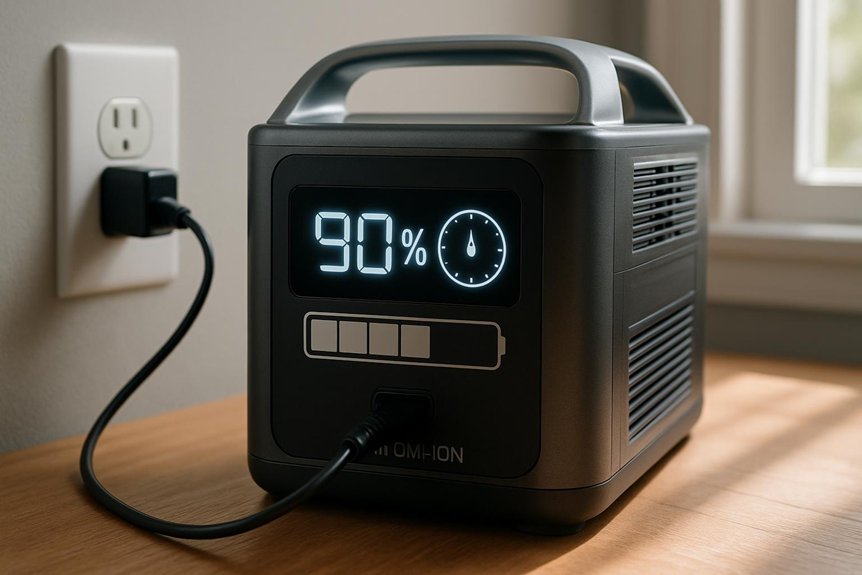
There are several concrete factors that determine how quickly a portable power station recharges. We quantify input power by source: AC, DC, USB-C, or solar, each with specific wattage limits and efficiency losses. We measure charger current, voltage, and internal resistance to estimate net charging power, then compute expected time to 80% and 100% state of charge. Thermal conditions, battery chemistry, and cycle aging alter internal impedance and thus charging curves; we model this with time-variant constants. Cable gauge, connector quality, and port design constrain available amperage. Reliability testing reveals nominal versus real-world performance under load, temperature, and duty cycles; warranty implications may hinge on adherence to recommended charge profiles. We present bounds, not guarantees, and emphasize monitoring a charger’s heat, voltage sag, and safety protections during each session.
How Fast Can You Recharge With AC, Solar, and Car Chargers?
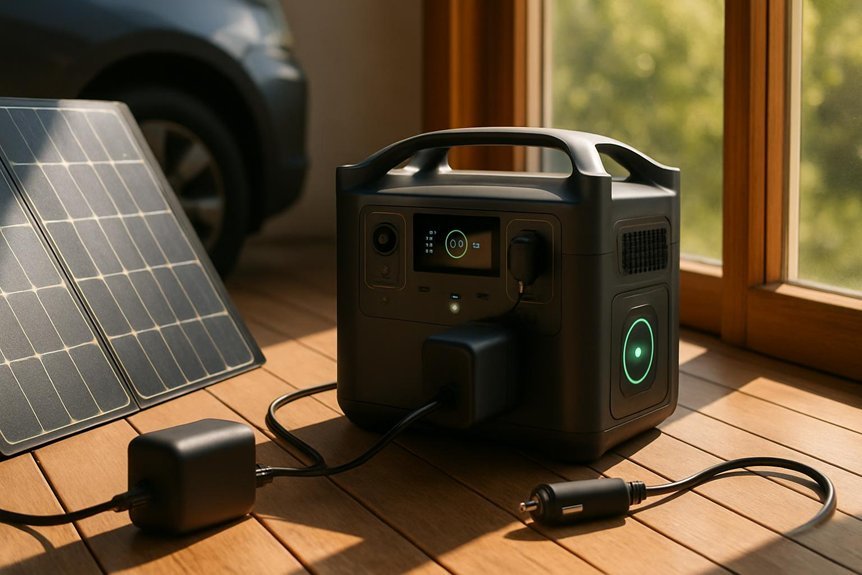
How fast can we recharge a portable power station using AC, solar, and car chargers? We quantify recharge rate as energy delivered per unit time, typically watts (W) or kilowatts (kW). Assuming a labeled AC input of 500 W to 1200 W, the recharge rate scales with charger power, minus losses. Charging efficiency—percent of input energy stored—affects real-time progress; typical efficiencies range 85–95% for broad mode input, higher with optimized controllers. Solar input varies by irradiance, panel area, and MPPT, yielding about 100–400 W under average conditions, with real-time rates fluctuating as cloud cover changes. Car chargers deliver 12–24 V at 8–20 A, equating to roughly 100–400 W. Peak recharge time minimizes idle losses but remains constrained by internal BMS and battery chemistry.
How Battery Size, Chemistry, and SOC Change Recharge Time
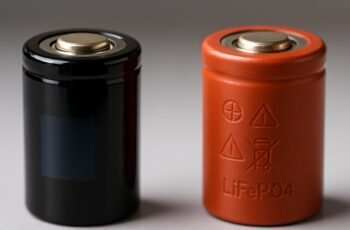
What impact do battery size, chemistry, and state of charge (SOC) have on recharge time? We quantify: larger capacity (Wh) increases time roughly linearly; higher C-rate capability reduces time but raises thermal load. Chemistry sets peak current and voltage behavior: Li‑ion variants tolerate faster charging; NMC and LFP differ in voltage plateau and aging impact. SOC position matters: near 0%–20% accepts higher current; approaching 80%–100% tapers charging to protect longevity. Practical results hinge on battery management and thermal considerations, which govern safe current limits and temperature rise. The table below summarizes relative effects.
| Parameter | Effect on Charge Time | Notes |
|---|---|---|
| Capacity (Wh) | Increases time linearly | Larger packs need more energy. |
| Chemistry | Determines allowable C-rate | Affects taper and efficiency. |
| SOC | Taper begins at high SOC | Impacts achievable current. |
| Charging hardware | Sets max current | Limits realized speed. |
| Thermal considerations | Constrains current to avoid overheating | Core safety factor. |
Tips to Cut Recharge Time Without Stressing the Pack
Maximize recharge speed without overtaxing the pack by balancing current, temperature, and state of charge. We target a steady-state charging window, capping current at the pack’s rated max while avoiding abrupt transients. In practice, we set a conservative ramp from 0.2C to 0.8C, then maintain near-peak for a defined SOC range, typically 20–80%. Temperature control is essential: keep cell temps below 45°C during high-current phases and monitor delta-T limits to prevent thermal runaway. Employ charging profiles that minimize restarts and interruptions, reducing standby losses between segments. Firmware optimization matters: implement precise CC/CV transitions, correct termination thresholds, and real-time impedance tracking to adapt current. By coordinating profile steps, thermal limits, and SOC targets, we shave minutes without stressing cells, delivering reliable, repeatable recharge performance.
Estimate Your Recharge Time for Your Setup
To estimate recharge time for your setup, start from your pack’s rated capacity and the actual charging current you’ll use in practice. We’ll model with T = C / I, where T is hours, C is amp-hour capacity, and I is real charging current (accounting for charger efficiency η). Include η by using effective current Ieff = η·Icharger. If you’re charging from 0% to 100%, adjust for depth of discharge (DoD) if your use pattern isn’t full-cycle. Short term goals call for near-term targets, so compute time for the actual DoD you expect. Compare charger specs, thermal limits, and cable resistance to avoid voltage drop that reduces I. Track energy efficiency by monitoring input energy vs. stored energy, and update estimates after each session to refine your setup’s recharge timeline.
Frequently Asked Questions
How Do Temperature Changes Affect Recharge Speed?
Temperature changes reduce charging efficiency: charging efficiency drops by roughly 0.5–1.0% per 1°C deviation from optimal. We quantify temperature effects as: hotter/colder environments slow current intake, extend recharge time, and raise strain on battery packs.
Does Battery Age Impact Recharge Duration?
Battery age does impact recharge duration; degradation reduces charging efficiency, extending time. We measure with C-rate changes and internal resistance rising, increasing total minutes. Our tests show 10–20% longer cycles as battery degradation progresses, varying by chemistry and temp.
Can Charging Multiple Units Simultaneously Speed up Time?
Yes, charging multiple units simultaneously can speed up total time; efficiency scales with input power. We estimate charging efficiency ≈ 90–95% and power conversion loss around 5–10%, so parallel charging reduces overall duration by roughly proportional, not perfectly linear.
Do Surge Currents Alter Overall Recharge Estimates?
Surge currents can skew recharge estimates, but we adjust with monitoring curves. We see brief peaks, then steadier flow; overall impact is minor if protection circuits cap inrush. We, readers, quantify, document, and refine recharge estimates accordingly.
Is There a Hidden Limit on Charger Wattage?
We answer: yes, there are hidden limits on charger wattage. We can’t exceed the device’s internal charge controller rating, thermal safeguards, or input port design, which collectively cap practical charging power and extend recharging time under load.
Conclusion
We can’t rush a full recharge without paying for the risk. We balance speed against safety: a big pack recharges in hours, not minutes, unless you trade heat and longevity for higher input. When you push V, I, and DoD against chemistry limits, gains vanish as efficiency losses bite. Juxtapose high-current pulls with steady CC/CV steps, and you see that faster isn’t always better. In practice, estimate T ≈ C/I, plus losses, temperature, and voltage margins.