Ad Blocker Detected
Our website is made possible by displaying online advertisements to our visitors. Please consider supporting us by disabling your ad blocker.
Like a steady lighthouse on a foggy coast, portable power stations promise reliable backup when grids fail. We assess their value by load needs, charging options, and chemistry, then weigh total ownership against use frequency and maintenance. For off-grid living or frequent outdoor use, they offer modularity and quiet operation, but costs and surge requirements matter. We’ll lay out sizing, safety, and ROI factors to guide your next step, keeping you oriented as scenarios unfold.
Key Takeaways
- They provide reliable off-grid power for essential loads with fast setup and modular scalability.
- LiFePO4 chemistry offers longer life, better thermal management, and predictable DoD for savings.
- Sizing around real-world runtimes and recharge rates prevents overpaying for unused capacity.
- Total cost of ownership matters: consider initial cost, charging options, and potential solar integration.
- Safety features and proper maintenance ensure dependable performance for camping, RV, and backup use.
Decide If a Portable Power Station Fits Your Needs
So, does a portable power station fit our needs? We assess use frequency, cost, and reliability to decide if it aligns with our profiles: frequent campers, vanlifers, RVers, and outage-prone households. Break-even analysis shows 6–10 uses when comparing a 1,000Wh unit ($600–$1,200) against generator rental ($30–$50 per weekend). For occasional use, renting often remains optimal. Secondary uses—backyard events, tailgates, mobile work, emergency charging—enhance per-unit value beyond camping. LiFePO4 units offer longer lifecycle and higher resale potential than NMC. Temperature, weather, and storage considerations affect performance and longevity. Real-world runtimes meet typical device needs, but surge ratings and continuous output govern sustained loads. Informed purchase decisions require matching patterns to specs, avoiding unrelated topic and off topic diversions. A main factual point is that pure sine wave inverters provide safer, cleaner power for sensitive electronics, which is crucial for reliable operation in all use cases.
How to Size Capacity, Output, and Chemistry for You
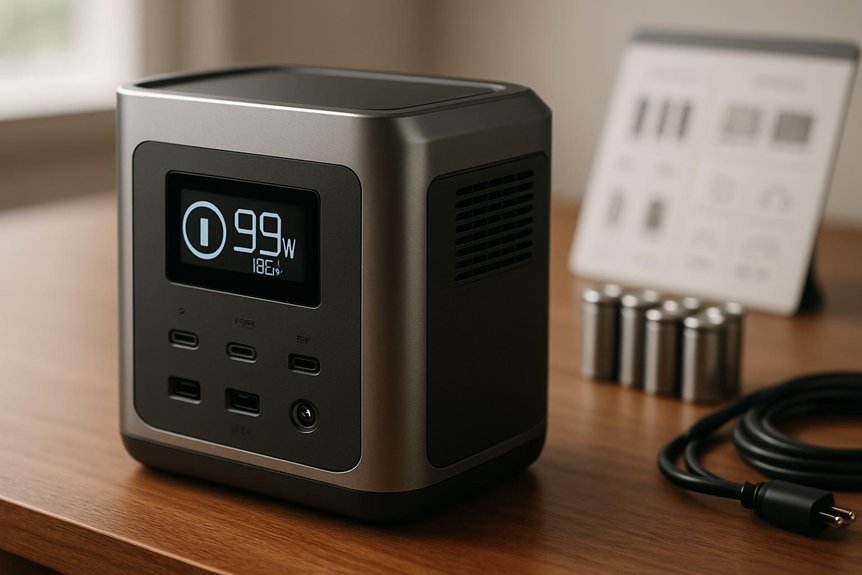
How should you size capacity, output, and chemistry for your portable power needs? We calculate capacity in Wh by summing device Wh, applying duty cycles, and adding a 20–30% inefficiency buffer, then match outage duration. Translate Wh to runtime (e.g., 1000 Wh ≈ 10 h at 100 W) to validate capacity. For output, choose a unit whose continuous AC rating meets simultaneous loads; ensure inverter surge covers transient motor/compressor starts; verify port distribution fits Bluetooth, USB, PD, and 100 W+. Chemistry matters: lithium tradeoffs—NMC/NCA offer energy density with shorter cycle life; LFP provides 2,000–6,000+ cycles, deeper DoD, but lower energy density and higher upfront cost. Evaluate cycle life vs usable Wh, temperature and charging specs, and end-of-life options. Charging options: size solar input to meet daily recharge, and compare AC grid speeds to capacity, and consider essentials like CPAP, lights, and well pumps which influence required capacity and runtime. Essential medical devices can drive higher baseline loads and should be prioritized when sizing a portable power setup.
Use Cases and the Best-Fit Models for Camping, Home Backup, and Work
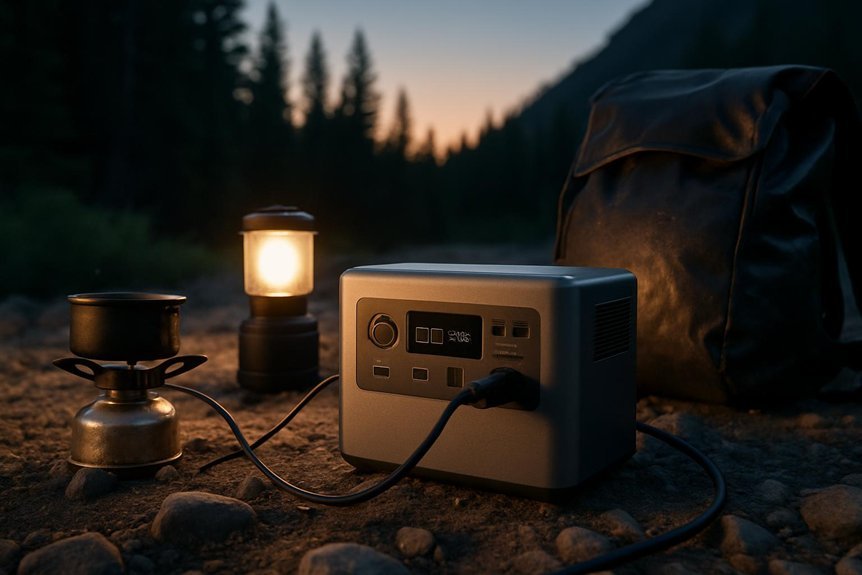
When choosing a portable power station for camping, home backup, or work, we start by matching loads, runtime targets, and environment to the unit’s capacity, inverter, and chemistry. For camping, we select by load profiles (fridge 40–80 W, CPAP 25–60 W, lighting 5–20 W) and solar recharge, balancing weight and runtime (500–2,000 Wh) with 100–600 W panels. For home backup, critical loads (fridge 100–800 W start, 10–100 W lighting, CPAP 25–60 W) drive 1,500–8,000 Wh systems and instant-transfer UPS features to minimize bypass risk. Across work and camping, grid independence benefits from LiFePO4 with thermal management and expandable modules. We favor higher surge ratings for motor starts and modularity for scalability and resilience. LiFePO4 chemistry especially supports longer life cycles and safer operation in varied environments.
Costs, ROI, and Charging Options
- Upfront price ranges: small units ~$200; large >$3,000, with LiFePO4 higher upfront but longer life
- Accessory and modularity costs vary $50–$800, influencing total system cost
- 1,000 Wh example: charging ~$0.19 per full charge at $0.16/kWh, 85% efficiency
- Round-trip efficiency generally 75%–90%, affecting usable energy
- ROI hinges on use-case mix, solar coupling, and local rates; standby losses and replacement costs matter
Charging options: wall, solar, and vehicle inputs—each with distinct efficiency and time profiles.
Safety, Reliability, and Maintenance Essentials
Are portable power stations safe to rely on for critical power needs, and how can we ensure they remain trustworthy over time? We approach safety with concrete checks: robust BMS protections, certified components, and clear fault indicators reduce safety gaps. LFP chemistry lowers fire risk versus NMC, but only when units include proper venting, thermal management, and certifications. Warranty depth signals durability and after-sales support, but real reliability comes from documented MTBF, DoD tolerance, and SoH readouts. Below is a quick matrix on essential safeguards and maintenance needs.
| Criterion | What to verify | Practical action |
|---|---|---|
| Safety gaps | BMS specs, thermal controls | Demand cell-balancing, fuses, and software updates |
| Reliability | DoD, DoE tests, MTBF | Review independent tests and warranty depth |
| Maintenance | SoH, cycle counters, storage | Track cycles, store at 40–60% SOC |
Quick Start Checklist and Next-Step Buying Guide
We’ll start by outlining Quick Start Essentials to match your use case, then map that to a Next-Step Buying Guide that emphasizesSizing and Safety Tips. We’ll present a concise decision framework for selecting capacity, charging options, and porting needs, aligned with real-world loads. This discussion sets the foundation for a precise, action-oriented buying path without unnecessary fluff.
Quick Start Essentials
Deciding what to buy starts with a practical Quick Start Checklist that covers core specs, runtime calculations, safety, and reliability features. We present concise, objective parameters you can verify before purchase.
- Battery capacity in Wh and usable fraction (e.g., 80–90% for LiFePO4)
- Continuous and surge watt ratings with headroom for safety
- Recharge options, max input, MPPT solar ranges, and car/12V limits
- Port types and counts to match devices (AC, 12V, USB‑A/C)
- Protections, waveform, certifications, and real‑world reliability data
Runtime estimation follows simple math: total device watts × hours, then divide station Wh by total watts, apply efficiency derating. Irrelevant topic, outside scope, but helps framing.
Next-Step Buying Guide
Where should you start when advancing from a quick-start checklist to a full buying guide? We prioritize battery chemistry, input capability, and usable capacity to guide model selection. We emphasize LiFePO4 for longer cycle life, higher usable energy, and predictable thermal behavior, while noting lithium-cobalt/nickel options lower upfront cost but shorter cycle life. Demand a high continuous AC watt rating to exceed expected load by 20–30%, and seek 85–95% usable capacity after BMS reserve. Maximize input capability for faster recharging, including solar and AC options, and ensure a diverse port mix to minimize DC-DC losses. Use the table below to compare capabilities at a glance.
| Criterion | Rationale |
|---|---|
| Battery chemistry | LiFePO4 for durability vs. alternatives |
| Input capability | Faster recharge, better multi-day use |
| Usable capacity | Real energy available after BMS reserve |
| Port mix | Compatibility with devices, reduced losses |
| Continuous watt | Avoid overloads; meet ahead of load |
Sizing and Safety Tips
Sizing a portable power station starts with precise energy needs: calculate total watt-hours by summing device wattage times use hours, add a practical 0.85 inverter/conversion factor, and factor startup surges for inductive loads.
- Verify continuous vs. surge ratings for all devices
- Include 15–25% buffer for inverter losses
- Account for duty cycles and multi-day recharge opportunities
- Match solar input to battery size for daily sustain
- Review protection features and safe installation practices
We present a concise, technical guide to sizing and safety, aligning runtime estimates with real-world recharge and protection requirements. In planning, remember unrelated topic budgeting tips to frame cost-per-cycle and total cost of ownership. This Quick Start supports a disciplined buying process, ensuring compatibility, reliability, and safe operation across typical off-grid scenarios.
Frequently Asked Questions
How Long Will a Portable Power Station Hold a Full Charge?
A portable power station’s time to charge varies by battery chemistry and usage, but in typical storage it lasts months: NMC drains 12–30% over six months, LiFePO4 6–15%, with maintenance top-ups extending holds.
Do Portable Power Stations Work in Extreme Cold or Heat?
We operate in extreme temperature conditions but performance varies with battery chemistry. In cold, you’ll see reduced output and efficiency; in heat, derating and thermal protection may occur. We optimize use by matching battery chemistry to environment.
Can I Mix Brands or Upgrade Batteries Later?
We don’t recommend mixing brands; battery upgradeability depends on brand compatibility. We’ll prioritize official expansion packs for safe, synchronized charging, textile, and warranty; third-party packs risk non-cooperation, mismatched chemistry, and degraded performance. Seek vendor-supported options.
Are There Hidden Costs Beyond the Unit Price?
Yes—hidden fees beyond the unit price exist. For example, we’d budget for extended warranties and adapters. Hidden fees can include warranty limits, taxes, shipping, and maintenance, affecting total cost per useable watt-hour and lifecycle economics.
What Maintenance Keeps a Station Performing Longest?
We perform regular maintenance checks and monitor battery health to keep a station performing longest. We run firmware updates, inspect connections, manage thermal exposure, track cycles, and avoid deep discharges to preserve longevity and reliability.
Conclusion
We’ve seen how portable power stations can transform off-grid living and outdoor ventures—like a calm harbor steadying a restless voyage. When sized right, they act as a lantern in darkness, bright enough to power essentials without noise or fumes. They’re most valuable when paired with smart charging and solid safety features, delivering predictable runtimes and protection. If your loads and cadence deserve reliability, these systems offer a precise, scalable path—worth the investment with careful planning.