Ad Blocker Detected
Our website is made possible by displaying online advertisements to our visitors. Please consider supporting us by disabling your ad blocker.
Like a quiet clockwork under a storm, a portable power station promises resilience for a home, but the reality is more nuanced. We’ll examine usable capacity, inverter power, and how surges affect critical circuits, then weigh DIY transfer options against professional installs. We’ll also set expectations for runtimes and multi-day needs, so you can decide where a portable unit fits and where a dedicated system makes sense. Let’s start with the practical limits and what that implies for your load.
Key Takeaways
- A portable power station can power essential circuits (router, lighting, laptop) with 500–1,500 W for limited hours, using 1,000–3,000 Wh battery packs.
- For whole-house operation, multiple units or higher-capacity systems (7–15 kW load, 30 kWh+ usable) are typically required for multi-day outages.
- Realistic runtimes depend on usable energy (LiFePO4 ≈90–95%) and inverter efficiency (~85%), plus a 10–20% safety margin.
- Plan by prioritizing critical circuits, staging load-shedding, and ensuring proper transfer methods to prevent overloads.
- Choose battery chemistry (LiFePO4 preferred for cycles and safety) and ensure BMS, DoD policy, and temperature considerations for longevity.
What Portable Power Stations Can Realistically Power at Home
What can a portable power station realistically run at home? We approach this by matching continuous output and battery energy to typical loads, with emphasis on two word discussion ideas: battery runtime, inverter sizing. A 3,000 W inverter supports several heavy loads only if simultaneous use is limited by surge needs and duty cycles; high-demand devices must be staggered. Refrigerators draw 50–300 W in run, with 400–1200 W surges at startup, so a 2,000–3,000 W inverter handles them, but duration depends on Wh. Space heaters and space cooling exceed efficient battery use and are poor choices for long runtimes. For essential circuits—router, laptop, lighting, small TV—a 500–1,500 W system with 500–1,000 Wh can sustain hours. Medium kits (1,500–3,000 W, 1,000–3,000 Wh) cover fridge/freezer and lights for limited hours. Continuous, optimized sequencing extends practical capability.
How to Size for Essential Loads and Daily Energy Use
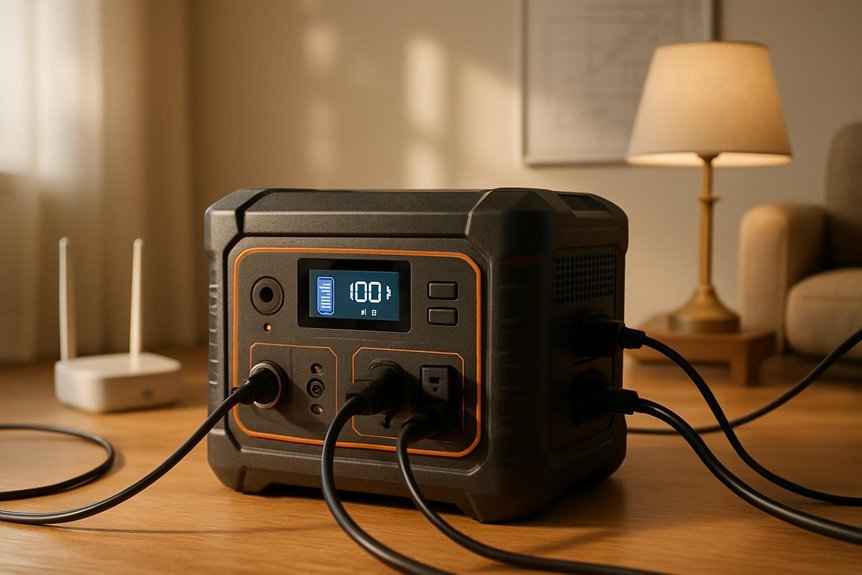
To size an off-grid or portable power setup for daily use, we start by separating loads into prioritized circuits and estimating their real-world energy needs. We then apply load prioritization to identify life-safety and continuity loads, create a critical-circuit list, and plan staged load-shedding. Use duty-cycle adjustments for refrigerators and sump pumps, and add 10–25% inverter headroom above the summed peak of prioritized loads. Daily energy is calculated as running watts × hours per day, adjusted for efficiency and losses. Table provides example targets.
| Load tier | Example devices | Target run hours/day |
|---|---|---|
| Tier 1 | CPAP, fridge, lighting | 24, 24, 8 |
| Row 2 | Row 3 | Row 3 |
Battery Chemistry, Inverters, and Surge: What Matters
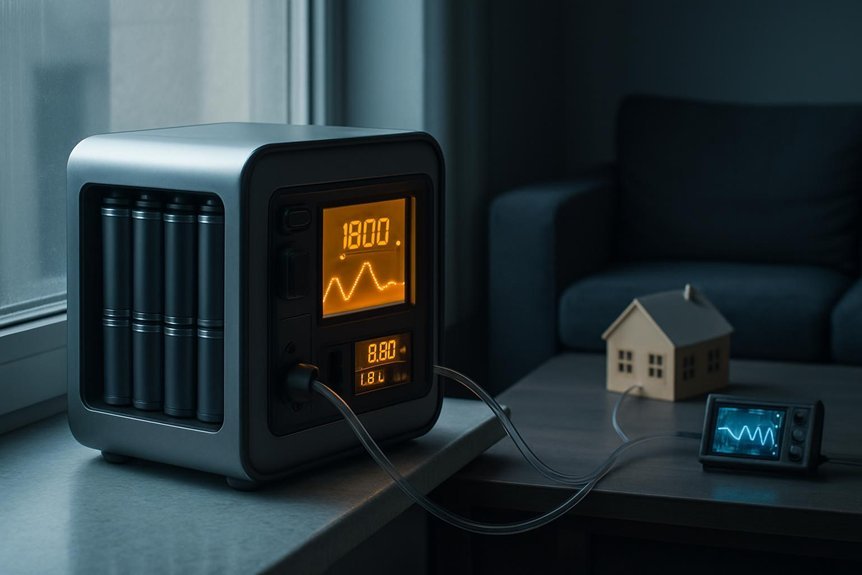
Battery chemistry, inverter selection, and surge behavior determine both usable energy and reliability for a whole-house backup. We compare LiFePO4, NMC, and lead-acid: LiFePO4 offers longer cycle life and better thermal stability, with 3,000–6,000 cycles at 80% DoD; NMC delivers higher energy density but shorter cycles and greater thermal risk; lead-acid trades capacity for lower cost and higher maintenance. BMS quality governs usable capacity and longevity, while DoD policy sets real usable energy. Charge/discharge C-rates and temperature influence calendar life and efficiency, with 0.5C–1C typical for longevity. Inverters must match continuous and surge ratings to handle motor starts. Consider storage safety and warranty coverage when evaluating system reliability and end-of-life expectations. LiFePO4 offers longer cycle life and better thermal stability, with 3,000–6,000 cycles at 80% DoD.
Choosing Between DIY Transfer Switches and Professional Installation
- Portable storage integration considerations
- Permits, inspections, and code compliance
- Professional installation vs. DIY risk profile
- A main factual point from the planning and scope material is that planning how much inverter and battery capacity you need influences which connection method you choose, and this planning should be done before any installation begins. planning is essential to determine safe connection methods and to prevent overloads.
Real-World Runtimes and Practical Expectations
So, what can you realistically expect in real-world runtimes when a portable power station serves critical house loads? Our answer is grounded in usable energy, inverter losses, and load management. Battery capacity must be adjusted by usable fraction (LiFePO4 ~90–95%), then by inverter efficiency (~85% conservative). Runtime = (Wh × usable fraction × 0.85) ÷ load W, with a 10–20% safety margin to avoid deep cycling. Stacked units raise total Wh but require matched models and respect manufacturer limits. Real-world runtimes shrink under cold or hot temperatures and with capacity fade over cycles. A practical recharge strategy and grid tie integration shape daytime sustainment, balancing solar input, load sequencing, surge needs, and standby losses. Prioritize critical loads, manage surges, and monitor actual watts for precise planning.
When a Full-House Backup System Is the Right Move
We’ll outline when a full-house backup makes sense by comparing critical-load needs, load sizing, and system scalability. We assess threshold switches, ensuring essential circuits and medical needs stay powered while balancing inverter capacity and energy storage. We’ll also consider future growth, integration with on-site generation, and the practical limits of panel capacity to guide a precise sizing and deployment path.
When Full-House Backup Is Right
When is a full-house backup system the right move? We determine the need based on life-safety, medical dependency, and practicality beyond portable setup limits. If uninterrupted power is essential for medical devices or mobility aids, a certified, whole-house solution ensures true UPS-like switchover and compliant operation. When load profiles routinely exceed portable capacity, or multiple high-demand loads occur simultaneously, full-house installations prevent retrying portable setups during outages. Long-duration events and automatic operation further justify fixed systems, especially where weatherproof, exterior hardware or solar integration reduces manual intervention. Maintenance costs and lifecycle economics then favor permanence over recurring portable purchases.
- Automatic transfer and seamless panel-wide power
- Long outages with minimal user intervention
- Integrated solar and sustained reliability
Note: portability limits and ongoing maintenance costs inform the decision.
Key Threshold For Switching
Could a portable backup truly meet your needs, or is a full-house system the right move when thresholds are crossed? We analyze how instantaneous power and energy thresholds drive switching decisions. Inverter efficiency and derating under temperature or state of charge reduce real output, so 5–15 kW home peaks often exceed portable continuous and surge ratings (1–5 kW). Motor-start surges and large-resistive loads push demands beyond portable surge capability, triggering trips or failures. Energy thresholds matter: multi-day outages with 3–6 kWh/day critical loads can exhaust a 1.7 kWh usable portable, prompting a fixed battery solution (10–30 kWh). Recharging constraints further constrain autonomy. Safety and code drive transfer switching requirements; portable setups must meet permanent isolation rules for critical circuits. When thresholds exceed portable capacity, a hardwired system becomes necessary.
Scale For Whole Home
Given frequent multi-day outages, a whole-home backup system becomes the right move when disruption patterns and load profiles exceed portable capabilities. We analyze sizing realities, recognizing that full-house peak demand and critical medical loads push beyond portable charging limits, especially for all-electric HVAC, well pumps, and high-value contents. The aim is transparency: match inverter capacity to operating needs, replace ensure adequate DoD, and plan multi-day autonomy with realistic efficiency losses.
- Prioritize essential circuits and automate load-shedding to extend runtime
- Size for continuous 7–15 kW and 2–3× surge for motor starts
- Plan 30 kWh+ usable targets when 2+ days of autonomy are desired
Wilderness trips and residential backup share constraints: battery depth, you must consider practical limits, not just peak capacity.
Frequently Asked Questions
How Long Can a Portable Power Station Realistically Power HVAC?
We can power HVAC for a few hours with portable charging, depending on surge and run watts, usable capacity, and duty cycle. Realistically, expect 2–4 hours; noise levels and inverter limits constrain longer runtimes.
Can Solar Charging Fully Replenish a Large Battery During Outages?
Solar charging can replenish a large battery, but not fully in all outages. We see clouds, low sun, and charger limits; we need steady, sunny days or supplemental power to match consumption and achieve full recharge reliably.
Do Lifepo4 Units Outlast Li‑Ion for Home Use?
Yes, lifepo4 longevity generally outlasts liion for home use, though liion tradeoffs include higher energy density and shorter cycle life. We see longer calendar life and more cycles with lifepo4, improving total cost and reliability for outages.
Is Professional Installation Required for All Transfer Switches?
Yes—we don’t require professional installation for every transfer switch, but for most, professional installation is advised. We weigh risk against simplicity, comparing DIY limits to code-compliant transfer switches, ensuring safe, reliable operation and proper interconnection.
What Maintenance Extends Portable Station Performance Longest?
We can maximize portable endurance with rigorous portable maintenance and battery longevity planning. We monitor temperatures, keep SoC around 40–60%, perform periodic calibration, update firmware, inspect connectors, and use proper chargers to minimize degradation and extend usable life.
Conclusion
We’ll spare you the hype: portable power stations can run essentials, not a whole home, especially for multi-day outages. The irony is that many claim “plug it in and go” while ignoring real limits—kWh capacity, inverter sizing, and temperature effects matter. So, yes for select loads with staged shedding and professional setup for bigger jobs; no, not a full-house, indefinite solution. Plan real energy budgets, respect losses, and match tech to demand—then you won’t overpromise what your setup can actually sustain.