Ad Blocker Detected
Our website is made possible by displaying online advertisements to our visitors. Please consider supporting us by disabling your ad blocker.
We can power a refrigerator with a portable power station, but doing it reliably depends on careful sizing. We’ll look at running watts, startup surges, inverter type, and usable battery capacity to meet daily energy needs. We’ll factor in duty cycle, losses, and ambient conditions, plus safety and ventilation. If you want to avoid failures during outages, we’ll need to plan with headroom and redundancy—and we’ll show you how each choice affects runtime. Let’s start with the numbers.
Key Takeaways
- Most portable power stations can run a fridge, but you must match running watts and surge to the unit’s capacity and inverter type.
- Know fridge draw: typical running watts ~195–207 W with surges ~390–414 W; size an inverter with surge margin.
- Check battery capacity: usable energy (60–95% usable) should cover daily Wh needs plus inverter losses.
- Use pure sinewave output for compressors and ensure adequate ventilation and safe cable sizing.
- Plan for duty cycle and derates: account for ambient temperature and 20–30% extra buffer to ensure reliable operation.
Fridge Power Basics and What You’ll Need
Fridge power basics hinge on understanding running versus startup load and the duty cycle. We break down typical running watts by model: mini/compact 50–100 W, top-freezer 100–200 W, bottom-freezer/top-mount 120–250 W, side-by-side/French-door 150–350 W, and older units above 200 W. Startup surges can spike to 3–5× running watts for less than a second, with longer spikes possible for large compressors. The duty cycle, the on-time fraction, governs average draw and runtime calculations: average watts ≈ running watts × duty cycle. Inverter selection requires headroom above running watts plus surge capability for startup. Waveform matters; pure sine is preferred. Also plan for derating, efficiency losses, and safe ventilation to maintain refrigerator efficiency under backup operation. Key sizing rule ensures you choose an inverter and battery with enough headroom to handle startup surges without tripping or shutdowns.
How to Estimate Your Fridge’s Load
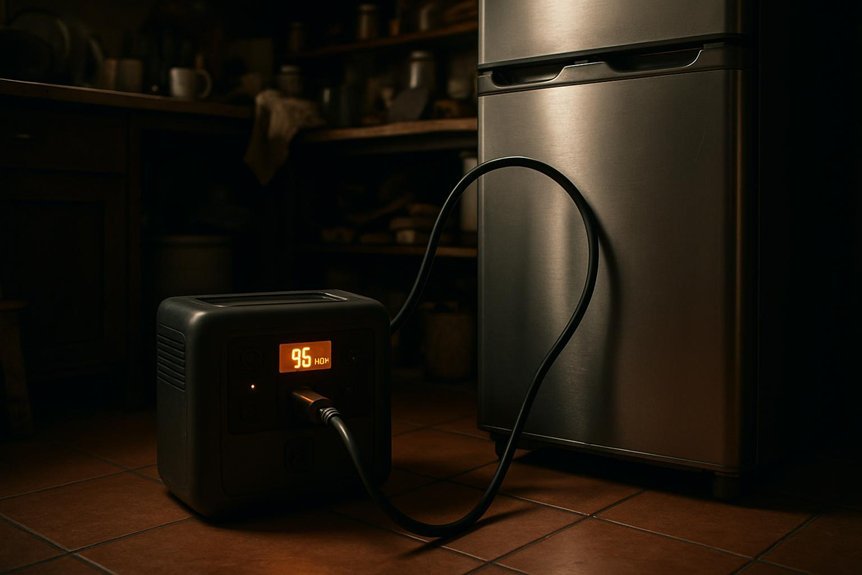
We’ll start by pinning down running watts from measured averages or EnergyGuide estimates, then apply startup surge factors to reflect modern inverter-driven compressors versus older PSC motors. We’ll discuss how duty cycle and simultaneous loads influence both running and surge needs, and how these factors shape sizing margins for a portable power station. In short, precise wattage estimates drive accurate load budgeting and informed inverter selection. Fridge power characteristics include running watts around 195–207 W for modern french door fridges with surges of 390–414 W and a typical duty cycle near 0.40, which helps determine both daily energy use and expected runtime.
Running Watts Estimation
Ever wonder how much a fridge actually draws in daily use? We begin with a precise, recipe-like estimate from nameplate data: convert volts × amps to watts, note running-watt figures, and derive Wh/day from kWh/year when possible. We then apply a duty cycle to obtain average continuous draw. Using typical residential ranges, running watts × duty cycle yields the average watts, which times 24 h gives Wh/day. We account for environmental factors that shift duty cycle and, consequently, daily energy. For practical sizing, we target a duty-cycle-adjusted Wh/day rather than raw running watts. We corroborate with in-situ measurements (plug meter, clamp meter) and EnergyGuide values, reconciling any gaps by adjusting the duty cycle. This yields a robust startup surge-aware, duty-cycle-informed estimate. main factual point [brackets placed
Startup Surge Factors
Can we quantify a fridge’s startup surge with practical, field-ready estimates? We approach inrush with a tight, data-driven lens. Locked-rotor current for single-phase compressors runs about 5–8× running current, with a 50–300 ms peak surge and most energy in the first 0.1 second. The waveform is resistive-plus-inductive; crest factor can exceed 2.5, and PSC, ESM, or BLDC types set distinct profiles. Colder windings raise inrush; higher mechanical resistance from age, wear, improper charge, or added loads increases surge. Inverter choice matters: pure sine better than stepped, while battery resistance and state of charge cap instantaneous current. We measure with high-sample-rate clamp or oscilloscope to capture crest factor and true peak. Use field multipliers, and document multiple starts to bound worst-case surge. inrush classics. crest factor. Main point: Surge magnitude can exceed running current by several times and occur within a fraction of a second, which guides how we size portable power stations and choose measurement tools.
Duty Cycle Influence
Duty-cycle is the practical bridge between running power and energy storage. We quantify load by translating running watts with a duty cycle to an average draw, then to daily energy. Duty cycle misconceptions often stem from treating peak wattage as constant; in reality, ambient temperature effects and usage patterns drive nonlinearity. Modern ENERGY STAR fridges typically run 20%–40% under normal conditions, while older units exceed 40%–60%. Higher ambient temperatures raise cycle frequency and duration, increasing average draw nonlinearly. We estimate duty cycle from EnergyGuide data or measured averages, then apply derating for inverter losses. To size a portable power station, use running watts × duty cycle × hours, adjusted for usable efficiency. Validate with 24‑hour metering to capture real-world duty cycle under target conditions.
Inverter Size: Sizing for Compressor Starts
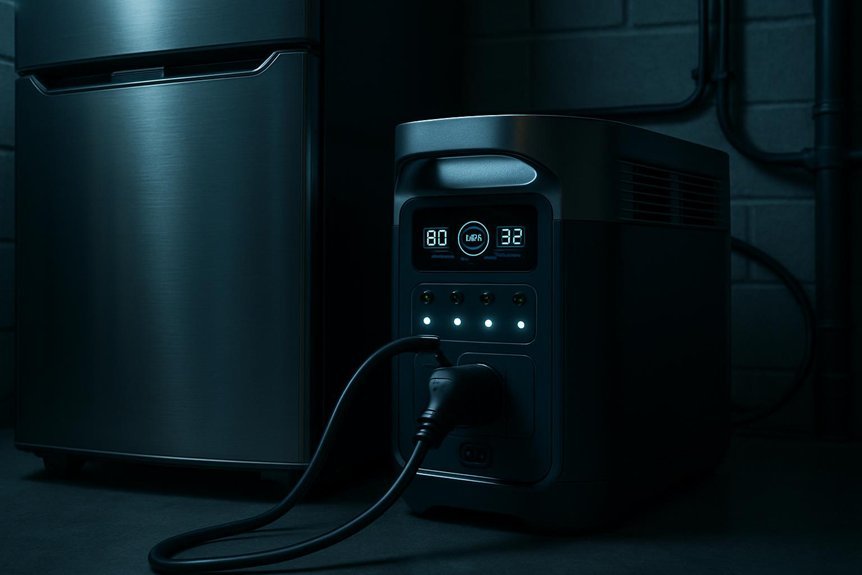
Sizing an inverter to start a compressor hinges on predicting surge requirements and matching them to the inverter’s peak capability. We factor motor start surge by examining LRA multiples and starting behavior, then compare those numbers to peak ratings. For single-phase PSC/CSCR motors, inrush can reach 2–10× running watts, so the surge capacity must exceed that to ensure reliable starts. For older or larger units, derating to 1.5–3× running watts is prudent. Variable-speed compressors present lower surges, which eases sizing. Pure sine wave inverters improve start reliability versus modified outputs, reducing voltage sag during startup. We also account for waveform quality, transient response, and protection trip thresholds, since exceeding peak or thermal limits ends starts. Inverter sizing must balance running load, peak margin, and overall system constraints.
Battery Capacity: How Much Usable Wh You Need
Determining usable watt-hours (Wh) starts with translating fridge energy use into a practical, battery-ready figure. We factor usable capacity versus nameplate, applying derate factors (typical 60–90%, common 70% usable) and DoD implications; Li-ion NMC often yields 90–95% usable, LiFePO4 80–90% for longevity. Real-world fridge loads vary: 1,000–2,000 Wh/day for full-size, 100–300 Wh/day for mini-fridges. Use EnergyGuide to estimate daily Wh, adjusting for a 30–50% duty cycle and 10–50% ambient effects. Basic runtime equals usable Wh divided by average draw, plus 20–30% for inverter losses. For overnight, target usable Wh = draw × hours × 1.3, with surge headroom separate. Reserve 10–20% unused to protect cycles; plan around unrelated topic, irrelevant focus to stay within safe margins.
AC Output: Pure Sine vs Modified Sine
What matters most for a portable power station running a refrigerator is the waveform it delivers: pure sine or modified sine. We analyze how waveform shape affects compatibility, efficiency, and reliability, focusing on practical outcomes for the fridge’s motor and electronics.
1)
- Pure sine delivers smoother current, lower THD, and cleaner surge response than modified sine.
- Modified sine increases harmonic content, stressing motors, control boards, and SMPS/PFC circuits.
- Compatibility gaps arise with inductive loads, digital clocks, and some warranties that require pure sine.
- Performance impact shows higher heating, modest efficiency loss, and higher start-failure risk on modified waveforms.
Two word discussion ideas: purity versus practicality; compatibility constraints. Pure sine benefits, while modified sine may save cost but introduces risks.
DoD and Longevity for Fridge Backups
How should we choose DoD to maximize fridge-backup longevity without sacrificing usable runtime? We apply a DoD strategy that balances runtime and cycle lifespan, guided by chemistry. LiFePO4 offers superior longevity for frequent fridge use, delivering 2,000–6,000 cycles at 80–90% DoD with modest calendar fade. NMC/NCA delivers higher energy density but shorter cycle lifespan (roughly 500–2,000 cycles at 80% DoD), while lead‑acid remains limited by 50% DoD and faster degradation. We plan around the cycle life versus DoD tradeoff, recognizing that halving DoD can extend cycles by roughly 2×–3× depending on chemistry. Manufacturers define EOL at 70–80% capacity; a conservative DoD strategy preserves usable runtime while protecting long-term integrity. Overall, calendar effects and BMS quality further shape cycle lifespan. DoD strategy informs TCO projections.
Real-World Runtimes and Planning Derates
Realistic runtime estimates begin with usable battery energy and a clear model of the fridge’s energy profile. We base calculations on usable Wh, adjust for inverter and aging, then apply the fridge’s duty cycle and ambient conditions to derive a practical runtime.
- Use usable Wh (nominal Wh × usable fraction) and convert daily energy to a continuous draw for accurate planning.
- Apply duty cycle and real‑world derates (0.70–0.85 overall) to compute expected runtime.
- Include surge headroom by ensuring inverter surge specs cover compressor inrush plus simultaneous loads.
- Factor ambient temperature into fridge energy efficiency, anticipating higher loads in hot environments and planning for worst‑case conditions.
Setup Tips: Cables, Ventilation, and Safety
To set up safely and efficiently, we’ll start with cables, ventilation, and safety fundamentals that directly impact reliability and component life. We methodically specify AC extension cords: 12 AWG for loads over 10 A, 14 AWG for under 10 A; three-prong, grounded, UL/ETL listed. DC output cables must match power station and fridge specs, with correct polarity, connector type, and gauge to limit voltage drop below 3% on short runs. Use dedicated heavy-duty cords for high-surge compressors; keep runs ≤3 m. Install inline surge protection and DC fuses sized slightly above running current. Locking or strain-relief connectors prevent disconnection during startup. Ensure 10–20 cm ventilation clearance, ambient 0–40°C, and separate heat sources. Consider unrelated topic and formatting considerations in layout to maintain clarity and safety compliance.
Planning for Multi-Day Outages: Recharge and Redundancy
Planning for multi-day outages hinges on sizing for both recharge rate and redundancy. We balance fridge energy, auxiliary loads, and buffer losses to sustain operation through days of limited sun or fuel. We also weigh expansion paths and safe operation, including battery expansion and safety ventilation considerations, to keep performance within design margins.
- Compute daily fridge use (1.0–2.0 kWh for full-size, 0.7–1.2 kWh for chest) and add lights, modem, and small loads.
- Determine usable capacity with derating (nameplate × 0.7–0.85) and add 20–30% buffer; plan for N+1 redundancy.
- Evaluate recharge options: 300–2,000 W grid/shore input and 200–400 W solar with derate.
- Schedule cross-connect and expansion paths (Battery Expansion, Safety Ventilation) while maintaining SOC 20–80%.
Frequently Asked Questions
Can a Fridge Start on a Small Boost From a Portable Power Station?
Yes, a fridge may start with a small boost, but it depends on surge headroom. We, however, evaluate portable charging specs, inverter type, and startup surge before committing, ensuring two word discussion ideas stay clear: portable charging.
Do All Fridges Have Similar Startup Surges Across Brands?
We’d say no: fridge startup varies widely, showing significant surge variance across brands. We observe inverter models near 1–2×, older compressors 5–10×, and unit-to-unit differences driven by start schemes, capacity, and components.
How Accurate Are Energyguide Numbers for Real-World Runs?
Fridge efficiency varies; EnergyGuide numbers are approximate. We see real-world runs diverge due to ambient, usage, and startup surges. We’d say, for accurate inverter sizing, treat labels as baseline, then adjust upward.
Can I Run a Fridge off USB-C PD Power Banks?
Yes, we can’t reliably run a fridge off USB-C PD banks alone. Fridge wattage and startup surge exceed typical PD bank limits, plus inverter losses; we’d need a capable portable power station with proper pure sine output and surge handling.
Is It Better to Run a Fridge on Solar or Generator Backup?
Short answer: solar-backed portable power is cleaner and quieter, but generator backups win on reliability during extended outages. We’d favor solar for energy efficiency and renewables, using a generator for surge resilience and cloudy spells.
Conclusion
We can rightly size a portable power station to run a fridge, and we can do it with precision, planning, and precautions. We’ll match load, surge, capacity, and efficiency, we’ll account for duty cycle, losses, and ambient effects, and we’ll build margins for safety, reliability, and longevity. We’ll check runtimes, verify inverter quality, ensure ventilation, and respect DoD. We’ll plan for recharge, redundancy, and real-world contingencies, and we’ll keep monitoring, adjusting, and documenting for confidence.