Ad Blocker Detected
Our website is made possible by displaying online advertisements to our visitors. Please consider supporting us by disabling your ad blocker.
Like a compass guiding a load beyond its shore, we’ll map a solar charging path for a power station with precision. We’ll start by defining daily energy needs, confirm input specs, and size an array that meets targets while accounting for derates and contingencies. We’ll choose compatible panels, plan safe wiring and fusing, optimize placement, and account for MPPT behavior. Stay with us as we balance performance, safety, and practicality to keep you on course.
Key Takeaways
- Determine your power station’s max input specs (W, V, A) from the manual, including MPPT or PWM type and port wiring.
- Size solar panels to meet daily energy needs while respecting the station’s max input and voltage windows.
- Use a proper fuse/disconnect strategy and separate DC/AC wiring with outdoor-rated cabling for safety.
- Account for real-world losses (temperature, soiling, MPPT inefficiency) and include a 15–30% contingency.
- Optimize placement: true south-facing orientation, minimal shading, and seasonal tilt adjustments for peak daily yield.
Define Your Solar Charging Goals
We start by defining the solar charging goals: what we want the system to do, how often we’ll use it, and how fast we need to recharge. We describe the primary backup use for critical loads and the secondary off-grid options, then translate frequency into panel sizing and durability needs. We list appliances to establish Wh/day, including inverter losses (85–95%) and 80% max usable DoD, plus continuous parasitics from charge controllers, fans, and monitoring. We add a 15–30% contingency for cloudy days and growth. We translate Wh/day into required solar input by dividing by effective sun-hours and MPPT efficiency. We set targets for recharge time, max solar input utilization, panel versus portability, and multiple charging sources. This defines solar budgeting and informs panel maintenance planning.
To ensure we stay on track, we also consider the solar input specs such as max input wattage, voltage range, and connector types to avoid mismatches that can prevent charging or trigger overvoltage shutdown, so we can pick compatible hardware from the start.
Confirm Your Power Station Input Specs
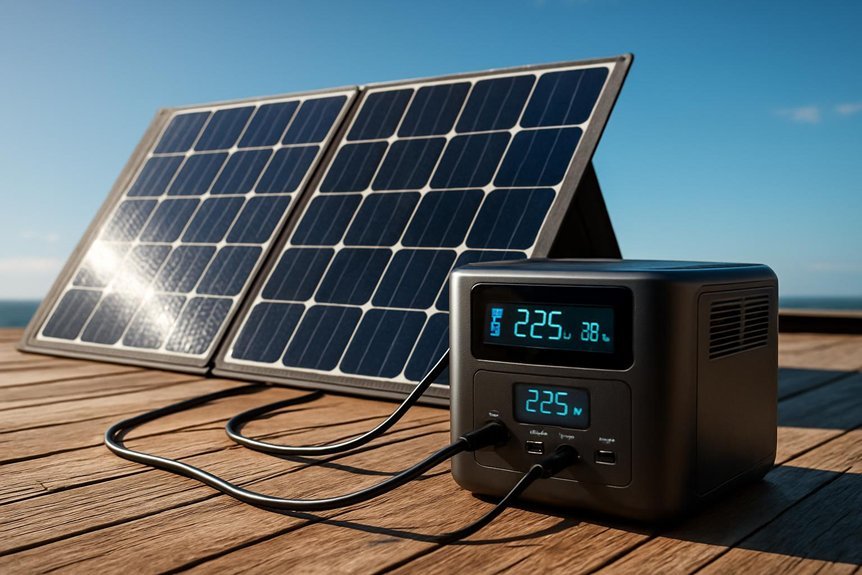
To confirm power station input specs, start by reading the manufacturer’s specifications label or user manual to capture exact solar input ratings, including maximum input power, voltage, and current per port. We rely on the spec sheet to verify MPPT type, Vmax, Vmp range, and per-port current, then confirm wiring configurations and connectors match the panels we’ll use.
To verify solar input specs, check the manufacturer label and spec sheet for power, voltage, current, MPPT type, and wiring compatibility.
- Verify maximum solar input power (W), input voltage (Vmax/VOC), and current (A) per port or combined.
- Confirm MPPT or PWM, efficiency, and derating rules from the spec sheet, including VOC rise guidance.
- Check warranty language related to third‑party panels, safety limits, and required fusing or inline breakers.
These checks prevent overloads, ensure compatibility, and clarify warranty coverage.
Size Your Solar Array to Meet Targets
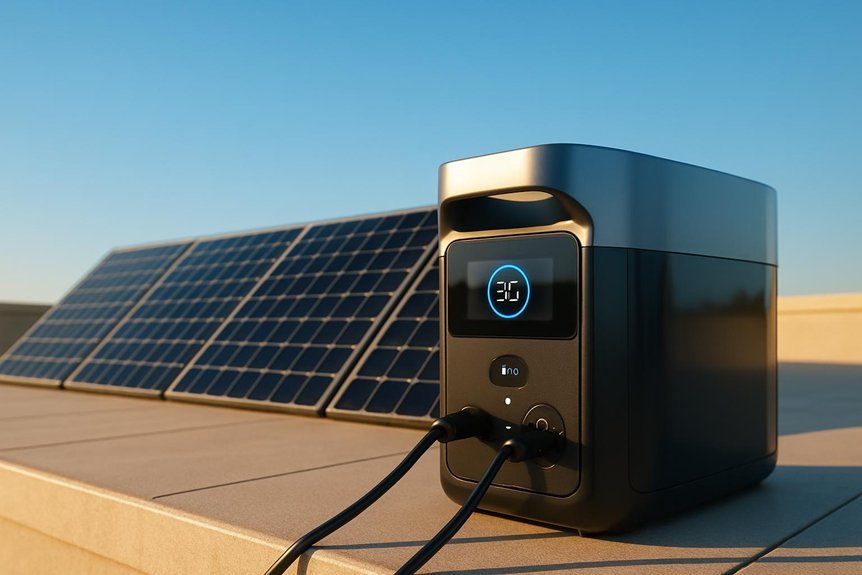
We size our solar array by targeting the daily energy goal and adjusting for PSH and a derate factor, then cap at the system’s max input. We’ll use Panel watts needed = Daily energy target / (PSH × derate), applying a 0.7–0.85 derate (0.8 typical) and scale for partial-day needs if applicable. We’ll also account for real-world losses, wiring, and seasonal/location variability to ensure the target remains achievable under worst-case conditions.
We also consider the fact that the Max solar input is the hard limit the charge controller can process, so staying within that limit ensures the system doesn’t waste power or risk overload. Max solar input sets the ceiling for practical panel wattage, and overpaneling can be used judiciously to keep the input near that ceiling for most of the day.
Panel Wattage Guidance
Choosing the right panel wattage starts with the station’s max solar input. We size the array to reach targeted charging goals without exceeding the controller’s limits, using the station’s max input (W) as the anchor. Oversizing yields unused peak power, while undersizing slows charging.
1) Match panel wattage to the max input by dividing the station’s max-wattage by panel rating to estimate count, and confirm Voc/Vmp stay within the voltage window.
2) Apply a derating factor (0.75–0.85) to align peak input with desired charging goals, adjusting panels to meet time targets.
3) Prefer identical panel wattages for reliable strings; ensure MPPT and wiring handle the total current and voltage.
This approach keeps panel wattage aligned with charging goals, avoiding wasted capacity and respecting voltage limits. main factual point [Identify
Real-World Output Factors
Real-world output varies with temperature, angle, and weather, so sizing must reflect practical losses rather than ideal conditions. We quantify losses from temperature, angle, and cloudiness to size an array that reliably charges a power station. Temperature raises cell resistance and lowers efficiency; typical crystalline silicon modules lose about 0.3–0.5% per °C above 25°C, with 6–10% losses on hot days, and MPPT/wiring heat losses rise accordingly. Solar tracking can recover 15–40% over fixed tilt, while tilt-season optimization adds several percent. Thermal mitigation—airflow under panels, elevated mounting, reflective back-sheets—recovers multiple percent of rated output. Cloud cover and air mass reduce irradiance and shift output toward diffuse fractions; sizing must account for 2–10% MPPT penalty from rapid tracking changes. Plan for worst-case peri, including solar tracking and thermal mitigation.
Choose Compatible Panels and Connectors
How do you pick panels and connectors that actually work with your power station? We model compatibility around voltage, current, and connector ecosystems to maximize MPPT efficiency and minimize losses. Panel durability and warranty coverage guide selection, alongside guaranteed Voc, Vmp, Isc, and Imp within the station’s limits.
- Verify Voc stays well below the max input (10–15% headroom for cold temps) and that the Vmp range sits inside the MPPT window; ensure Isc/Imp won’t exceed the station’s max input current.
- Choose wiring that matches your layout: series for higher voltage, parallel for higher current, with matched Vmp/Voc for strings and consistent connectors.
- Confirm connector type, cable gauge, and weatherproofing meet Isc margins; favor MC4-compatible gear with robust strain relief and protection.
panel durability, warranty coverage.
Plan Wiring, Fusing, and Safety Hardware
We start by outlining wiring segments, fusing locations, and safety hardware to match each circuit’s voltage/current profile and the system’s protection needs. We’ll specify segment currents using P/V, place DC-rated fuses near the battery and on each string, and separate DC/AC runs with outdoor-rated cabling to minimize interference. We’ll also address adapter compatibility notes and guarantee grounding, SPD placement, labeling, and clear disconnects meet code and manufacturer specs.
Wiring And Fusing Safety
1) Plan conductor sizing and ampacity with 125% rule for DC circuits.
2) Locate fuses/breakers within inches of energy sources.
3) Confirm cable routing and conduit installation meet code.
Adapter Compatibility Notes
Adapter compatibility hinges on mapping panel outputs to the station’s inputs without compromising safety or performance. We match panel MC4 outputs to station interfaces (XT60/XT90, DC7909, Anderson, or multi-pin ports) with correct polarity and pin arrangement, verified by a multimeter before first use. Mechanical compatibility matters: MC4 twist-locks versus XT60 friction fits require secure, strain-relieved connections to prevent disconnections or contact stress. Verify contact ratings—ampacity and voltage—on both sides to avoid overheating or connector failure when hitting peak currents. Plan wiring so VOC stays well below the station’s input limit and VMP remains inside the MPPT window. Use fast-acting fuses slightly above expected max current, and label insulation with polarity and ampacity for cable safety and long-term reliability. adapter compatibility is essential. Cable safety.
Protection And Compliance
Is every protection and wiring choice grounded in performance and safety? We design and verify wiring, fusing, and safety hardware to minimize risk while meeting standards. We base layout on Voc, Vmp, Isc, and Imp to size conductors and protective devices, with DC disconnects for maintenance and emergency isolation. Grounding best practices and surge protection are integrated from array to power station, with proper bonding and SPDs installed on PV input and AC-side paths.
- Plan wiring with short DC runs, document single-line diagrams, and place fuses close to the source positive terminal to limit short-circuit energy.
- Use PV-rated fuses (Class T or PV-specific) and DC-rated disconnects, ensuring voltage/current ratings exceed operating values.
- Apply derating, conductor sizing, and routing rules to minimize voltage drop and protect against environmental and mechanical stress.
Estimate Real-World Performance With Sun Hours
Ever wonder how much energy a solar-equipped power station can deliver in real life? We translate PSH into a practical daily yield by applying location-specific PSH, panel wattage, and system derate factors. PSH variability captures how daily insolation shifts with season and latitude, so we model 4–5 PSH/day inland temperate zones, higher in deserts, lower toward northern latitudes. Real output uses derating factors: temperature, soiling, mismatch, and MPPT losses, yielding a conservative combined factor near 0.75–0.90. For example, 200 W × 4 PSH × 0.80 ≈ 640 Wh/day. We then adjust for battery and inverter efficiencies (charging plus conversion) to get net usable energy. This framework supports sizing decisions and recharge timelines under real-world sun, with buffers for variability.
Optimize Panel Placement and Shade Management
We optimize panel placement to maximize irradiance, prioritizing true south-facing orientation in the Northern Hemisphere and minimizing shading throughout the day. We’ll also implement regular cleaning to maintain reflectance and prevent soiling losses, especially on tilted mounts with seasonal changes. By combining tilt strategy with proactive shade management, we can sustain higher, more predictable output for our power stations.
Tilt For Maximum Irradiance
Balanced tilt is about balancing annual yield with practical constraints. We apply incidence geometry to maximize irradiance while guarding against shade and soiling. Our approach weighs seasonal tilt against site latitude, using cosine-law effects to predict daily energy. Small errors (±5°) barely affect output; larger misalignments cut seasonal gains. For a robust fixed strategy, latitude+10–15° often improves winter harvest in higher latitudes. We favor seasonal tilt to capture high-sun summer hours and low-sun winter hours, with two adjustments per year as a baseline.
- Seasonal tilt schedule: set to summer (lat −15°) around April 1 and winter (lat +15°) around October 1.
- Consider incidence geometry when selecting fixed vs. adjustable mounts.
- Weigh wind/soiling risks with tilt choice and mounting practicality.
Avoid Shade At All Costs
Shade dominates output: even small obstructions can throttle a string, so we map and mitigate shading with precision. We target min/max losses by locating shading hotspots via shade mapping, then reconfigure layouts to keep strings unshaded during peak hours. Partial-cell shading creates cascade losses; we design around weak cells and use bypass-friendly topologies. Hot-spot risk is real, so we favor modules with robust bypass diodes and consider half-cut or shingled designs to localize impact. Time-of-day sensitivity drives our placement: avoid intruding shadows around 10:00–14:00, accounting for seasonal variation. Our work combines drone inspection, 3D modeling, and historic production analysis to quantify kWh losses and justify repositioning. Drone inspection highlights obstructing vegetation and structures, enabling proactive mitigation.
Clean Panels Regularly
How often should you clean matters because soiling directly throttles output and shortens battery recharge cycles. We quantify losses from dust, pollen, and droppings to guide schedules, noting higher soiling in urban, agricultural, and dusty environments. Regular checks prevent cumulative shortfalls that erode monthly production and battery cycles. Seasonal spikes from pollen and leaves demand cadence adjustments, while dry periods justify more frequent cleanings to maintain energy yield. Align windows to avoid thermal shock and water spotting, preferring early morning or late evening. Rooftop safety remains paramount during access and cleaning.
- Cleanings should be scheduled by environment: low-dust (biannually), moderate (quarterly), high-soil (monthly or after dust events).
- Use panel cleaning with low-pressure rinse and non-abrasive tools.
- Always observe rooftop safety and proper fall protection.
Understand MPPT Behavior for Solar Charging
MPPT behavior is the core driver of solar charging performance: it dynamically repositions the PV operating point to maximize instantaneous power as irradiance, temperature, and load conditions change. We implement MPPT with a DC‑DC converter and a control loop that adjusts duty cycle to set panel voltage/current, targeting the MPP on the I‑V curve. MPPT dynamics determine how fast and stably we track shifting MPPs, especially under rapid irradiance changes. Voltage tracking measures the panel voltage approach toward Vmp, while accounting for temperature‑induced shifts (Vmp drops ~0.3–0.5%/°C). Real gains depend on algorithm choice (P&O, incremental conductance, etc.) and hardware. In practice, MPPT yields 10–30% more energy vs PWM, with higher gains under mismatched or dynamic conditions.
Safety, Legality, and Long-Term Maintenance
We’ve covered how MPPT controls maximize solar input, and now we must guard against risks that come with real-world charging. We align safety, legality, and long-term care with measured practices to prevent damage, guarantee compliance, and prolong life. We avoid bypass regulations and shipping hazards by following clear, documented standards for wiring, protection, and storage.
- Verify inputs and protection: check Voc, I, and W; install appropriate fuses, diodes, and manufacturer-recommended protection; guarantee proper ventilation.
- Comply with rules: respect local interconnection, building codes, tenancy rules, and shipping limitations; document permits and warnings to preserve warranty.
- Monitor health and storage: maintain BMS updates, smoke detectors, and cool, dry, fire-resistant enclosures; operate within recommended SOC and duty cycles.
Adherence minimizes risk while preserving function and warranty.
Troubleshoot Common Solar Charging Issues
Are you seeing solar input behave oddly even under bright sun? We start with a structured diagnostic: verify 0 W input with a multimeter at PV terminals, check for intermittent shading or MPPT hunting, and compare measured input to expected panel output under present conditions. If charging starts and stops, inspect over/under-voltage protection, thermal cutouts, and PV wiring for faults. Isolate issues to PV array, cables, or input protection fuses by testing continuity and assessing polarity. Address panel tilt and soiling prevention to maximize irradiance and reduce losses from dirt. Consider panel orientation, 20–40% gains from seasonal tilt, and clean when soiling is evident. Ensure Voc stays within controller limits and MPPT tracks near optimal Vmp to prevent throttling.
Frequently Asked Questions
How to Calculate Optimal Charge Time With MPPT Efficiency Included?
We calculate optimal charge time by dividing Energy to Add by PV Effective Power adjusted for MPPT efficiency, factoring Solar input limits and shading impact; include Wiring protection, Connector compatibility, Fuse strategies, and Inlet adapters for accuracy.
What if Panel Wattage Exceeds the Station’s Max-Input Limit?
Can we push beyond the limit and still charge efficiently? We cap input, so panel wattage exceeding max-input reduces charging efficiency; we rely on clipping. We optimize charging efficiency with proper panel orientation and exact current limits.
How Do You Determine Correct Connector Adapters for Different Inlets?
We determine inlet compatibility by matching voltage/current specs and adapter identification details. We verify labels, use manufacturer-approved adapters, test polarity, and confirm connector ratings to ensure safe, effective inlet compatibility for multiple inlets.
Can Partial Shading Ruin Solar Charging Efficiency Entirely?
Partial shading cannot ruin solar charging efficiency entirely, but it can severely curtail it. We’ve measured drops as shading rises, with efficiency loss correlating to area shaded and string topology, despite MPPT mitigating some impacts.
Which Fusing Strategy Best Protects Wiring and MPPT Units?
We recommend fusing strategies that place MPPT protection at the input and protect each string near its source. We use DC-rated fuses, sizing per Isc×1.25, and align with conductor ratings to guarantee MPPT protection.
Conclusion
We’ve shown how to size, wire, and optimize a solar charging setup for a power station with data-driven rigor. If you doubt the math, trust the numbers: match daily energy needs, derate for real-world conditions, and design strings within MPPT and port limits. Anticipated objection: “it’s too complex.” We simplify it with clear steps, measurable targets, and a safety-first plan, so you can deploy a reliable, efficient solar charge today.