Ad Blocker Detected
Our website is made possible by displaying online advertisements to our visitors. Please consider supporting us by disabling your ad blocker.
We run into a coincidence: many users overlook simple daily watt-hours yet plan around flashy outputs, so we’ll tackle the core first. We’ll break down how to size a portable power station by listing essential devices, calculating total daily Wh with duty cycles and surges, and applying inverter losses, so you know what fits both present needs and occasional spikes. If our approach aligns with your goals, we can map your exact numbers and edge cases before you decide.
Key Takeaways
- List your total daily energy needs in Wh (sum watts × hours for all devices, including standby and peak loads).
- Choose an inverter that comfortably handles peak and surge loads, with continuous rating above running watts by 10–25%.
- Select a battery chemistry and usable capacity that meets your daily Wh needs after 85–95% round-trip efficiency and 1.1–1.25 derating.
- Match charging sources to harvest 200–400 Wh daily (typical 100 W panel) and ensure total input capacity stays under ~1,600 W.
- Build a prioritized use plan (essential loads first) and allow for expandability via MPPT gains and safe BMS tapering beyond ~80% SOC.
What a Portable Power Station Is
So, what exactly is a portable power station? We define it as a portable battery that stores electrical energy in internal cells measured in watt‑hours (Wh) and delivers power via AC outlets (inverter), DC ports, and USB outputs without onboard fuel. It recharges from AC mains, solar panels (DC), or vehicle 12V systems, operating silently and without combustion. Integrated management electronics—BMS, inverter, and charge controller—regulate charging, discharging, and cell protection. Key components include the battery pack (Li‑ion or LiFePO4), the inverter that converts DC to AC with a specified continuous and surge capacity, and MPPT charge controllers for efficient solar input. Output ports, fuses, and relays provide multiple connection options with safety limits, while inverter efficiency governs usable AC power. The portable power station is designed to be a compact, self-contained energy storage and delivery system that enables silent operation and indoor-friendly use.
Calculate Your Daily Wh Requirement
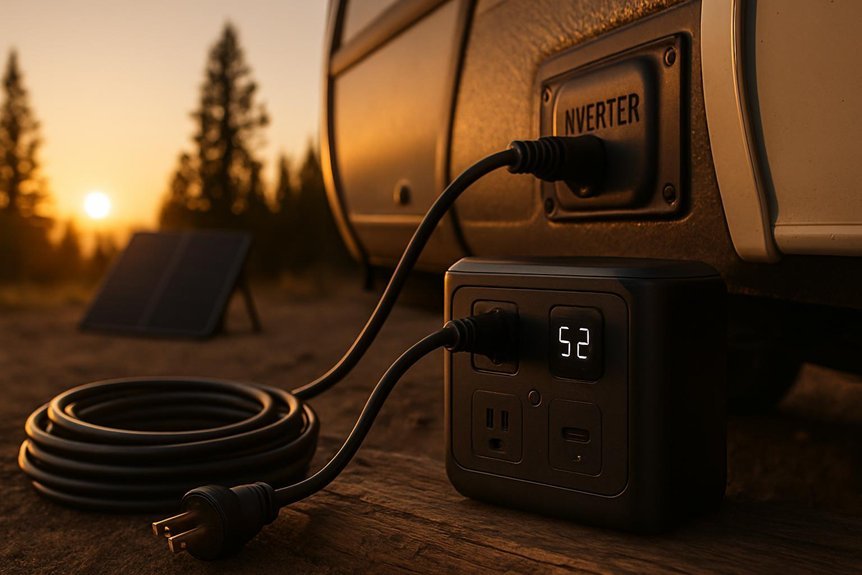
To size a portable power station, we start by calculating our daily Wh requirement. We sum each device’s Wh = watts × hours, adjust for duty cycles, and round to nearest 5–10 Wh. Include standby loads 24/7 and intermittent high-power uses by estimating typical minutes per day. Account for inverter losses by using a conservative efficiency range (85–90%) and apply a factor of 1.1–1.25 to cover DC‑to‑AC conversion, internal resistance, and heat. Don’t forget usable capacity differences: Li‑ion is ~90–95%, while lead‑acid is lower, so factor usable Wh accordingly. When planning multi‑day autonomy, multiply daily Wh and subtract anticipated recharge from solar or generator. Include a 20% contingency for variability, weather, and aging, and document all devices in a clear worksheet. battery capacity, inverter losses. Main factual point The capacity- and output-aware sizing approach aligns with real-world practice, ensuring you pick a power station that meets both the total energy needed and the simultaneous load you expect.
Match Continuous and Surge Power
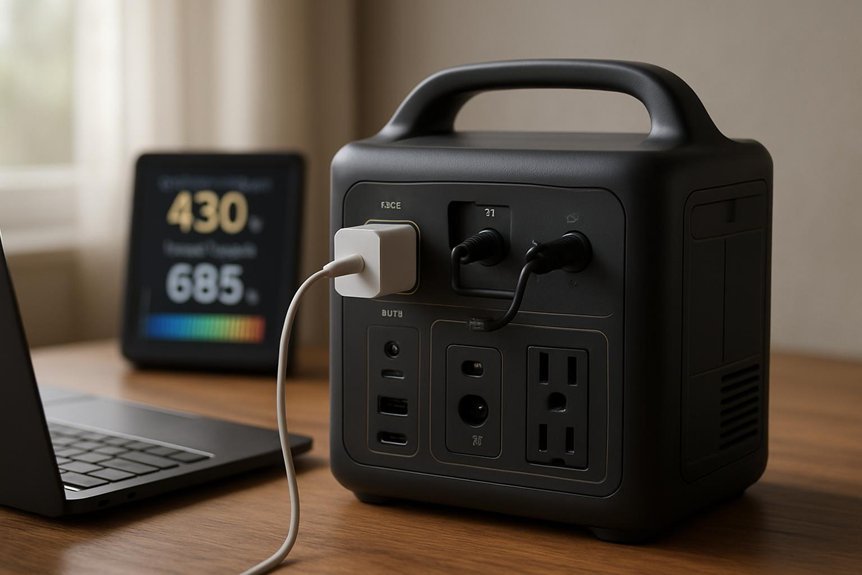
How do we align continuous and surge power when sizing a portable power station? We start by matching running watts to continuous rating, ensuring the total load sits 10–25% below the inverter’s continuous capacity to provide headroom. Inverter efficiency matters: usable continuous output is reduced by efficiency, so derate the continuous calculation accordingly. Thermal derating also limits available power in high-temperature environments, so ratings may drop above a specified temperature threshold. For startups, we design surge capability to exceed the largest startup surge, typically 10–20% above peak run, and consider LRA multipliers of 3–8× for motors. When multiple motor starts occur, sum worst-case surges or sequence starts. Use soft-start where possible to minimize instantaneous demand and avoid trips. Surge watts drive startability and are critical for proper sizing, so balance continuous and surge with attention to motor inrush dynamics.
Top Use Cases: Camping, Medical, Home Backup
Camping, medical, and home backup scenarios each demand a distinct sizing approach: camping emphasizes portable energy for intermittent loads and solar recharging, medical use concentrates on reliable, continuous power with tight duty cycles and reserves, and home backup requires prioritized tiers to sustain essential functions during outages. We summarize camping loads as tiered packs: weekend minimalist, car-camping, family setups, and multi-night off-grid, with solar recharging focused on 100–400 W panels and daily harvest roughly 200–400 Wh from a typical 100 W panel. For medical devices, we target CPAP 30–60 W nightly and portable oxygen concentrators’ higher draws, ensuring 24–72 h of autonomy with 20–30% margin for inverter losses. In all cases, planning emphasizes resilience, predictable duty cycles, and clear capacity buffers to support camping loads, medical devices, and critical communications. Power uses efficiency gains to reduce required capacity, and this point guides how we size systems based on real-world duty cycles.
Charging, Efficiency, and Expandability
We’ll build on the sizing concepts from camping, medical, and home-backup use and focus now on how charging, efficiency, and expandability shape real-world performance. We analyze multi-source charging, where solar 100–1,200W, AC 100–2,400W, and vehicle inputs 100–800W (often higher with DC fast ports) can converge to exceed single-source limits, typical 1,600W ceilings. Charging efficiency is weather- and chemistry-dependent, with round-trip efficiency 85–95% and LiFePO4 often higher than Li-ion; expect 8–15% inverter/DC-DC losses. Thermal management mitigates heat-driven losses but consumes energy. Expansion options hinge on MPPT gains, modular input ceilings, and safe BMS tapering beyond ~80% SOC. Our guidance emphasizes choosing a station with flexible input, robust cooling, and clear headroom for future batteries and higher C-rates. charging efficiency, expansion options.
Frequently Asked Questions
How Long Will the Battery Last Between Charges in Mixed Use?
We’ll estimate that mixed use lasts about 1–3 days per 500 Wh, depending on load and battery efficiency. Battery drift and charging speed matter; warranty coverage can affect performance expectations as temperatures and usage vary.
Can I Extend Capacity With Modular Battery Packs?
Yes, we can extend capacity with modular packs. We analyze compatibility, BMS coordination, and DoD. Two word discussion ideas, modular capacity, guide us. Two word discussion ideas, battery expansion, informs sizing, runtime, and safe practice for expansion.
What Are Real-World Inverter Losses During Peak Loads?
Inverter losses spike at peak loads, yet real-world performance often stays steady due to better design. We see higher switching and conduction losses, but advanced topologies and cooling keep peak-load efficiency surprisingly workable for practical use.
How Does Temperature Affect Performance and Longevity?
Temperature impact and longevity factors: we observe cold reduces capacity and charging, while heat accelerates degradation; thermal management, derating, and chemistry choice (LFP vs NMC) crucially influence usable life and performance under real-world conditions.
Which Ports and Adapters Maximize Efficiency for Devices?
We maximize efficiency with USB‑C PD ports and direct DC outputs; we’ll prioritize adapters that support PD PPS and keep power management tight. We’ve found which ports, adapters maximize efficiency for devices, reducing conversion losses and heat.
Conclusion
We’ve walked through sizing a portable power station by listing essential devices, calculating daily Wh, and checking continuous vs. surge ratings, all with efficiency and loss factors in mind. For example, a weekend camper runs fridge 24/7, lights, and charging—total ~350 Wh/day—so a 600–800 Wh battery with ~1000–1500 W surge handle it, plus MPPT charging. In multi-day outages, add a 20–30% reserve. The right unit fits daily needs, margins, and expandability without overspending.