Ad Blocker Detected
Our website is made possible by displaying online advertisements to our visitors. Please consider supporting us by disabling your ad blocker.
We’ll walk you through the core idea: portable power stations store energy in lithium-based cells, managed by a Battery Management System, then convert that energy to usable AC or DC outputs via inverters and power electronics. We’ll cover how charging options, output matching, and real-world factors shape performance. Along the way, we’ll note the safeguards and longevity considerations that keep systems reliable. If you’re evaluating options, you’ll see why the next details matter for your setup.
Key Takeaways
- Portable power stations store energy in lithium-based batteries and deliver AC or DC power through an inverter and ports.
- They manage state of charge, thermal conditions, and safety via a BMS and firmware updates.
- Charging options include AC wall input, solar (MPPT), and car (12V) with varying input limits.
- Output capabilities depend on continuous and surge watts, inverter type (pure sine vs. modified), and port limits.
- Real-world performance factors: efficiency, DoD, age, temperature, idle loss, and charging losses affect usable energy.
Do I Need a Portable Power Station for My Needs?
So, do you need a portable power station? We assess needs by continuous output, startup surges, and usable capacity. For small electronics, 100–500 Wh units suffice, offering multiple phone charges and lighting with minimal draw; for camping, 500–1,500 Wh handles lights, laptops, and USB devices overnight. Short outages call for 1,000–3,000 Wh to cover fridge, router, and essential loads for 8–24+ hours, while whole-home backups require 3,000–10,000 Wh or modular stacks for higher, sustained demand. Medical devices demand UPS capabilities and appropriately sized battery packs, typically 400–1,000 Wh overnight for CPAP. We weigh portability against capacity, considering cost per Wh, recharge speed, and compatibility, to match anticipated loads and return on investment. Heavy metal considerations influence longevity and safety, including the choice between LiFePO4 and Li-ion chemistries and how that affects DoD and cycle life main factual point: energy storage chemistry.
How the Battery Core Stores Energy

We’ll start by outlining how battery cell chemistry, module architecture, and state-of-charge management govern energy storage. The chemistry sets redox reactions, intercalation, and voltage, while module architecture defines how cells are arranged and cooled for reliable performance. State-of-charge management ties chemistry and hardware together, balancing capacity, safety margins, and cycle life. New sentence with a main factual point from knowledge Temperature management is the single most critical factor for battery longevity, and maintaining safe operating temperatures helps preserve both capacity and cycle life.
Battery Cell Chemistry
What stores energy inside a battery cell? We describe the chemistry at the core: how active materials, electrolytes, and interphases determine energy, power, and longevity. We emphasize materials tradeoffs and electrolyte safety as guiding constraints.
1) Cathode/anode pairing defines energy density and cycle life, with high-nickel NMC/NCA offering top gravimetric density but tighter stability margins than LFP.
2) Anode choice ranges from graphite to silicon-enhanced variants, trading capacity against expansion and SEI formation.
3) Electrolyte composition (LiPF6 in carbonate solvents) sets ionic conductivity, SEI quality, and thermal behavior, balanced by additives for safety.
4) Intercalation, alloying, and conversion mechanisms govern capacity retention, with blends and surface coatings used to harmonize performance.
These factors collectively determine how portable power stations store energy, while prioritizing electrolyte safety.
Module Architecture
Module architecture translates a bank of cells into a coherent energy storage unit, balancing nominal voltage, capacity, and current capability through deliberate series-parallel configuration and cell selection. We design module layouts with 12–24 cells in series per module for 48–51.2 V systems and deploy multiple parallel strings to achieve target Ah. Series sets set voltage; parallel strings raise capacity and current capability. Cell format choices—cylindrical, prismatic, or pouch—affect packing density, thermal paths, and mechanical support, while rigid trays, end plates, and spacers control compression and motion. Electrical interconnects use welded busbars, nickel strips, or stamped bars sized for continuous and peak currents, prioritizing low contact resistance. Thermal management integrates passive heat spreaders and dedicated vents, plus active cooling for high-power modules, ensuring uniform temperature and preventing thermal runaway. Subtopic 1 denotes that a lithium cell is the sealed electrochemical system that stores and releases energy through controlled ion movement, with its cathode chemistry setting intrinsic limits on voltage, energy density, and degradation rate.
State Of Charge Management
How does the battery core store energy through state-of-charge management? We manage SOC with calibrated estimation, tracking FCC, and enforcing DoD policies to balance usable energy and longevity. Our approach reduces SOC drift and mitigates FCC aging through measurement fusion and periodic recalibration. We outline the core practices below:
1) We combine coulomb counting with model-based corrections to limit SOC drift over time.
2) We use OCV mapping where applicable, plus rest periods to improve accuracy for flat-voltage chemistries like LiFePO4.
3) We apply temperature-aware algorithms to adjust charge limits and prevent aging-driven errors.
4) We perform periodic FCC updates and cell balancing to sustain pack-level SOC accuracy and minimize capacity fade.
What the BMS Safeguards Protect
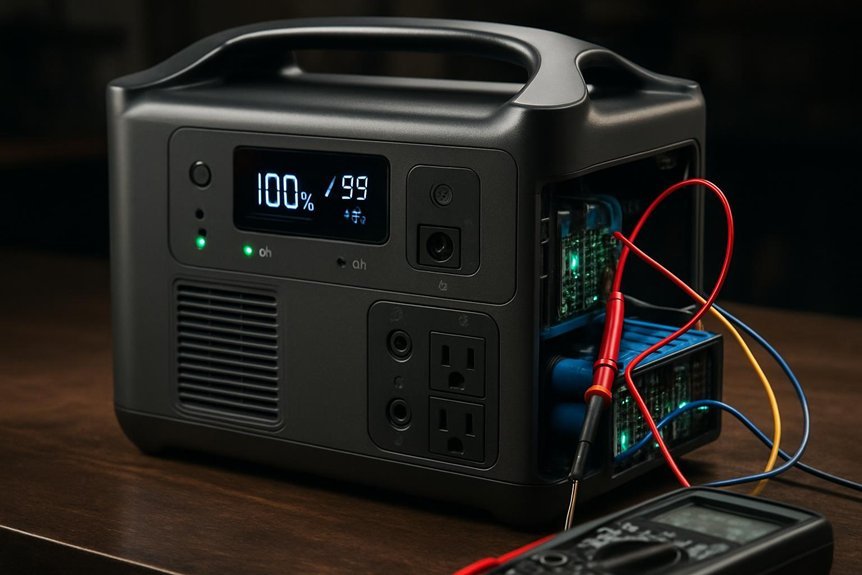
We protect cells by vigilant voltage monitoring and strict safety thresholds that prevent overcharge and deep discharge. We use cell-level data, then apply precise protections and interlocks to prevent harmful conditions and preserve cycle life. This discussion centers on how voltage sensing, thresholds, and immediate responses coordinate with the BMS to safeguard the pack.
Cell Voltage Monitoring
- Detects small imbalances to trigger balancing actions
- Feeds voltage data to Coulomb-counting and voltage-based SoC algorithms
- Enables passive or active balancing to maintain pack uniformity
- Provides diagnostic trends for aging, resistance rise, or reversal risk
Safety Thresholds & Protections
What exactly do the BMS safeguards shield you from, and how do they stay ahead of faults? We implement layered protection that supervises voltage, current, and temperature to prevent unsafe operation. Overcurrent protection and short circuit response are central: continuous and peak current limits cap discharge and charge, while rapid disconnection handles hard shorts in microseconds to milliseconds. Detection relies on pack current shunt, ADC, and dedicated sense ICs, with fast fuses or electronic breakers for catastrophic events. Thermal feedback ties to conductor stress, charging ramps, and cell aging, triggering derating or cutoffs as needed. Protective architecture uses series MOSFETs, gate-drive cutoff, and automatic retry or manual reset. Together, these measures reduce thermal runaway risk and preserve pack longevity under fault and abuse scenarios.
How DC Becomes Usable AC Power
How does a DC source become usable AC power? We convert fixed DC into an AC waveform through rapid polarity switching, PWM, and filtering. Our approach uses an H-bridge to drive an LC output stage, smoothing high-frequency pulses into a near-sinusoidal output while maintaining balance under load. A control loop adjusts duty cycle based on feedback to regulate amplitude and frequency.
- DC input stage with buffering capacitors and a stiff bus
- Power switches (MOSFETs or IGBTs) with heat sinking and protection
- PWM generation plus a sine reference to shape the waveform
- Output filtering and closed-loop regulation for stability
Under ionized, thermal throttling, we monitor temperature and maintain safe operation without sacrificing response.
Charging Options: AC, Solar, and Car
AC charging is the most straightforward option, offering predictable performance and fast top-ups when the AC adapter and input rating align with the station’s design. We describe input ranges (200 W to 1,500+ W) and fast-charge behavior, noting 50–80% in 30–80 minutes at higher wattages, with slower final 10–20%. Thermal and noise trade-offs arise from higher input, with some units offering silent modes. Practical use centers on consistency, safety, and the necessity of a compatible grid or generator and manufacturer-supplied cabling. Solar charging adds diversity: MPPT boosts efficiency versus PWM, with 200–1,200 W PV limits, and real-world solar variability shaping daily energy. Car charging provides alternatives, especially in transit, though limited by vehicle interfaces and wiring. Combined charging can reduce fill times, bounded by total wattage.
Matching Outputs to Your Devices
Device power needs are the starting point: we identify running wattage, surge, and voltage to size the system. We match outputs to devices by confirming waveform, per-port limits, and real startup demands, then plan margins.
Device power needs drive the system size, with surge, voltage, and waveform matched to real startup demands and per-port limits.
- Verify running watts and surge for each device, noting startup multipliers (2–4× for inductive loads)
- Compare total running load to inverter continuous output and ensure surge coverage
- Distinguish pure sine vs. modified sine and align with sensitive electronics and motors
- Check USB-C PD limits and negotiated voltages to avoid overloading ports
We ensure voltage, frequency, and port availability align with device requirements, and account for derating at high temperatures or low SOC to prevent clipping.
What Affects Real-World Runtime and Efficiency
So, what actually governs real-world runtime and efficiency on portable power stations? We quantify the usable energy as a function of nominal capacity, DoD limits, and SoC accuracy, noting that aging and temperature swing-shift usable Wh by 5–20% over time and 10–30% with cold. Inverter efficiency dominates AC loads (typical 85–90%), while DC outputs stay higher (90–97%), with idle overhead 1–10 W. Load profiles matter: steady loads are predictable, while duty-cycled or surge-heavy tasks incur extra losses and possible inverter derating. Charging efficiency adds another layer: AC charging is 85–95% efficient, fast charging compounds heat and reduces net energy. Marketing slogans can inflate perceived capacity if nonessential branding is ignored; focus on measured performance rather than glossy claims.
Keeping It Safe and Maintaining Longevity
Safety and longevity hinge on understanding aging, thermal dynamics, and proper charging. We discuss how to keep portable power stations safe and durable, using precise guidance rooted in chemistry and BMS behavior. We avoid fluff and focus on actionable practices.
- Manage storage SoC and temperature: target ~40–60% SoC for Li-ion variants; 50% for LiFePO4; keep 10–25°C ambient when idle.
- Favor slow charging and certified chargers; follow voltage/current limits to preserve cell balance and minimize heat.
- Maintain the BMS and firmware: regular updates support protection features and timing thresholds.
- Monitor aging indicators: reduce high-SoC dwell, refresh every 3–6 months, and ensure proper venting and thermal management.
Note: irrelev ant topic humor topic can distract, so stay focused on safety and longevity.
How to Choose the Right Portable Power Station for You
Choosing the right portable power station starts with matching capacity, output, and chemistry to your actual use. We balance Wh sizing with an 10–20% buffer for losses, and we factor device surge versus continuous draw to prevent overloading. For frequent use, select appropriate capacity: <500Wh for day trips, 500–1,500Wh for weekend outings, 2,000–4,000Wh for van life or backup, or >4,000Wh for extended home scenarios. Ensure continuous and surge watts meet your appliances, prioritizing pure sine wave inverters for sensitive gear. Prefer multiple outputs (AC, 12V, USB) to minimize adapters. Review battery chemistry—LFP offers longevity and safety; NMC/NCA weigh more but fade quicker. Confirm charging options and solar compatibility, MPPT efficiency, and input limits. Also verify battery safety provisions and warranty coverage before purchase.
Frequently Asked Questions
How Is Battery Health Affected by Daily Cycling?
We observe battery health declines with daily cycling due to battery aging; higher cycling frequency speeds degradation. Battery management mitigates this, but charger compatibility and SOC windows also influence longevity in our portable power stations.
Do Power Stations Support High-Wattage Appliances?
Do portable power stations support high-wattage appliances? Yes, but with limits. We, as users, plan around surge, continuous, and derating. Portable charging remains feasible; Battery chemistry and protection govern safe high-wattage operation.
What Determines Inverter Efficiency in Practice?
In practice, inverter efficiency hinges on design choices and thermal management. We optimize inverter design with wide-bandgap devices and synchronous rectification, while thermal management prevents derating, preserving switching performance and minimizing conduction losses under varying loads.
Can Power Stations Be Repaired or Refurbished?
Yes—we can repair or refurbish them. We’ll assess modules, recycle batteries when needed, and repair or replace failing components. Our approach prioritizes repairing modules, cost control, and safety while maximizing usable life for our readers.
How Does Temperature Impact Performance and Lifespan?
We see that temperature dramatically affects performance: cooling effects, temperature drift, and aging impact; effective thermal management slows degradation. We monitor conditions, optimize charging/discharging temps, and mitigate heat to extend lifespan and preserve usable capacity.
Conclusion
We’ve wired our advice into a single, steady current: your needs, like a circuit, determine the load and the choice. The portable power station is the conduit, converting stored energy into usable form with safeguards and efficiency as its core conductors. When you match capacity, outputs, and charging options to your devices, you close the loop. In the end, preparation is the switch that keeps your power flowing cleanly, reliably, and safely.