Ad Blocker Detected
Our website is made possible by displaying online advertisements to our visitors. Please consider supporting us by disabling your ad blocker.
We explain portable power stations as compact battery packs with built‑in inverters that deliver clean AC or DC output for essential devices, whether off-grid or during outages. We’ll quantify capacity, runtimes, and charging options—AC, solar, or vehicle—then compare chemistry like Li-ion vs LiFePO4 for safety and longevity. We’ll validate how peak surges are handled and how to estimate usable run time. The details will guide your next step, and the choice awaits you beyond the basics.
Key Takeaways
- A portable power station is a compact, reliable source of backup and off-grid power for essential devices and routines.
- It stores energy in batteries (LiFePO4 or Li-ion) with BMS protection and manages charging/discharging safely.
- It can be recharged via AC mains, solar panels, or a 12V car connection, often with MPPT optimization.
- Output options include AC, USB, and DC ports with inverter types (pure sine wave preferred for sensitive electronics).
- Use-case planning involves sizing by runtime, duty cycles, and factoring inverter efficiency and DoD for longevity.
What a Portable Power Station Does for You
A portable power station serves as a compact, reliable source of backup and off-grid power for essential devices and routines. We quantify its value by runtime and duty, not promises. For food safety, a 1,000 Wh unit can sustain a 100–200 W fridge for roughly 5–10 hours, and CPAPs or oxygen equipment run roughly 12–30 hours, depending on draw. Home connectivity stays intact as routers pull 5–20 W, while lighting and security cameras use 5–15 W per LED fixture, enabling hours of illumination. Outdoor use scales: 300–600 Wh recharges phones dozens of times, and 40–60 W 12V fridges extend stays. We reference unused topics and pricing expectations to avoid scope creep while clarifying unit duties and practical limits. A portable power station is designed to deliver clean, efficient power for sensitive electronics, ensuring safer operation in diverse environments.
How These Units Store Energy and Protect the Battery
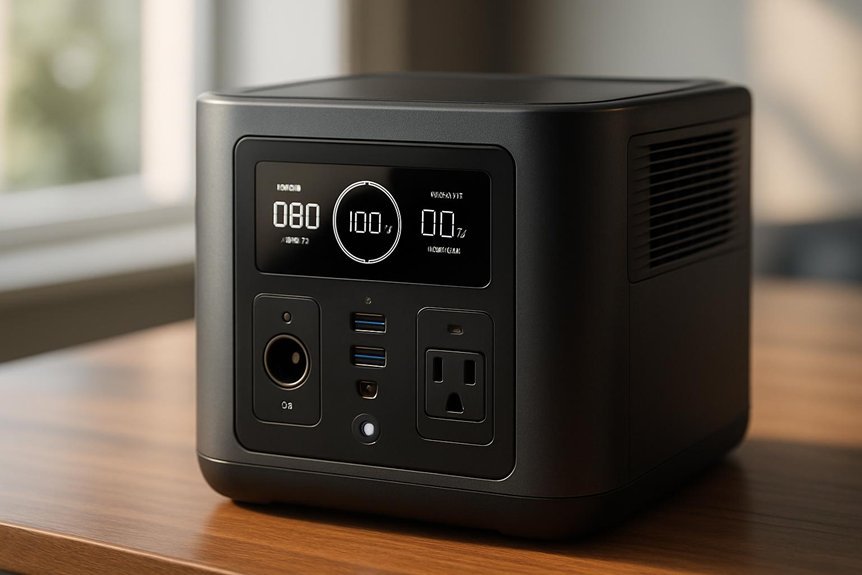
We’ll start by outlining how these units store energy and how the battery management system protects that energy. Nominal capacity ranges from ~200 to 3,000+ Wh, with SoC accuracy typically ±5–10% using voltage, current, and coulomb counting. Usable capacity is reduced by BMS cutoffs and reserve margins of 5–20%. DoD varies by chemistry; LiFePO4 yields 80–100% usable DoD, while lithium‑ion designs commonly cap at 80–90%. Energy density drives weight; modern Li‑ion cells offer higher Wh/kg than LiFePO4, which trades lower energy density for more cycles. Charging uses CC/CV with 0.2–0.5C typical. MPPT solar and DC inputs follow priority logic. BMS provides over/under‑voltage, over‑current, and cell balancing (passive or active), plus thermal management alerts and throttling to protect cells.
Li-Ion vs LiFePO4: Which Chemistry Fits Your Needs
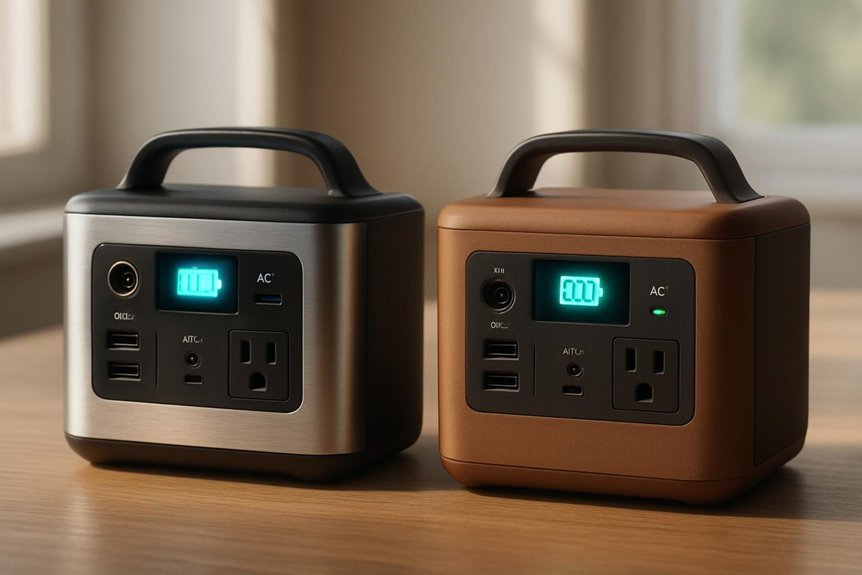
Which chemistry fits depends on how you balance energy density, cycle life, safety, and cost for your use case. We compare LiFePO4 and NMC/NCA on four axes: energy density, cycle life, safety, and cost. LiFePO4 trails NMC in Wh/kg by roughly 20–40%, but offers superior thermal stability and lower risk of thermal runaway. Cycle life is substantially longer for LiFePO4 (2,000–6,000 cycles to 80% DoD) and calendar aging is slower when idle. NMC/NCA provides higher specific energy for lighter, smaller units but demands stricter thermal management. For lithium safety and safety margins, LiFePO4 reduces catastrophic failure probability yet still requires BMS. For regular use, LiFePO4 often yields lower TCO through longer life and steadier performance.
Choosing LiFePO4 for safety and durability, or NMC/NCA for higher energy density, depends on use case and management.
- Choose LiFePO4 for safety, durability, and cost per cycle
- Choose NMC/NCA for higher energy density and lighter packs
- Consider use case, temperature, and charging practices to optimize life and safety
Inverters, Outputs, and Handling Peak Surges
How do inverter type and protection features shape peak performance? We examine output dynamics with precision. Pure sine wave inverters minimize THD (<3%), supporting sensitive electronics, while modified sine wave units trade efficiency and compatibility for cost. High-frequency designs reduce weight but may limit surge capacity; transformer-based (low-frequency) units deliver stronger short-term surges and isolation at the cost of size and weight. Protection features—fast overcurrent detection, soft-start, thermal management, ATS, and tight frequency/voltage regulation—limit inrush and maintain stable operation under load variation. Surge ratings typically exceed continuous wattage by 1.5–3×, but real-world surges fall with low state-of-charge, heat, or aging. Inverter efficiency and Battery chemistry govern continuous versus peak delivery, constrained by DC-side current. The fast-switching electronics and robust MOSFET circuits inverters provide instant response to load changes, acting as the shock absorber for electrical stress during spikes and helping prevent flicker or overload shutdown.
How Charging Works: AC, Solar, and Car Inputs
Charging a portable power station involves three main inputs—AC, solar, and 12V car connections—each with distinct electrical paths, limits, and efficiency implications. We quantify input ranges: AC 200–1,500+ W (some units 1,800–3,000 W with dual chargers); solar 12–150 V, up to 2,000+ W; DC 12V inputs 120–700 W. Efficiency hinges on MPPT, thermal management, and charging modes; heat rises with higher AC currents, prompting cooling and throttling. Battery chemistry and BMS constraints shape charge curves, depth-of-discharge, and cycle life, influencing charging compatibility and longevity. Real-world throughput factors include panel irradiance, temperature, and vehicle alternator capacity during DC charging.
- Clear, measurable charging paths, with explicit limits
- Predictable performance across AC, solar, and car inputs
- Transparent trade-offs between speed and battery longevity
How to Estimate Runtime and Pick Capacity
To estimate runtime and pick capacity, we start from a simple energy balance: runtime equals usable battery energy divided by the device’s average power draw, with inverter and conversion losses folded in. We model usable fraction 80–90% for lithium, about 50% for lead-acid, and adjust for temperature and discharge rate. Inverter efficiency (85–95%) multiplies into the usable energy, reducing required input Wh. We account for continuous versus peak draw, startup surges, and duty cycles to compute daily Wh. For common use cases, we size to match estimated Wh with a 15–25% safety margin against aging and losses. Avoid unrelated topic detours; otherwise, include a stray discussion only if it clarifies buffers, derating, and worst-case environmental impacts. Choose capacity to cover calculated Wh plus headroom for inverter and future needs.
Safety, Maintenance, and Storage Tips
Are you taking the right steps to keep a portable power station safe, reliable, and long-lasting? We evaluate battery chemistry and thermal safety with precision. LFP offers higher thermal stability and lower fire risk, supporting 3,000–5,000+ cycle life, while NMC delivers higher energy density but greater thermal runaway risk. Respect thermal thresholds: NMC may fail around 150°C, LFP exceeds 250°C and reduces chain reactions. A robust BMS balances cells and enforces voltage/temperature cutoffs; inverter/charger protections shield both station and devices. Adhere to UN38.3 for transport, maintain secure firmware updates, and use rated cables with clean terminals. Store at 40–60% charge, 10–25°C, and away from heat or moisture. Follow manufacturer limits for solar and AC input, and practice safe disconnection when servicing.
- Battery safety focus, clear, measurable steps
- Preventive maintenance reduces risk and extends life
- Storage discipline preserves capacity and balance
Real-World Scenarios and a Quick Buying Checklist
We’ll map real-world usage to concrete power needs, from camping and RV setups to emergency home backup and remote work, using typical loads and target capacities to frame decisions. We’ll quantify daily consumption (W and Wh) and translate that into recommended battery size, inverter capability, and solar input, then pair each scenario with a concise, itemized buying checklists. In short, we’ll present a precise, scenario-driven guide that helps you compare options quickly and choose the right portable power station.
Real-World Usage Scenarios
Real-world usage often hinges on matching loads to capacity and balancing recharge options for reliability. We align loads with capacity windows (e.g., 1,000–2,500 Wh for multi-day trips; 300–1,000 Wh for weekends) and optimize charging via DC‑to‑DC or 300–600 W solar with MPPT, ensuring headroom for surges. LiFePO4 offers high cycle life; sodium‑ion may perform in extreme cold. We weigh cost benefit and environmental impact when selecting chemistry, weight, and ventilation needs for secure mounting. Our approach emphasizes predictable runtimes, thermal management, and pass‑through charging for field work.
- Proven runtimes and weight penalties drive on‑vehicle mounting and ventilation decisions
- Solar recharge efficiency and headroom quantify reliability and cost benefit
- Cold-weather performance highlights environmental impact and resilience
Quick Buying Checklist
Quick Buying Checklist: Real-world scenarios demand a structured, numbers-driven approach to choose a portable power station. We start by sizing load: sum device watts × hours, add 20–30% buffer for inverter inefficiency, using a 0.85 runtime factor to reflect typical 80–90% system efficiency. Consider capacity tiers: <300 Wh, 300–1,200 Wh, or 1,200+ Wh, aligning with DoD and usable DoD recommendations (80–90%). Evaluate power output: continuous watts must exceed combined load plus margin; peak surge should match startup needs (2–3× continuous briefly). Inspect inverter efficiency and battery chemistry; Li-ion NMC offers fewer cycles than LiFePO4, affecting longevity. Check charging: AC 100–600 W, solarMPPT, and combined input limits. Ensure ports, including USB-C PD and RV TT-30, meet appliance requirements.
Frequently Asked Questions About Portable Power Stations
What are the most important questions about portable power stations, and how do their specs translate into real use? We answer with precision: capacity (Wh) and continuous/surge (W) determine runtime and startup ability; LiFePO4 offers longer cycles and safety, while Li-ion gives higher energy density and lighter weight. Multi-input charging (AC, solar, car) shortens recharge time; efficiency matters (inverter 85–95% plus use of DC outputs). For backup power and camping trips, match size class to load: compact 100–500 Wh for essentials, mid-size 500–1500 Wh for more devices, heavy-duty 1500+ Wh. Consider thermal limits and altitude, BMS safety, and certifications (UL/CE). Plan for fire safety and transport rules when traveling.
- Clear performance maps empower confident, emotion-driven choices
- Real-world runtimes align with planned camping trips
- Safe, compliant, reliable portable power every time
Frequently Asked Questions
Do Portable Power Stations Require a Dedicated App to Monitor Stats?
No, portable power stations don’t require an app to monitor stats. We typically use onboard displays for power management, with optional app integration for real-time telemetry, historical data, and remote control when available.
Can I Parallel-Connect Multiple Units for More Power?
We can do a parallel configuration only with manufacturer-approved kits for power scaling; otherwise we risk imbalance. We carefully match specs, manage BMS, and limit units per guidance to avoid overload and thermal faults.
Are There Hidden Costs or Fees for Software Upgrades?
We’ll confirm: yes, there can be hidden costs for software upgrades, even with optional features. We quantify potential fees, outline escalation paths, and show how optional features affect total cost, ensuring transparent, precise budgeting before adopting upgrades.
How Quiet Are They in Normal Operation Indoors?
We’re typically at quiet operation levels around 20–40 dBA indoors, depending on load and cooling. Indoor noise stays well below conversation levels; we measure perchance 30 dBA at bedside with light use, rising with heat.
Do They Contain Hazardous Materials Beyond Lithium Batteries?
Yes—we, with precision, note hazardous materials beyond lithium battery chemistry exist (electrolytes, binders, PCBs, flame retardants), though quantities are small and controlled; we quantify risks through strict safety data, testing, and compliant recycling pathways. Anachronism: “By Jove, …”
Conclusion
We’ve laid out how portable power stations gel into real life: capacity, chemistry, and outputs mapped to your needs. When you’re comparing, think in concrete terms—Wh, peak surge, MPPT efficiency, and charging options—then translate to runtime for your essential devices. If your concern is weight or cost, lean on LiFePO4 for safety and longevity, and target 0.5–1.0 C cycle clarity. Yes, they’re an investment, but predictable, reliable power is priceless in outages.