Ad Blocker Detected
Our website is made possible by displaying online advertisements to our visitors. Please consider supporting us by disabling your ad blocker.
A storm knocked out the grid last winter and our house ran on a borrowed inverter for 12 hours, proving the value of a well‑sized solar generator. We’ll outline goals, loads, autonomy, and environment with precise calculations, safety considerations, and scalable hardware choices to avoid under‑ or over‑design. We’ll detail how to size the array and storage, select panels, controllers, and batteries, and plan wiring and permits. Stay with us as we pin down the critical steps that keep systems compliant and reliable, even on worst days.
Key Takeaways
- Define goals, loads, and autonomy to size panels, batteries, and inverter for essential circuits and planned service levels.
- Inventory devices, compute daily Wh/day, and apply worst-month data with buffers for accurate energy targets.
- Design storage and PV sizing with DoD considerations, efficiency losses, and a 10–30% contingency for reliability.
- Specify hardware and safety requirements: LiFePO4, pure sine inverter, MPPT controller, proper BMS, and code-compliant wiring.
- Plan interconnection, permits, monitoring, and maintenance with real-time performance metrics and robust documentation.
Define Your Solar Generator Goals and Constraints
What are your exact goals, and what constraints cap them? We define clear priorities by categorizing emergency backup, off-grid use, or portable power, then map loads to criticality—medical devices, refrigeration, communications, lighting, and essentials. We quantify devices: smartphones 5–15 Wh/day, laptops 30–100 Wh/day, mini-fridges 300–1,200 Wh/day, full refrigerators 1,000–2,500 Wh/day, CPAP 40–100 Wh/night. We anticipate simultaneous-load constraints: peak start-up surges 2–6× running watts, continuous inverter limits, and branch-circuit boundaries. Our goal set aligns with acceptable service levels: essential circuits only or multi-day rotation. We address site footprint, climate, and permitting while ensuring safe maintenance access. Inverter sizing and battery chemistry choices drive reliability, safety margins, and lifecycle performance within budget. Solar panels play a crucial role in recharging between use cycles, especially for off-grid or extended trips.
Assess Load, Autonomy, and Environment
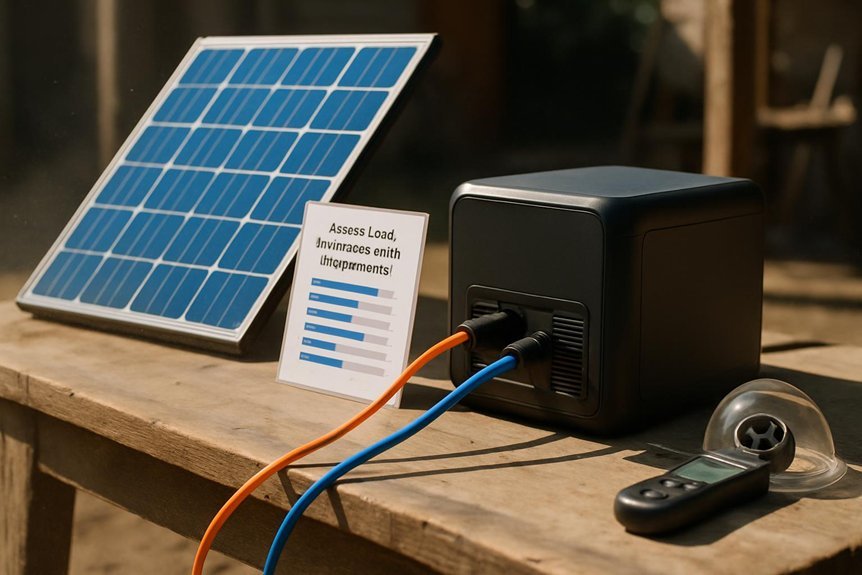
We begin by cataloging every device to determine loads: list nameplate watts, duty cycles, and whether the load is continuous or intermittent with its average and peak currents. We then compute daily energy per device: watts × hours/day, summing to total Wh/day, and tag continuous versus intermittent/surge profiles. Validate worst‑month daily kWh using utility data (12 months preferred) to bound seasonal peaks, and add a +10–30% buffer for phantom loads and expansion. Determine autonomy days based on climate, converting to Battery_Wh = Daily_Wh × Days_of_Autonomy ÷ Usable_DoD. Assess recovery needs with PV_kW required to recharge within sunny windows. Evaluate site PSH, variability, and temperature effects on PV and batteries, prioritizing solar storage and battery safety.
Size the Array and Storage to Your Needs
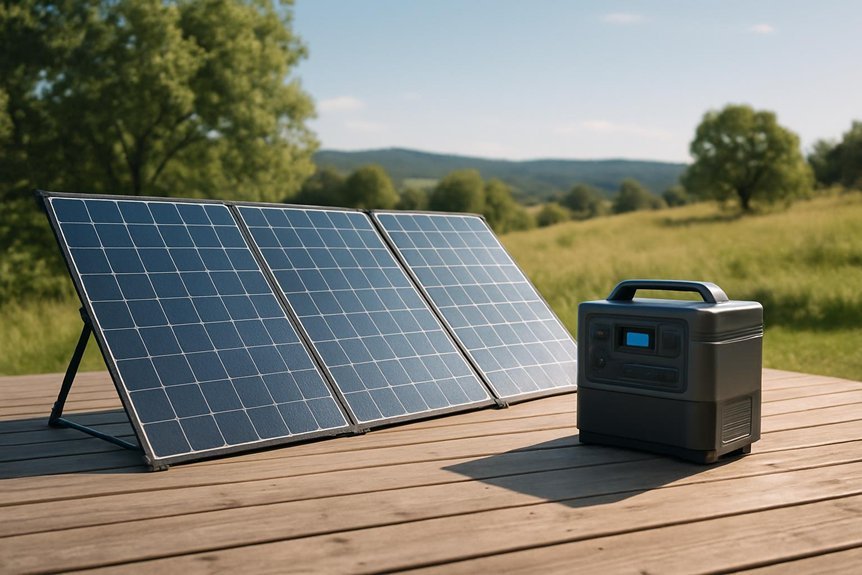
We start by defining a daily energy target and translating that into required storage capacity, then convert that usable energy into battery Ah at our chosen system voltage with safety margins. We then size the solar array around worst-month peak sun hours, accounting for derate factors and end-to-end efficiency to ensure recharge within the intended autonomy. This approach keeps module counts, wiring, and charge-controller limits practical while preserving performance and safety.
Daily Energy Target
Determining the daily energy target starts with a precise Wh/day estimate for all loads and then expands to account for losses and margins. We begin with an appliance inventory: wattages, runtimes, and frequencies yield Wh/day per device; then apply duty cycles with average running watts, and add standby/phantom loads (5–15%) for always-on draws. Inverter efficiency (DC to AC) increases the baseline energy need by ~10–15%. Metering with Kill-A-Watt or smart plugs over 24–72 hours validates estimates. Add system losses: battery round-trip efficiency (LiFePO4 90–98%), wiring/MPPT losses (0.75–0.9 derate), and inverter idle/surge. Contingency margins of 10–30% cover unforeseen loads and estimation error, while worst-month design ensures reliability. We then convert Wh/day into DoD-aware Ah targets, noting budget constraints and non technical jargon to aid practical decisions. Main factual point: The plan includes a 25% system losses buffer for accurate demand [Main factual point: The plan includes a 25% system losses buffer for accurate demand
Peak Sun Hours
| PSH (avg) | Derate | Daily Energy (kWh) |
|---|---|---|
| 4 | 0.8 | 30 |
| 5 | 0.8 | 37.5 |
| 6 | 0.8 | 45 |
| 7 | 0.8 | 52.5 |
| 8 | 0.8 | 60 |
Storage Sizing Method
To size the array and storage to your needs, we start from a precise energy budget: sum daily Wh demands (including standby and phantom loads), convert that to usable battery capacity using the system voltage and DoD, and then translate peak power needs into inverter and surge ratings. We model daily Wh with losses (inverter 85–98%, DC wiring 2–5%, round-trip battery 80–98%), adjust for worst day and season, and add motor start currents and HVAC surges. Battery chemistry informs usable Ah via DoD and degradation, ensuring safe DoD targets. Autarkic strategies require autonomy days and reserve policies, plus thermal management energy. Size PV charging paths to meet bulk current limits, then confirm derating, MPPT, and recharge window. Finalize with safety margins, cycle life, and maintainable DoD, balancing capital cost and reliability.
Pick Compatible Hardware (Panels, Controller, Battery, Inverter)
When picking hardware, we start by matching panel output, charge controller input, battery voltage, and inverter rating to your daily energy goals and site conditions, then verify that each component supports safe operation within its rated limits.
When selecting hardware, align panel output, controller input, battery voltage, and inverter rating with your daily energy goals and site conditions, then confirm safe operation within limits.
- Panel type and rating alignment: choose monocrystalline for higher efficiency and panel mounting fit, with 18–24% typical efficiency and 350–520W residential modules.
- Controller choice and sizing: MPPT preferred, ensure PV watts ≥ planned array wattage and Isc × 1.25 safety margin.
- Battery chemistry and bank: aim LiFePO4 for 3,000–6,000+ cycles and 80–90% DoD; match nominal voltage to inverter.
- Inverter selection: pure sine wave, size for continuous and surge loads, account for marginal efficiency losses.
- Environmental and safety checks: temperature coeffs, proper wiring, and BMS/over‑load protections.
Plan Installation, Wiring, and Safety
We plan installation with precise layout and documented wiring paths, ensuring panel placement minimizes shading and maximizes azimuth/tilt efficiency while allowing for safe clearance and future expansion. We’ll size conductors to keep voltage drop under 3–5% for DC runs and design wiring routes that meet NEC/local code, with clear labeling, service disconnects, and robust protection. We’ll align safety-focused practices with BMS, MPPT sequencing, ventilation, and enclosure integrity to prevent overheating and ensure reliable operation.
Panel Placement Considerations
Panel placement starts with a rigorous site assessment to optimize sun exposure, shading, and access for installation and maintenance. We tailor panel orientation and tilt by site latitude, accounting for obstructions and shadowing at 10:00, 12:00, and 14:00 local time to maximize energy yield and maintain consistent MPPT operation.
- panel orientation and tilt alignment to true south/north reference, with latitude-based adjustments
- shadow mitigation through spacing, seasonal simulations, and vegetation management
- debris, soiling, and wind exposure considerations to minimize losses
- fixed vs adjustable mounts evaluated for seasonal performance and cost
- routing, access, and fire-code setbacks to preserve maintenance and safety
We quantify losses for non-ideal orientations and emphasize preventing inter-row shading, preserving consistent output.
Safe Wiring Practices
Planning the installation starts with a precise wiring strategy that meets code and supports safe maintenance. We determine total system current and voltage, size conductors and overcurrent protection for worst-case short-circuit and operating currents, then apply NEC 690 and AHJ permit requirements. We create a wiring diagram detailing panel strings, combiner/MC4 junctions, charge-controller inputs, battery banks, inverter/charger, disconnects, and AC interconnect to the breaker box. We enforce the 120% rule and bus-bar limits for grid-interactive connections, compare load-side versus supply-side options, and plan equipment placement to minimize DC length and voltage drop. We select copper conductors with ambient-temperature derating, provide conduit protection, align polarity per manufacturer, and document archival records for inspections and insurance compliance. We implement rapid shutdown, grounding, and proper terminations.
Meet Codes, Permits, and Inspections
Are you prepared for the regulatory maze that accompanies solar generator installations? We align with code requirements, coordinating permitting processes and AHJ etiquette to ensure safe, compliant systems. Our approach is precise, documenting every parameter and ensuring traceable, audit-ready submittals.
- Identify AHJ and project scope early to minimize delays
- Compile electrical, structural, and fire-safety data with complete listings
- Ensure plan sets reflect NEC 690/705/706, NFPA 855, and IFC requirements
- Include PE stamps, UL/IEEE listings, and site-specific clearances
- Plan for utility PTO timing and possible interconnection amendments
We emphasize timely plan reviews, disciplined corrections, and clear communication. By respecting AHJ etiquette and robust documentation, we reduce rework, safeguard life safety, and align commissioning with verified performance.
Monitor, Maintain, and Plan for Future Growth
How will we guarantee ongoing performance and scalable growth for your solar generator system? We’ll monitor real-time kW, cumulative kWh, and SOC at 15‑minute resolution, plus daily peak generation, produced/consumed kWh, and round‑trip battery efficiency. We track inverter/MPPT fault codes, temperature derating, and power clipping, with per‑string telemetry to identify underperforming panels, hotspots, or shading losses. Baseline performance is seasonally calculated and year‑over‑year compared; >5% unexplained monthly drops trigger investigation. Maintenance follows a cadence: panel cleaning; quarterly visual inspections; monthly/quarterly battery checks; biannual electrical inspections; annual professional inverter updates and thermal imaging. Alarms cover faults, high temperature, SOC limits, and communication loss; use secure remote diagnostics, with on‑site verification for safety. Plan for growth by documenting bypass protections and noting warranty exclusions.
Frequently Asked Questions
How Long Will My Battery Last Under Daily Use?
We’ll estimate runtime from usable capacity and daily use, then translate into days: battery lifespan depends on DoD, cycles, and temperature; with typical LiFePO4 2,000–5,000 cycles, we’d project X days of daily use before significant loss.
What’s the Simplest Way to Estimate My Start-Up Costs?
We’re surprised how much coincidence helps budgeting: start-up costs equal price estimation plus contingency. We estimate kit price by per-watt and per‑kWh targets, add 15–30% for BOS, shipping, permits, and safety margins for startup costs.
How Do I Protect Panels From Shading and Temperature Effects?
We prioritize panel shading and temperature mitigation by optimizing layout, using microinverters or optimizers, and monitoring temps; system upgrades include bypass diodes and MPPT per panel, while avoiding permitting pitfalls with code-compliant, safe designs.
Can I Upgrade My System Without Redoing the Whole Setup?
Yes, we can pursue an upgrade compatibility assessment with retrofit options, targeting minimal disruption. We’ll consider inverter/headroom, panel shadings, battery replacement feasibility, and safety margins, performing precise calculations to confirm practical, code-compliant improvements.
What Are the Most Common Permitting Pitfalls to Avoid?
We understand permitting pitfalls threaten compliance challenges, cost overruns, and regulatory hurdles; we’ll avoid them by precise calculations, rigorous documentation, and safety-minded planning, ensuring complete permit packages, proper sequencing, licensing, stamps, and local AHJ coordination from the outset.
Conclusion
We’ve mapped goals, sized loads, and planned for the harshest days, so your solar generator becomes more than gear—it’s a resilient, living system. Picture quiet panels sipping sun as batteries store calm energy for the night, vibrations of a pure sine wave powering essential tools. With precise calculations, safety fencing the path, and meticulous wiring tracing a safe, scalable future, you’ll trust the system to perform, adapt, and endure, no matter what the horizon brings.