Ad Blocker Detected
Our website is made possible by displaying online advertisements to our visitors. Please consider supporting us by disabling your ad blocker.
We’re exploring off-grid power setups with portable stations to combine mobility with reliability. We’ll assess loads, size batteries for true autonomy, and choose formats that fit our space and climate. We’ll map solar charging, inverters, and safety features with practical, testable steps. Our approach stays disciplined and scalable, prioritizing lifecycle and maintenance. There are critical tradeoffs we’ll uncover as we plan, and practical decisions that will shape what comes next for our setup.
Key Takeaways
- Use portable stations as primary or backup power sources, connecting to a critical-load panel for off-grid reliability or outage protection.
- Size 1–3 kWh for portable units up to 5–40+ kWh modular packs to match load profiles and mobility needs.
- Decide DC- or AC-coupled configurations to optimize efficiency, charging options, and lifecycle management.
- Conduct thorough load planning with an appliance audit and adjust for inverter losses and motor surge to gauge autonomy.
- Design solar charging plans that balance midday charging, SOC monitoring, and expansion paths for reliable daytime recharging.
What “Off-Grid With Portable Stations” Means for Homes
What does “off-grid with portable stations” mean for homes? We define portable power stations as self-contained systems with an integrated inverter, BMS, and charging inputs (AC/solar/vehicle). Off-grid use describes primary or supplemental home electrification via one or more portable stations rather than a fixed home battery bank. Scales range from a single unit (1–3 kWh usable) to modular arrays (5–40+ kWh) with parallel/stacking. Architectures include portable-station-as-primary, wired to a critical-load panel, or portable-station-as-backup for outages, with manual or automatic switchover. DC-coupled versus AC-coupled setups affect efficiency and management. We consider inverter efficiency and storage density in sizing, charging options, and reliability, including solar input limits, performance under thermal derating, and integration with generators or grid when applicable. Portable stations provide a flexible approach to power resilience while avoiding a fixed, wall-mounted battery bank, enabling scalable energy autonomy.
How to Assess Your Daily Load and Peak Needs
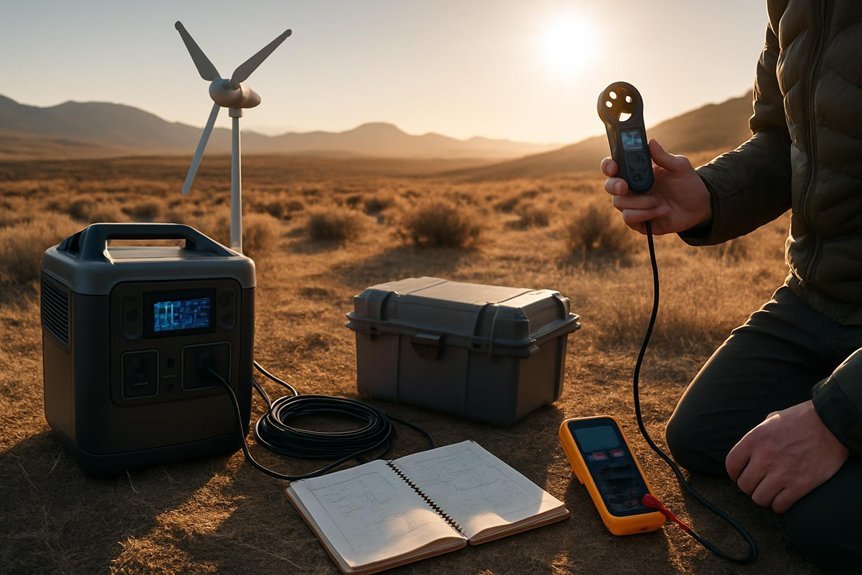
To assess daily load and peak needs, we start with a precise appliance audit that captures every device likely to run, including intermittent and standby loads. We itemize each device’s rated wattage and typical operating hours, using measured average watts for cycling loads. We convert usage to daily energy (Wh) by watts × hours, then sum for total daily Wh. Include invisible draws from network gear, battery management, monitoring, and DC-DC converters, which add 5–15%. Apply a system loss multiplier of 1.2–1.3 for inverter, controller, wiring, and round-trip losses. Separate continuous energy from peak power, noting motor-start surges 2–6× running watts. Model duty cycles and seasonal variation to build multi-day autonomy, ensuring capacity and charge power meet worst-case days.
Choosing a Portable-Station Format and Topology
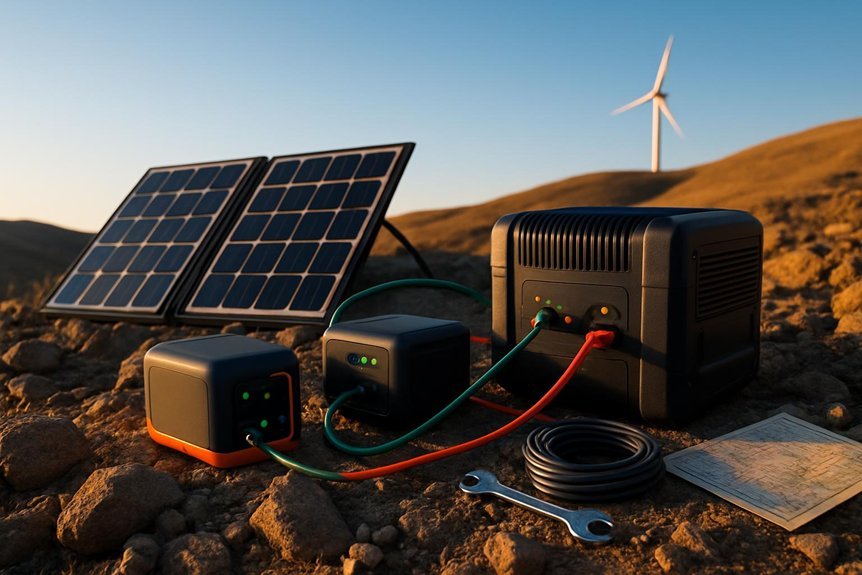
We start by matching your needs to portable-station formats, from backpack units to high-capacity, modular packs. Then we weigh topology options—single-box all-in-one, modular stackables, or hybrid/inverter arrangements—to balance setup simplicity, scalability, and maintenance. Finally, we account for solar integration style (DC- or AC-coupled) and DoD targets to optimize efficiency and lifecycle.
Portable Station Architecture
Choosing a portable-station format starts with matching your load profile, mobility needs, and space constraints to a practical topology. We target a modular topology that can scale from 1–5 kWh modules to 5–20 kWh mobile packs, adapted to available space and serviceability. We weigh compact integrated units for quick deployment against rack-mounted or stackable packs for higher density and easier upgrades. Thermal management drives selection: LiFePO4 cells with stable thermal behavior pair best with passive cooling in smaller units, while high-energy chemistries demand active cooling and enclosure heating in extreme conditions. Inverters must match expected loads, with pure-sine outputs and appropriate surge margins, while MPPT capacity and DC buses optimize efficiency. Safety-focused BMS integration remains essential for reliable, scalable, and maintainable portable stations.
To ensure year-round reliability, oversized capacity and robust weather resilience are essential, and the system should be designed with generous buffer to handle extended cloudy periods and seasonal spikes. Off-grid performance depends on a disciplined approach to load inventory and management, so planning for realistic year-round consumption should inform topology choices and expansion paths.
Topology Options Discussed
Have you settled on a portable-station format yet, or should we lock in a topology that best matches your load profile and mobility needs? We outline four practical options to match real-world usage. Single-Unit systems favor simplicity, with 500–6,000 Wh and 1,000–3,000 W continuous output, ideal for weekend trips and light backup. Modular-expandable bases offer scalable capacity from 1–3 kWh up to 10–25 kWh, balancing upfront cost and long-term growth. Stacked/parallel units deliver redundancy and increased power, but require careful load distribution and wiring. Hybrid setups centralize storage while feeding fixed loads through a transfer path for reliability. Across all topologies, consider security considerations and warranty coverage, ensuring protection against misuse and clear coverage during expansion or component failure. Precision planning minimizes surprises and maximizes resilience.
Sizing Batteries for Autonomy, Durability, and Lifecycle
How much battery capacity do we actually need to meet autonomy goals without sacrificing lifespan? We size by daily energy demand, desired days, usable fraction, and losses. LiFePO4 offers 80–95% usable, with high cycle life; lead‑acid sits around 40–50% usable and lower cycle life. We plan for calendar aging by storage at ~50% SOC and <25°C. Our rule: autonomy = Wh/day × days ÷ usable fraction, plus ~10% losses. Example: 2 kWh/day for 2 days with LiFePO4 at 90% usable and 90% round‑trip efficiency ≈ 5 kWh. Consider C‑rate and peak loads; larger banks absorb solar limits and shorten aging effects. Table below clarifies choices.
| Chemistry | Usable Fraction | Notes |
|---|---|---|
| LiFePO4 | 0.80–0.95 | High cycle life; modest temp sensitivity |
| Lead‑acid | 0.40–0.50 | Lower cycle life; maintenance needed |
| NMC/NCA | 0.80–0.90 | High DoD, moderate cycle life |
Designing a Practical Solar Array and Charging Plan
We sizing the solar array to match our portable station’s max input, then design a charging plan that accounts for peak sun hours, derating, and wiring losses to ensure reliable cycling. We’ll use parallel and series configurations deliberately to balance voltage, current, and MPPT tracking, keeping Voc within the controller’s limit under cold conditions. We’ll implement a practical schedule that prioritizes mid-day charging, monitors SOC and production, and layers backup options for variable sun.
Solar Array Sizing Basics
Sizing a practical solar array starts with a clear daily energy target and a realistic view of available sun. We present a disciplined sizing approach that accounts for demand, PSH realities, and component limits while anticipating grid tallbacks and seasonal variability.
- Define daily Wh/day from a complete load inventory, including standby and worst-case seasonal demand, then apply 10–30% system losses.
- Use location-specific worst-month PSH, adjusted for shading, tilt, and elevation, plus a 5–20% margin for irradiance variability.
- Compute Required Array STC = Daily Usable Wh / (PSH × Derate × Charge Efficiency) and round up to standard panel sizes.
- Align Voc/Vmp with controller input ranges, plan for expandability, and consider weather-driven seasonal variability in autonomy and recharge windows.
Charging Plan Strategies
Could the charging plan you choose make or break a portable solar system in variable conditions? We approach design with clear limits: identify max solar input from specs, ensure VOC stays under limits with a 10–15% cold-weather cushion, and respect MPPT current constraints. We plan for efficiency losses—charge controller 90–98% and conversion losses—when estimating charging times. Parallel vs. series wiring guides cable sizing and VOC risk. Priorities first: daytime critical loads get direct charging during peak sun; allocate blocks for recharge, load, and maintenance, with a midday window. Stagger stations to optimize input, and consider peak-sun tracking for 20–40% more yield. Include solar optimization and wind integration as complementary controls, plus redundancy with hybrid charging to cover low-sun periods.
Inverter Sizing, Safety Features, and System Integration
How do you choose an inverter that meets both load needs and safety requirements without overpaying? We size for realistic simultaneous loads, keep continuous output at 70–80% of rating, and ensure surge handles motor starts. Safety features, isolation, and THD under 3% protect sensitive gear, while tight frequency control avoids clock drift. System integration hinges on matching DC voltage, BMS communication, and PV/MPPT coordination for portable stations topology and reliability, with attention to autonomy durability under thermal and altitude derating.
Size for true continuous load, ensure 70–80% rating, and design for motor surge with safe, THD-conscious, well-integrated portable inverters.
- Size for continuous load plus headroom; verify surge duration and crest factor.
- Confirm transformer or transformerless topology aligns with grounding and safety requirements.
- Ensure BMS, CANbus/Modbus, and MPPT compatibility for seamless integration.
- Validate insulation, derating, and future load growth for durable, portable operation.
Smart Charging, Load Management, and Automation
Smart charging, load management, and automation bring coherence to portable off-grid stations by aligning energy sources with demand in real time. We implement adaptive charging using CCCV with temperature compensation and schedule charging during off-peak or solar midday to reduce costs. Multi-source prioritization favors solar first, then grid, generator, and vehicle-to-load to minimize fuel use. We cap charge currents and target 80–90% SOC daily to extend battery life, noting LFP benefits. Load management classifies circuits as critical, important, or nonessential, enabling automatic shedding during discharge. Forecasting smooths demand, pre-charging batteries, and pre-conditioning thermal loads. Central EMS provides rules, while edge logic handles safety-critical tasks. Migration patterns influence usage timing; battery chemistry underpins control limits and longevity strategies.
Maintenance, Safety Protocols, and Troubleshooting
Maintenance, safety, and troubleshooting are essential for reliability and longevity of off-grid portable stations; we’ll cover routine upkeep, safe operating practices, and systematic diagnostics to keep systems running.
Maintenance, safety, and troubleshooting sustain reliability for off-grid portable stations.
1) Maintain a strict maintenance cadence: inspect vents monthly, store at ~40–60% SOC, cycle batteries every 3–6 months, and update firmware when available.
2) Enforce thermal management: ensure 5–10 cm clearance, avoid sealed compartments, monitor surface temps, and use external ventilation for sustained high loads.
3) Follow electrical safety protocols: verify charger specs, use proper cables, install overcurrent protection, and observe grounding guidance.
4) Troubleshoot with discipline: address deep discharge, inverter faults, and solar charging anomalies by staged testing and resets, then reseat connections if needed.
Budgeting, Warranties, and Long-Term Ownership Considerations
Budgeting, warranties, and long-term ownership hinge on choosing the right system from the start, then planning for replacement, service, and end-of-life costs. We evaluate cost tiers, anticipate 10–30% of initial outlay for 5–10 year replacements, and track lifecycle costs per delivered kWh. Frugal maintenance and careful part selection extend usable life without sacrificing safety. Warranties vary: 2–10 years, with LFP models often offering longer coverage or cycle-based guarantees; verify pro‑rating terms, covered components, and on-site versus mail-in service. Transferability matters for resale and may affect value; document serials and registrations. Plan for recycling fees and potential battery module replacement costs, typically 30–60% of initial system price, depending on chemistry and modular design. Regular firmware updates and an active service network reduce downtime and total ownership friction.
Frequently Asked Questions
How Do Portable Stations Handle Long-Duration Outages Without Grid Backup?
We handle long outages with portable staging and modular kits, stacking packs as needed. We optimize recharge via solar, MPPT, and generator support, all inside weatherproof enclosures, prioritizing critical loads and precise energy budgeting for reliability.
Can Portable Systems Power High-Draw HVAC or Medical Equipment Safely?
Yes, we can power high draw loads, but only after rigorous safety testing, proper sizing, and continuous monitoring. We’ll document surge margins, assure pure sine outputs, and debounce protections to protect equipment and users.
What Maintenance Cadence Ensures Battery Longevity in Remote Locations?
Like a clockwork heartbeat, we schedule battery maintenance at daily, weekly, and monthly cadences to maximize longevity, tracking charge cycles, temperatures, and SoC, documenting faults; we trim, tighten, and balance to preserve reliable long-term performance.
How to Legally Site-Install Portable Off-Grid Power in HOA Communities?
We’ll secure permitting constraints and HOA compliance by surveying rules, obtaining approvals, and documenting thresholds; we’ll prioritize architectural review, licensing, and safety certifications, then install discreet portable stations in compliant locations with ongoing audits and renewals.
What Are Best Practices for Rapid Expansion After Initial Setup?
We start with rapid expansion in sight, like stacking dawn-lit bricks as we grow. We plan post installation upgrades methodically, document interfaces, and execute phased additions, ensuring compatibility, capacity, and smooth capacity ramp for scalable, reliable power.
Conclusion
We’ve mapped a practical path from loads and autonomy to charging plans and safety, so you can go off-grid with confidence. Think of our approach as a blueprint, not a dream: measure, size, and configure in repeatable steps, then test and adjust. Like a craftsman tuning an instrument, we’ll balance capacity, efficiency, and reliability. And in the quiet of off-grid days, you’ll hear a single, steady truth: preparedness multiplies safety and freedom.