Ad Blocker Detected
Our website is made possible by displaying online advertisements to our visitors. Please consider supporting us by disabling your ad blocker.
We can assess whether a portable power station can run a refrigerator or microwave by examining surge, continuous output, and energy capacity. We’ll compare typical fridge surges (600–1,200 W) and runtime with duty cycles, alongside microwave demands (600–1,200 W peak) and brief peaks. We’ll match these to inverter efficiency, port options, and battery size, then model run-time and safety margins. If you want reliable outages, we’ll need precise load profiles and a plan for sustained operation with proper sizing.
Key Takeaways
- Yes, a portable power station can run a refrigerator, but ensure continuous output matches the fridge draw and surge capacity handles startup surges.
- A microwave can run if the power station’s continuous watts meet or exceed the microwave’s running wattage and it can handle peak surges.
- Size the unit by totaling continuous loads plus startup surges, and verify AC outlets, USB-C, and 12V compatibility for appliances.
- Model runtimes with duty cycles (e.g., fridge 90 min on/60 min off) and solar or grid recharging windows for reliability.
- Include safety features (SOC alerts, auto shutoff, cooling) and plan maintenance to prevent overload or overheating during outages.
How Much Power Do a Refrigerator and Microwave Need?
How much power do a refrigerator and microwave need? We quantify loads to determine compatibility with a portable power source. For refrigerators, we examine running current and starting surge, expressed as refrigerator efficiency metrics and wattage ranges. Typical modern units pull 100–250 watts during steady operation, with starting surges requiring 600–1,200 watts briefly. Microwaves vary by wattage rating, commonly 600–1,200 watts input, with higher wattage delivering faster cooking but increasing instantaneous draw. To size a system, combine the continuous run rate with occasional surges, then add headroom for efficiency losses. Remember that surge demands, not just continuous use, drive capacity. In summary, know the refrigerator efficiency and microwave wattage, then select a power source that sustains both within duty cycles and peak constraints.
Can a Portable Power Station Run a Microwave Without Tripping?
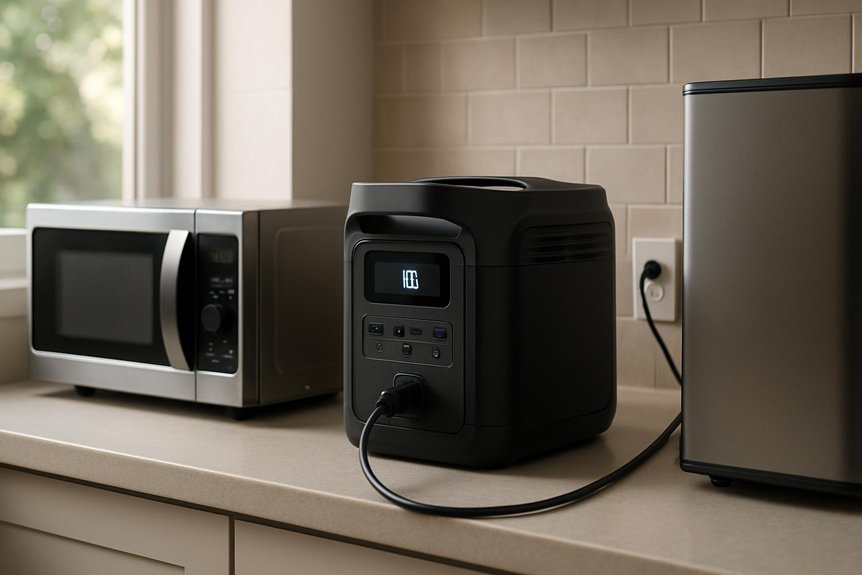
Can a portable power station run a microwave without tripping? We assess this by examining continuous draw and inverter headroom. Microwaves typically demand surge and sustained loads well above their rated running wattage, which can approach or exceed a power station’s continuous output. To avoid tripping, we must stay within the unit’s 80–90% rule of thumb for peak capability and consider the surge duration. Practical guidance: select a model with ample inverter wattage and robust peak rating; confirm battery chemistry supports sustained high draw. We also note recharging limitations—running a microwave drains the pack quickly, shortening run time—and noise considerations, as some inverters generate audible hum under load. In short, a microwave often trips if the power station isn’t sized for both continuous and surge demands.
How to Choose a Power Station: Watts, Ports, and Runtime
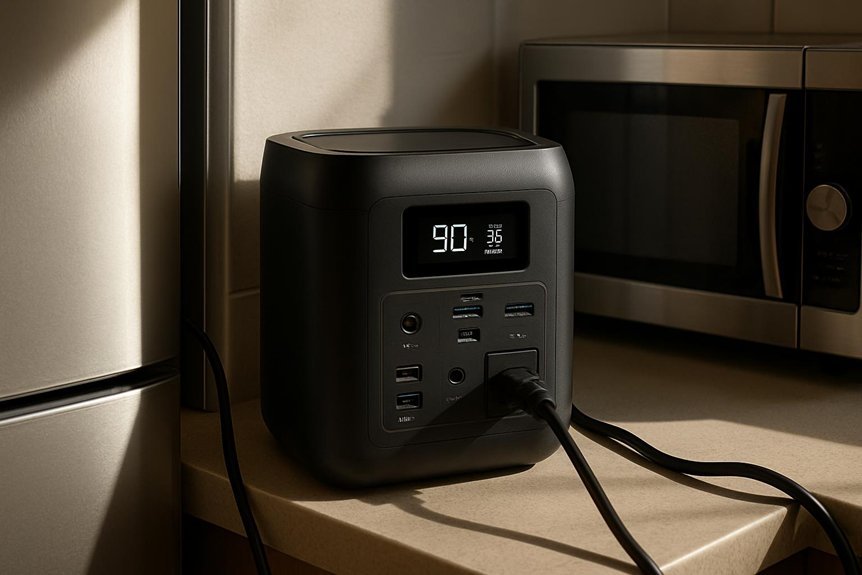
Choosing a power station hinges on watts, ports, and runtime. We prioritize continuous, labeled wattage rather than peak bursts, ensuring the device to run matches real load. Assess total wattage for each appliance you’ll power, then confirm the continuous output and surge capacity of the unit. Ports matter: USB-C, AC outlets, and 12V DC can coexist with dedicated charging cables or automotive adapters. Consider runtime by evaluating amp-hour or watt-hour ratings against your expected use, then model a realistic duty cycle. We emphasize portable charging strategies that align with your gear’s efficiency, including inverter quality and thermal management. Follow safety guidelines, including proper ventilation and battery health checks. We’ll guide you toward a balanced, reliable selection without overestimating capabilities.
Maximizing Run Time: Fridge Duty Cycles and Microwave Use
Fridge duty cycles and microwave use determine how long a portable power station will keep essential appliances running. We assess runtime by modeling compressor cycling, defrost, and fan loads for fridges, then compare peak microwave draws to inverter capacity. We emphasize average vs. peak power, duty cycle percentages, and duration at specific temperatures. For refrigerators, we track cyclic duty factors to avoid excessive continuous draw while maintaining interior stability; microwaves require brief, high-power pulses, often with longer cooldown gaps. We present reliability metrics to gauge endurance under typical weekend-use scenarios, then translate results into actionable limits. Maintenance tips: keep batteries within recommended temps, monitor cell voltage sag, and ensure connections remain tight. Together, these insights support predictable performance and extended runtimes without sacrificing safety or efficiency.
Real-World Outage Plans: Off-Grid Scenarios and Timed Runtimes
When planning real-world outages, we shift from static runtimes to timed strategies that balance reliability and resource use. We present practical off-grid scenarios and governed runtimes that reflect real conditions, not ideal assumptions. Our approach emphasizes reliability comparisons and safety considerations to prevent overdraw and equipment damage.
- Visualize a scheduled duty cycle: fridge on for 90 minutes, off 60, then reloads, with monitoring alerts.
- Prioritize load stacking: microwave only during peak solar hours or grid-refill windows, minimizing peak demand.
- Implement fail-safes: SOC thresholds, auto shutoff, and alert protocols to maintain system integrity under variable weather.
These steps support predictable performance, reduce risk, and guide informed, decisive outage responses.
Frequently Asked Questions
Can a Power Station Power a Fridge With Automatic Defrost?
We can power a fridge with automatic defrost if the power station’s inverter size supports startup surges and continuous load. We’d verify fridge defrost cycles and ensure inverter size accommodates peak startup for reliable operation.
Do Surge Watts Affect Microwave Performance With a Power Station?
Yes, surge watts affect microwave performance with a power station, since peak demand can exceed steady output. We’ll discuss two word discussion ideas, unrelated topic, to illustrate limits while maintaining precise, concise analysis for safe operation.
How Do Battery Chemistry and Inverter Size Impact Duty Cycles?
We investigate the theory: battery chemistry and inverter size set duty cycles. Battery chemistry dictates discharge limits; inverter size defines peak and sustained loads. We evaluate battery chemistry, inverter size, battery chemistry, inverter size to optimize duty cycles.
Can Car Adapters Charge a Portable Power Station for Outages?
Yes, car adapters can recharge a portable power station during outages, but we consider recharge options and safety considerations carefully, ensuring proper current limits, cable gauges, ventilation, and charger compatibility to prevent overheating or damage.
Are Multi-Device Setups Safe for Fridge and Microwave Simultaneously?
Are multi-device setups safe for fridge and microwave simultaneously? We believe reliability challenges and safety considerations arise, so we assess load balance, inverter capacity, surge handling, and proper disconnects before we power both appliances together.
Conclusion
We’ve shown that a portable power station can run a fridge or microwave, but success hinges on surge tolerance, inverter stability, and enough watt-hours for the duty cycle. We’ll size for fridge surges (600–1,200 W) and microwave peaks (600–1,200 W) with a generous cushion. In practice, model runtimes, account for defrost and fan loads, and plan for ventilation. So, plan carefully, run the numbers, and you’ll be ready when outages hit—like a well-oiled machine.Let’s stay sharp.