Ad Blocker Detected
Our website is made possible by displaying online advertisements to our visitors. Please consider supporting us by disabling your ad blocker.
Did you know the typical home outlet handles about 15 to 20 amps, enough for a modest mix of devices but not all at once? We’ll map each device’s wattage and amperage, add a safety margin, and compare it to your circuit and strip ratings. We’ll group high-draw items, balance loads, and plan staggered charging when needed. If we can’t fit everything safely, we’ll adjust and document the changes to keep you within limits.
Key Takeaways
- List each device’s wattage and amperage to sum total load before charging multiple devices.
- Round up total load with a safety margin to prevent overloading outlets or strips.
- Match each device to ports and circuits that meet its wattage and amperage requirements.
- Check outlet, strip, and circuit ratings plus surge protection for safe simultaneous charging.
- Balance load across ports and plan charging windows to avoid continuous high draws.
How Many Devices Can You Safely Charge at Once?
We can safely charge multiple devices at once by considering the total port current and the power available from the charger or power strip. We begin with the charger’s rated output and each port’s specification, then allocate a distribution plan that prevents overload. We assess device current draw, prioritizing essential devices first and using a staged approach for noncritical peripherals. We verify that the sum of port currents does not exceed the supply rating, and we ensure cable gauges and connectors support the planned currents. We document the final device distribution, noting which port powers which device and any required USB-C PD or quick-charge negotiation. This methodical process supports safe charging and reduces heat, noise, and voltage drop across the setup.
Read Wattage and Amperage to Size Your Load
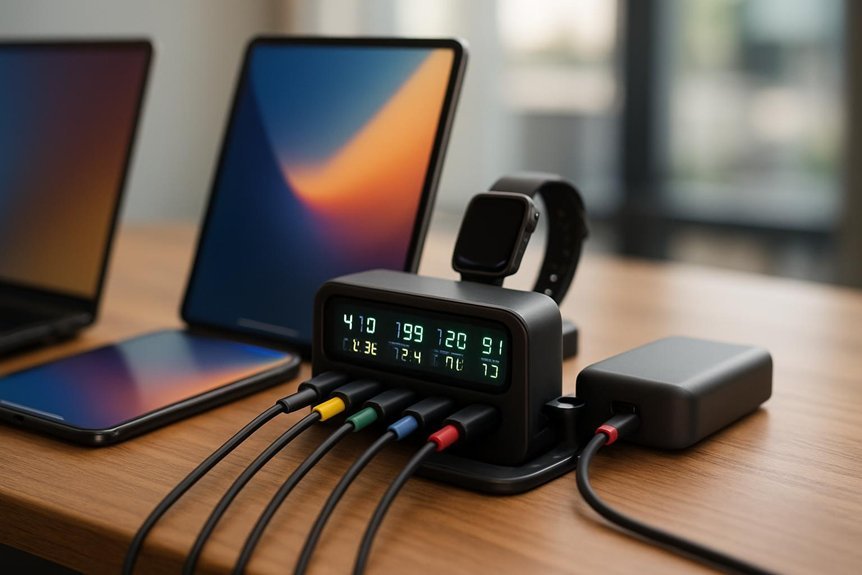
We read wattage carefully and verify device labels to confirm total load. We check amperage limits on outlets and circuits to avoid overrun. We size your load efficiently by summing expected draws and reserving headroom for spikes.
Read Wattage Carefully
To size your load accurately, start by reading both the wattage and amperage on each device or its charger. We compare the numbers to establish a total demand, then round up to account for fluctuations. Wattage reflects actual power draw, while amperage shows current requirement; both guide our before-you-plug calculation. We record each figure clearly and verify units (W, A) to avoid mismatches. We also note any dual-voltage adapters, which can alter effective wattage. Consistent labeling helps us track charging efficiency and prevents overloading circuits. We respect safety labeling and manufacturer instructions, using their limits as guardrails. If a device lists only wattage, estimate amperage from rated volts and apply a margin. Precision in this step minimizes risk and supports reliable, ongoing charging performance.
Check Amperage Limits
Do you know your device’s amperage limits before plugging in? We check amperage to size our load and ensure safe operation. By verifying each device’s rated current, we prevent overloading outlets and circuits, preserving device longevity and system reliability. We cross-reference with supply ratings and consider startup surges to avoid nuisance trips. Our approach centers on precise measurements, consistent labeling, and clear compatibility checks. We emphasize device compatibility and safety labeling in every step, so users avoid misinterpretations and unsafe configurations. With careful planning, we can maximize simultaneous charging without compromising performance or safety.
- Confirm label amperage versus actual draw to confirm compatibility
- Account for peak startup current and continuous load
- Match devices to circuit rating and outlet type
- Verify safety labeling and manufacturer guidance before plugging in
Size Your Load Efficiently
Ever wonder how to size a charging load precisely? We approach this by reading wattage and amperage to size your load, applying strict math, and confirming margins. We target size optimization through careful sum-and-check steps, ensuring we don’t exceed panel or breaker limits. Our method: identify device wattages, convert to amperage, and aggregate with a deliberate safety factor. We then verify continuous loads vs. intermittent spikes, adjusting as needed for practical use. This disciplined power budgeting avoids overloads and improves efficiency. Use the table below to track categories, wattage, and current draw, keeping a balanced load profile.
| Category | Wattage (W) | Amperage (A) |
|---|---|---|
| – | – | – |
| Phones/Tablets | 18–20 | 0.15–0.17 |
| Laptops | 45–90 | 0.38–0.75 |
| Misc. | 5–60 | 0.04–0.50 |
Calculate Your Power Strip’s Real Capacity in Minutes
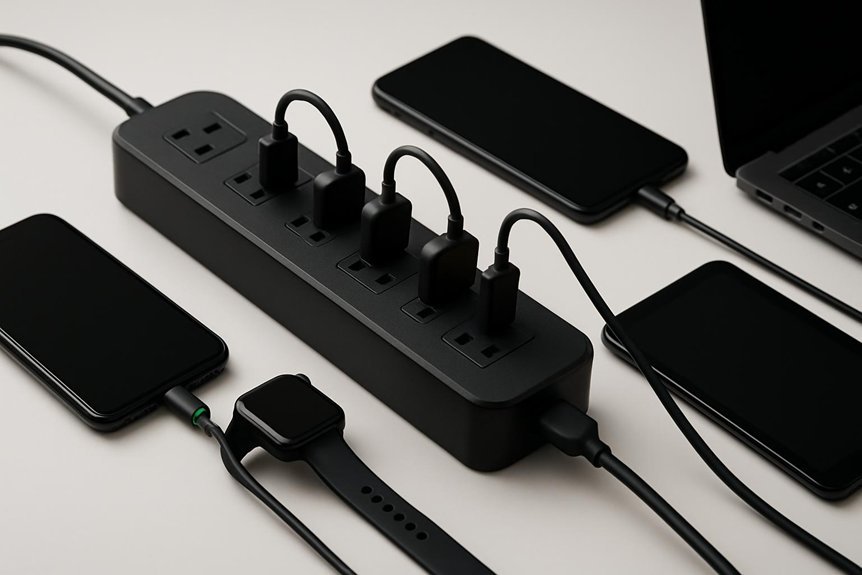
We can estimate your power strip’s real capacity by converting its labeled wattage into the practical time it can sustain a load, using a simple, repeatable method. We measure the rating in watts, convert to amperes if needed, and apply the formula: time (minutes) = (rating in watts) / (load in watts) × 60. This yields a usable, comparable metric for energy budgeting and outlet optimization without guessing. We account for continuous-load safety margins per standards, then adjust for real-world efficiency. The result guides how long a given mix of devices can run before recharging or redistribution is required.
- Establish strip rating and actual load, then compute minutes of operation
- Compare with device runtimes to identify peak demand
- Apply safety margins for continuous use
- Plan future outlets and redistribution steps
Charging Strategies for Phones, Tablets, Laptops, and Wearables
We’ll outline practical charging cadence guidelines and device-specific power tips to optimize performance across phones, tablets, laptops, and wearables. By aligning charger output, battery chemistry, and usage patterns, we can minimize heat, extend lifespan, and maximize readiness. Let’s start with clear, actionable steps for each category and establish a consistent framework for monitoring and adjustment.
Charging Cadence Guidelines
Charging cadence guidelines define how often and how long you should charge devices to optimize longevity and performance. We approach cadence with a disciplined framework that minimizes stress on batteries while meeting daily needs. By tracking cycles, rest periods, and charge slopes, we maintain capability across phones, tablets, laptops, and wearables. We emphasize staying within safe limits to prevent accelerated wear and heat buildup during top-offs and deep discharges.
- Monitor daily usage to set practical charging windows
- Favor partial charges over full, avoiding sustained high current
- Schedule overnight top-ups only when needed, respecting safe limits
- Use calibrated charging profiles to preserve long-term capacity
Device-Specific Power Tips
What’s the most efficient way to charge different devices without compromising longevity? We approach device-specific power tips with a methodical mindset. For phones and tablets, use chargers that match original power profiles and enable temperature monitoring; avoid under- or over-volt charging, and prefer USB-C PD where available. Laptops require higher-current negotiation and compliant adapters; rely on supplied cables and verify firmware compatibility for safe charging. Wearables benefit from low-current, steady profiling to minimize heat; dock or wireless pads should support energy-efficient standby. Always confirm device compatibility before connecting, and limit rapid-charge modes when not necessary. Employ surge protection to guard against spikes and power faults. In all cases, document charging cycles and inspect connectors periodically for corrosion or wear. Continuous monitoring preserves battery health and performance.
Troubleshoot Overloads and Heat for Safe Charging
To troubleshoot overloads and heat during charging, start by isolating the problem: check if the device, charger, or cable becomes unusually hot, and note when the heat starts during use. We approach this with a disciplined diagnostic routine focused on overload prevention and heat management, ensuring measurements are repeatable and outcomes clear. If any component heats beyond normal, swap suspect parts one at a time to pinpoint the culprit, and confirm with a controlled test. Document voltages, currents, and thermal observations to guide corrective actions. After identifying causes, implement targeted mitigations to sustain safe charging.
- Verify charger compatibility with device specifications
- Measure and log charging current at startup and steady state
- Inspect cables for insulation damage or wear
- Replace aging or mismatched components promptly
Step-by-Step Setup to Balance Your Devices Safely
We’ll apply the lessons from troubleshooting overloads to a careful, step-by-step setup that keeps all devices balanced and charging safely. We begin by enumerating power needs for each device, listing wattage and current draw, then pairing them with a dedicated port or circuit that matches or exceeds those specs. Next, we implement a centralized charging plan: group high-draw devices separately, use a single high-capacity hub, and route cables to avoid thermal hotspots. We verify outlet ratings, install surge protection, and enable automatic shutoff on fault conditions. We monitor temperature during initial use, adjust ports to maintain even distribution, and document every change. balance safety is maintained through disciplined sequencing, while efficiency tips focus on minimizing idle power and maximizing stable charge.
Frequently Asked Questions
Can I Charge Devices From Multiple Rooms at Once?
We can charge devices from multiple rooms at once, provided we manage energy distribution carefully and adhere to safety standards. We implement a centralized charger layout, monitor demand, and follow two word discussion ideas, energy distribution, and safety standards.
Do USB-C PD Chargers Count Toward Load Limits?
We answer: yes, USB-C PD counts toward load limits. We, as a system, monitor charging simultaneity with precise, methodical checks to guarantee device safety; USB C PD contributions are included in total draw, preventing overloads and safeguarding equipment.
Is Charging Overnight Safe for All Devices?
We answer: yes, charging overnight can be safe for all devices if you use a quality smart charger and a timer, ensuring device safety and energy efficiency, and monitoring heat, battery age, and charger temperature during the process.
How Do Power Outages Affect Simultaneous Charging?
We answer: power outages disrupt charging efficiency and raise safety concerns due to unstable voltages; during outages, we mitigate risks with surge protection, rated adapters, and uninterrupted monitoring, maintaining charging efficiency while addressing safety concerns for connected devices.
Can Wireless Charging Pads Share Power With Cables?
We can’t have wireless charging pads share power directly with cables; wireless sharing depends on mutual compatibility. We’ll test cable compatibility, verify regulators, and monitor current flow to guarantee safe, efficient power delivery during mixed charging setups.
Conclusion
We’ve mapped the current, weighed the wattage, and planned the ports like a precise blueprint. Each device finds its place, currents balanced, heat kept in check, and margins carved for safety. When a device hums louder, we stagger the charge or reroute a port, keeping the system cool and predictable. In this quiet orchestration, power becomes predictable confidence—our safe charging cadence, step by methodical step, guiding every device to wake recharged and ready.