Ad Blocker Detected
Our website is made possible by displaying online advertisements to our visitors. Please consider supporting us by disabling your ad blocker.
We’ll outline the output ports you’ll encounter on portable power stations, from AC outlets and USB-C PD to USB-A, 12V car ports, DC barrels, and wireless options. We’ll note wattage, waveform, and per-port limits, plus how multiple ports share load and how to match protections and derating to devices. This framework helps us evaluate interoperability and reliability across loads. There’s more to think about beyond this, and it directly informs how you’ll configure for your use case.
Key Takeaways
- USB-C PD ports support negotiated voltage (5–20V) and higher current for fast, flexible charging and power delivery.
- USB-A ports provide standard fixed-output charging, typically lower wattage and no negotiation.
- AC outlets deliver pure sine-wave power (often 100–1000W range) for household devices and appliances.
- 12V DC carports and direct DC outputs enable direct connection to automotive-style loads with minimal conversion.
- Specialty and wireless interfaces include Qi wireless charging, high-current DC barrels, and ruggedized/variant ports for niche devices.
Common Output Ports on Portable Power Stations
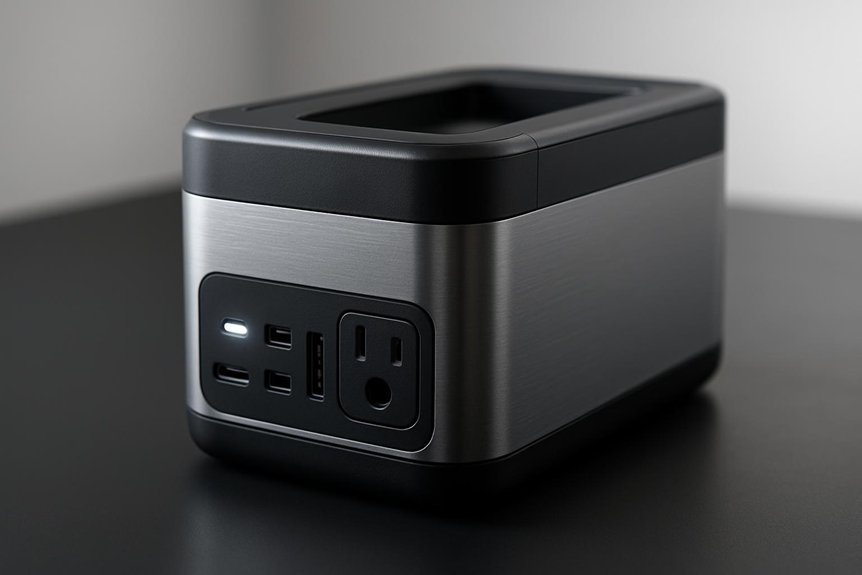
What output ports are typically found on portable power stations? We document common port types with precise definitions and standardized labeling to reduce ambiguity for users and integrators. In our assessment, AC outlets provide alternating current with defined voltage and frequency envelopes, while DC barrels, 12V automotive-style, and USB-C/USB-A ports deliver direct current at specified current limits. We discuss power ratings, peak and continuous current, and safety features such as overcurrent, short-circuit, and thermal protections aligned with industry standards. Concept limits appear where port counts and maximum total output constrain system design, guiding topology decisions. Port aesthetics are considered for maintainability and labeling, ensuring clear port groups and standardized color codes. This framing supports reproducible interoperability and predictable performance across models.
USB-C: How PD Enables Fast Charging
We’ll outline USB-C PD basics and how power delivery enables fast charging on portable power stations. By aligning PD negotiation, voltage/current profiles, and USB-C/FUSB-C standards, we show how host capability and device requests determine charging rates. This discussion establishes the framework for practical fast-charging performance and compatibility considerations.
USB-C PD Basics
USB-C Power Delivery (PD) is the standard that enables faster, flexible charging over USB-C by dynamically negotiating voltage and current between source and sink. We describe PD basics to establish interoperability guidelines, voltage profiles, and current limits that devices must support to maintain safe operation. PD uses USB Power Delivery Controller logic, placeholding role negotiation, and contract formation to set a shared voltage (e.g., 5–20 V) and wattage ceiling. We emphasize role reversal, cable integrity, and protection mechanisms for overvoltage, overcurrent, and thermal conditions. Our focus remains on practical implementations, including device detection, orientation-agnostic connectors, and cable certifications. USB c strategies inform how we balance performance with portability tradeoffs while preserving compatibility across ecosystems and adhering to USB-IF standards.
Fast-Charging With PD
Fast-Charging With PD leverages USB-C Power Delivery to push higher voltages and currents beyond standard USB charging, enabling much shorter fill times for portable power stations. We outline PD safeguards, negotiation, and role of USB-C connectors in delivering configurable profiles from 5 V up to 20 V, with current levels up to 5 A. Our focus remains on compatibility, cable quality, and device advertising data, ensuring predictable thermal and electrical behavior. PD implements contract-based power rules that adjust V and A based on device capability, cable rating, and source limits, safeguarding components and extending lifecycle. We emphasize standards conformance, ESR considerations, and EMI awareness while avoiding overspecification. Two word ideas: unrelated topic, off topic. This framing keeps charging efficiency and interoperability at the forefront.
USB-A Vs USB-C PD: What Matters for Compatibility
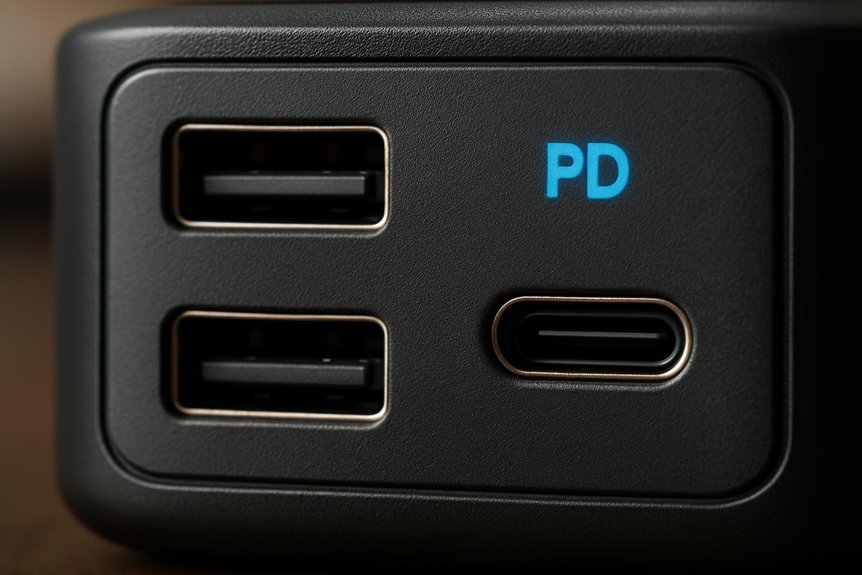
We compare USB-A limitations with USB-C PD benefits to clarify compatibility across ports and devices. We’ll emphasize how USB-A’s signaling and power bounds constrain accessories, while USB-C PD enables higher wattage and standardized negotiation for varied loads. Our focus is on compatibility essentials for ports, ensuring readers grasp the practical implications for portable power stations and connected gear.
USB-A Limitations Explained
While USB-C PD has become the standard for higher power and negotiated profiles, USB-A ports still impose concrete limitations that affect portable power stations. We identify bottlenecks in current USB-A implementations, including fixed voltage rails, non-negotiated current when multiple devices share a port, and limited power profiles that constrain rapid charging. These constraints influence usable payloads for consumer devices and demand careful system design for load prioritization, heat management, and cable quality. In practice, the relevance of USB-A rests on compatibility, not performance, and often leads to off topic debates about irrelevant topic expectations. Our assessment emphasizes predictable behavior, documented current limits, and safe, standards-aligned operation for mixed-device scenarios.
- Fixed voltage/current boundaries and lack of dynamic negotiation
- Shared-port current allocation impacting multi-device loads
- Thermal and cable-signal integrity considerations under high draw
USB-C PD Benefits
USB-C PD offers clear advantages in power negotiation, efficiency, and device compatibility by enabling dynamic voltage and current profiles that adapt to each load. We, as reviewers of port implementations, examine how PD negotiates across power envelopes, enabling higher wattage delivery with controlled rise times and error handling per USB-C and USB PD specifications. This enables safer power routing, reduced thermal impact, and streamlined cable coordination, with vendors reporting consistent performance across devices. Discussion ideas: USB C optimization, PD benefits. In practice, PD’s structured handshake facilitates multi‑step contract settlement, supporting profiles from 5V to 20V and current limits up to 5A, while maintaining interoperability through standard messages and BIST checks. Consequently, portable power stations can support diverse peripherals without resorting to proprietary adapters, preserving gateway compatibility and lifecycle efficiency.
Compatibility Essentials for Ports
Port compatibility hinges on how USB-A and USB-C PD implement power negotiation, signal integrity, and port behavior under load. We examine negotiation profiles, current capabilities, and connector-side impedance to ensure safe, predictable charging and data behavior. Our focus centers on two word discussion ideas and irrelevant subtopic dynamics, translating standards into practical expectations for portable power stations. By aligning USB-A legacy limits with USB-C PD profiles, we guarantee consistent voltages, protected power paths, and responsive device recognition. We emphasize compliance with IEC/IEEE, USB-IF, and PD tunneling specifics to avoid bottlenecks and cross-border variation.
- Interaction models: eligibility, priority handling, and fallback behaviors
- Compatibility metrics: ripple, load response, and cable impedance considerations
- Implementation caveats: irrelevant subtopic traps and cross-standard misinterpretations
AC Outlets: Wattage and Waveform You’Ll Get
AC outlets on portable power stations vary in wattage and waveform, so understanding these specs helps ensure compatible devices and safe operation. We summarize typical ratings and waveform characteristics to guide selection, performance limits, and safety margins. Our emphasis is on standardized outputs, device compatibility, and practical derating guidelines for continuous use.
| Attribute | Practical impact |
|---|---|
| Wattage range | Supports ranges from 100W–1000W, matching consumer loads |
| Waveform type | Pure sine wave preferred for sensitive electronics |
| Surge capacity | Accommodates brief higher loads to start motors or compressors |
| Certification | Look for UL/ETL or equivalent compliance |
Two word discussion ideas: portability aesthetics, warranty implications.
12V DC Car Ports: When You’D Use Them and Their Limits
We’ll start with the practical role of 12V DC car ports in portable power stations: they supply direct current for automotive-style loads and certain low-power devices without power conversion overhead. In our assessment, these ports serve as direct-seat interfaces for equipment that tolerates 12V nominal, maximizing efficiency and minimizing heat. Limits arise from current rating, potential voltage drop, and battery management constraints, which affect sustained use and device compatibility. For a portable battery system, 12V ports enable rapid access to automotive devices, low-draw tools, and essential accessories, provided we respect manufacturer specifications and safety interlocks. We also consider charging speeds when powering ancillary equipment from the main pack, ensuring the system maintains usable capacity under load.
- Current rating versus load profile for 12V devices
- Compatibility notes for automotive-style accessories
- Impact on overall charging speeds and runtime
Wireless Charging Pads and Specialty Ports
Are wireless charging pads and specialty ports worth the added complexity in a portable power station? We assess integration criteria, alignment with standards, and interoperability. Wireless charging implements Qi-compatible receivers and transmitter alignment, minimizing contact mechanical wear while preserving IP-rated enclosure integrity. We evaluate coil placement, ferrite shielding, and thermal management to maintain performance within specified efficiency and standby loss limits. Specialty ports encompass niche or ruggedized connectors, Universal Serial Bus variants, and high-current or high-voltage interfaces with defined pinouts and latching mechanisms. Our approach favors documented electrical characteristics, EMI/EMC compliance, and qualified connector materials. In practice, wireless charging and specialty ports are justified when they enable essential device compatibility, reduce user steps, and meet certified safety and reliability criteria without compromising overall system integrity.
Understanding Power Ratings: Watts, Amps, and Per-Port Limits
We’ll outline the key efficiency and safety considerations by clarifying wattage limits and per-port current specifications. We’ll connect wattage ceilings to per-port amperage ratings to show how total and individual outputs constrain device compatibility. We’ll also highlight how these metrics guide load management and compliance with applicable standards.
Wattage Limits Explained
How much power can you draw from a portable power station, and how is it limited per port? We describe wattage limits using standardized terms: total continuous power, per-port maximum, surge allowances, and derating under thermal load. Watts translate into amperage at a given voltage, with per-port labels reflecting actual permissible current during peak vs. sustained use. Hidden limitations include internal thermal throttling, cable resistance, and connector ratings that cap real-world performance. Missed connections between spec sheets and real operation occur when peak draws coincide with multiple ports. We emphasize a clear hierarchy: total system rating first, then per-port, then transient surge. By design, manufacturers publish both continuous and peak values to prevent overload and ensure safe operation, with documented derating curves for ambient conditions.
- Consistent total vs. per-port ratings help prevent overload
- Thermal derating and surge allowances drive practical limits
- Documentation gaps can mask hidden limitations and missed connections
Per-Port Current Details
Per-port current caps determine how much continuous and peak load a single output can safely handle, independent of the total system rating. We present per-port isolation as a key design control, ensuring that fault conditions or overloads on one channel do not propagate to others. Currents are specified in amps with explicit duty-cycle and ambient-temperature assumptions, aligning with IEC and UL guidance for portable power stations. Thermal considerations drive derating curves, so allowable current decreases with rising case or ambient temperature and sustained use. Peak surge specifications, usually at 0.5 to 1 second, differ from continuous ratings and are managed via protective trip thresholds. We emphasize measurement practices, traceable labeling, and documentation that clarifies port-specific limits, ensuring predictable, standards-compliant operation.
How Multiple Ports Share Load: Prioritization and Management
In portable power stations, multiple output ports share the available power based on load-splitting algorithms that prioritize essential circuits and demanded currents. We implement load balancing and power prioritization to optimize battery usage, preserve critical loads, and prevent overcurrent events. Our management framework allocates headroom to high-priority devices while throttling nonessential outputs within safe limits, ensuring stable voltage rails and thermal margins. Real-time monitoring detects load shifts, recalibrating allocations to maintain system integrity. Standards-aligned control loops rely on measured currents, port ratings, and fault protections to enforce safe distribution. This approach minimizes voltage sag, reduces peak demand, and extends runtime for mission-critical components.
Prioritized load balancing preserves critical loads while optimizing runtime and safety.
- Prioritization rules for essential vs. nonessential loads
- Dynamic reallocation in response to changing demands
- Safeguards: overcurrent, thermal, and short-circuit protections
Port Compatibility Tips: Matching Devices to the Right Port
When selecting a port for a device, we verify compatibility by matching electrical specifications, connector type, and current/voltage requirements to the port’s rated capabilities. We then confirm knot-point compatibility across standard interfaces (USB-C PD, USB-A, DC barrel, AC, and high-amperage prongs) and ensure the device’s communication/negotiation protocols align with the power station’s port controller. We prioritize current rating, voltage tolerance, and peak surge handling, applying manufacturer-recommended derating as applicable. We assess cable durability and connector mating cycles to minimize wear. We also evaluate port redundancy options to maintain, if needed, alternate pathways without compromising safety. Documentation adherence, including polarity, shielding, and safety certifications, guides final selection. This disciplined approach reduces misconnect risk and preserves port integrity during long-term use.
Planning Port Configurations for Common Use Cases
We can optimize port configurations to cover the most common use cases with minimal risk and maximal interoperability. We approach planning with a systems view, aligning port counts, types, and sequencing to anticipated loads, runtimes, and safety margins. We quantify backup capacity needs, prioritize universal standards, and define swap-ready pathways that preserve performance across devices. Our configuration model emphasizes lifecycle management, thermal envelopes, and EMI considerations to sustain silent operation under typical workloads. We document interface hierarchies to minimize adapter dependencies and simplify field service. Adherence to common charging protocols and power budgets reduces risk of incompatibilities while preserving future scalability. This disciplined approach ensures predictable behavior, reproducible results, and interoperability across ecosystems.
- Standardized port tiering and labeling for rapid diagnostics
- Redundancy planning that preserves backup capacity without compromising efficiency
- Ingress/egress impedance and thermal limits to sustain silent operation
Frequently Asked Questions
Do Portable Power Stations Support Solar Input Alongside Ports?
We can confirm portable power stations support solar input alongside ports, offering portable solar charging via MPPT or PWM regulation, enabling input versatility. We emphasize compatibility with standard panels, ensuring safe diode protection and optimum charging efficiency across ranges.
Can USB-C Ports Deliver Power Delivery While Others Charge Simultaneously?
Yes, USB-C PD can deliver power while other ports charge concurrently. We support USB C PD, plus DC 12V outputs, with independent regulation and simultaneous operation to optimize device charging and system efficiency.
How Do Port Limits Change Under High-Temperature Conditions?
Under a blazing sun, we note that high temperature performance tightens output port limits. We, as engineers, quantify derating curves, monitor thermal impedance, and document current, voltage, and port-specific specs to assure safe, compliant operation under heat.
Are There Ports That Auto-Detect Connected Device Protocols?
We do not mandate auto-detect protocols on standard port types; devices typically rely on fixed electrical specs. However, some models implement auto-detect protocols for specific data or smart charging ports, enabling dynamic negotiation with connected devices.
Do Handheld Devices Require Adapters for Certain 12V Ports?
We say: handheld devices often require adapters for certain 12V ports to match connector standards and voltage tolerances, ensuring safe operation; we recommend portable power stations provide compatible handheld adapters and clearly labeled 12V ports for rapid, compliant use.
Conclusion
We’ll summarize with a tight, standards-aligned focus: portable power stations offer a spectrum of output ports—AC outlets (generally 100–1000 W with pure sine wave and surge), USB-C PD for high-wume negotiation, USB-A for legacy devices, 12 V DC car ports, DC barrel outputs, and wireless options. An interesting stat: many units report simultaneous USB-C PD and AC draw limits, highlighting per-port derating—typically 20–30% of total rated power during peak multi-port use. Plan loads to avoid overloads and respect per-port specs.