Ad Blocker Detected
Our website is made possible by displaying online advertisements to our visitors. Please consider supporting us by disabling your ad blocker.
LIBRIDS C600 Portable Power Station: Product Overview
Does a compact 640Wh power station with 600W output provide dependable backup for camping, travel, and home outages? The LIBRIDS C600 portable power station looks well suited to modest loads rather than whole-home emergency power, combining four AC outlets, eight total output ports, UPS functionality, and a LiFePO4 battery in a relatively compact unit. At the listed price of $399.99 in 2026, it deserves consideration from shoppers who need flexible power for electronics, lighting, communications equipment, or selected medical devices, but its 600W continuous ceiling sets a clear boundary.
The manufacturer lists the C600 as a 640Wh portable power station with a five-year limited warranty. Intended uses include lights, fans, cameras, laptops, projectors, Wi-Fi equipment, CPAP machines, security systems, and small refrigerators. Those examples describe the type of equipment the unit is designed to support, not a promise that every appliance will run for a particular number of hours.
The listing currently shows only units left in stock, although availability can change and shouldn’t be the main reason to buy. We would separate the published specifications from real-world performance: capacity, output, recharge claims, UPS response, and cycle life come from the product description, while dependable runtime, fan behaviour, appliance compatibility, and charging experience require customer evidence or hands-on testing.
Because no customer rating or review count was supplied with the listing information for this review, we won’t invent a score or attribute experiences to buyers. Our assessment therefore focuses on the documented design and the checks we recommend before relying on the LIBRIDS C600 portable power station during an outage.

Key Specifications and Everyday Portability
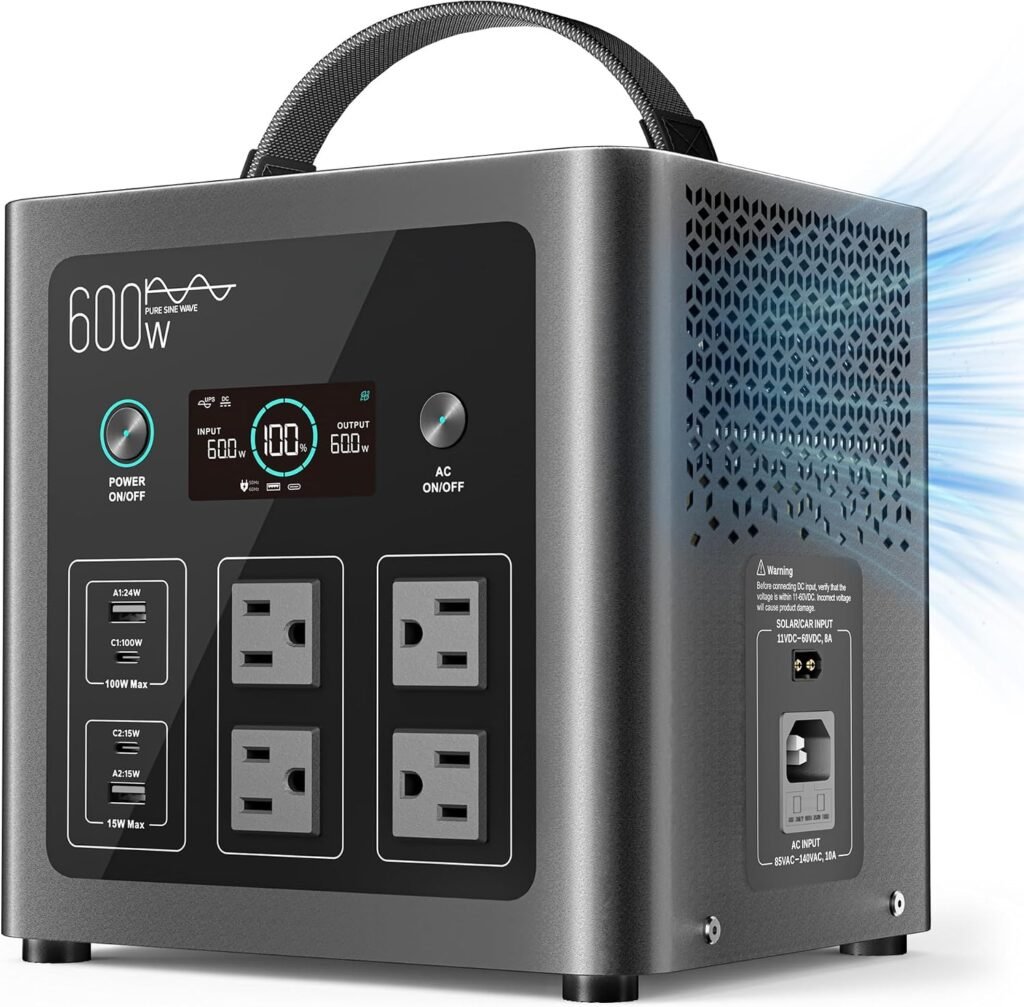
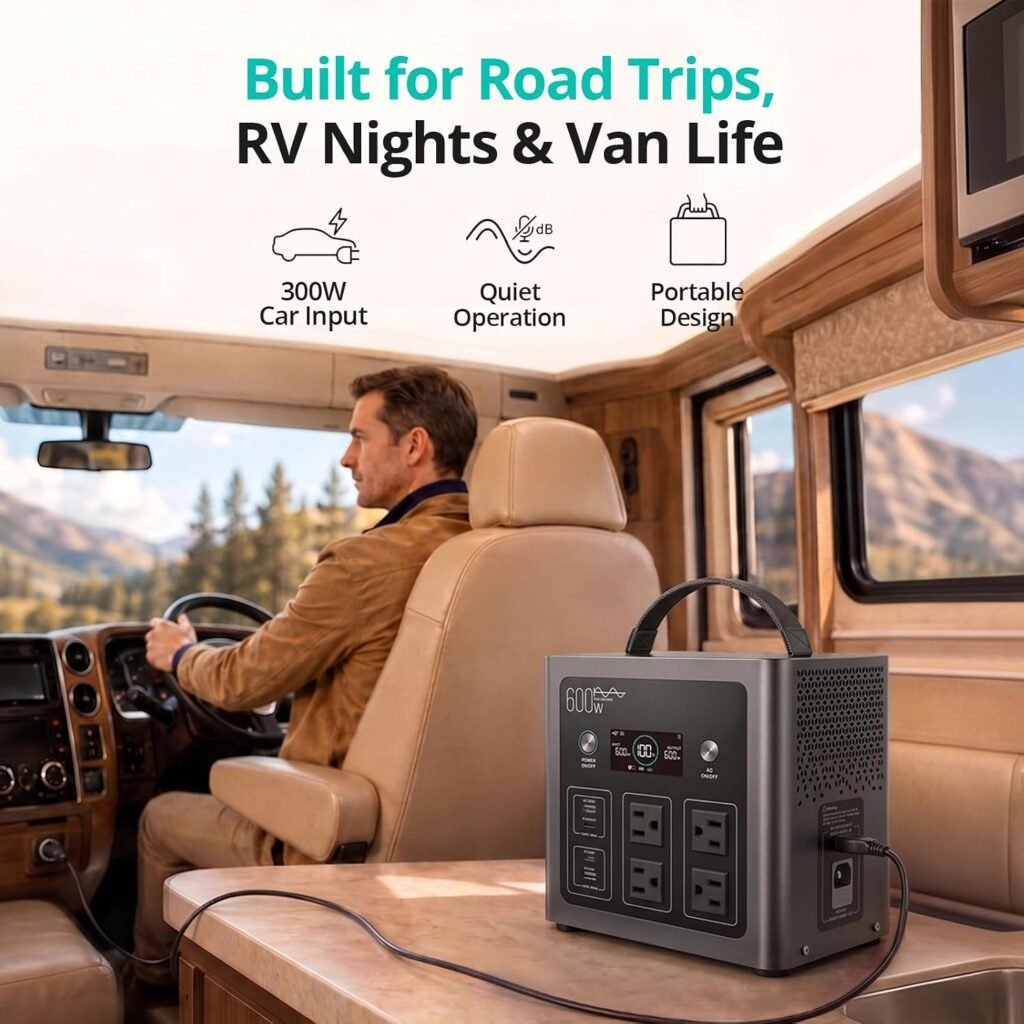
The C600 measures 8.1 × 7.1 × 8.3 inches and weighs 16.3 pounds. That is roughly soccer-ball-sized, so it should fit more easily than a large power station in a car trunk, RV storage area, closet, campsite kit, or emergency supply cupboard. It is compact enough for short-distance transport, but 16.3 pounds is still substantial if we have to carry it over a long trail or between several campsites.
An integrated carrying handle makes the unit easier to lift without needing a separate case. The reinforced metal housing is intended to provide protection against ordinary bumps, accidental drops, and outdoor handling. In practice, that design should help with transport and storage, though metal construction doesn’t make the station waterproof or immune to impact damage. We would still keep it dry and avoid placing heavy equipment on top.
The stated 640Wh capacity describes the energy stored in the battery, not the exact energy every connected device will receive. Conversion losses, device wattage, inverter efficiency, battery condition, temperature, and simultaneous loads all affect operating time. A lower-wattage router and LED light will place a very different demand on the station from a refrigerator compressor or projector.
The LCD is useful for planning because it displays battery percentage, input power, output power, estimated charging time, and estimated runtime. Before a trip or outage, we would write down each device’s rated wattage, add the devices that will operate at the same time, compare the total with the 600W continuous limit, and leave headroom for startup surges. This simple check is more reliable than judging suitability by the battery capacity alone.
600W Output, 1200W Surge, and Eight Ports
The central operating limit is a 600W rated AC output. The listing also gives a 1200W surge rating, which is intended for brief startup demands rather than sustained operation. That distinction matters: a device that starts below 1200W may still draw too much power if its running demand remains above 600W.
Four AC outlets are convenient when several low- or moderate-wattage devices need power together. We could connect a laptop, LED lights, a camera charger, and a router without using a mains extension board, provided their combined demand remains within the station’s limit. More outlets improve convenience; they do not increase the total available wattage. Connecting four appliances does not create four separate 600W supplies.
The product description confirms eight versatile output ports in total, including four AC outlets. It does not provide enough detail here to identify every remaining port type or unspecified USB ratings, so shoppers should inspect the live listing and manual before buying cables or planning a particular DC setup. We would not assume a port’s charging speed or voltage without confirmation.
For load planning, we would take four steps:
- Record the running wattage printed on each device or its power adapter.
- Add only the loads that will run simultaneously.
- Keep that total below 600W, with extra room for motors and compressors.
- Check startup requirements separately for refrigerators, pumps, heaters, kettles, hair dryers, and power tools.
A laptop, router, camera charger, and efficient lighting are sensible examples. Heating appliances, cooking equipment, air conditioners, and many power tools can exceed the ceiling or produce difficult startup surges, making them poor matches even when they appear to operate briefly.
10ms UPS and Pure Sine Wave AC Power
The advertised 10ms UPS switchover is aimed at keeping selected equipment powered when mains electricity fails. A near-instant transition can matter for Wi-Fi routers, computers, NAS devices, security systems, televisions, and small servers, where even a brief interruption may cause a reboot or disconnect. The C600 also uses a pure sine wave AC output, which is designed to provide cleaner power for sensitive electronics, regulated power supplies, and equipment containing motors.
A 10ms claim should not be treated as universal compatibility. Different devices respond differently to transfer time, grounding, power quality, and UPS operating modes. Before depending on the LIBRIDS C600 portable power station for work or security equipment, we would test the exact device rather than assume that the advertised response will prevent every interruption.
Our recommended test is straightforward:
- Charge the station fully from a wall outlet.
- Connect one essential device and confirm that it operates normally.
- Simulate a brief outage by disconnecting the station from mains power while leaving the device connected.
- Watch for a reboot, warning tone, flicker, or loss of network connection.
- Check the LCD for output power and remaining runtime.
This makes the unit a possible backup for selected electronics, not a whole-home solution. A 600W station cannot replace a large home battery or fuel generator for heating, cooking, air conditioning, or multiple major appliances. For a router, computer, security hub, or modest communications setup, however, pure sine wave output and UPS behaviour are useful features if the specific equipment passes testing.

Charging Options and the 1.5-Hour Recharge Claim
The listing identifies four recharge methods: AC wall charging, solar charging through an XT60 connection, car charging, and a gas generator. It also advertises a full recharge time of as little as 1.5 hours. That is a best-case claim, not a guaranteed result for every input method. Actual time depends on the source, available input power, battery state, temperature, charging limits, and whether devices are drawing power at the same time.
Combined AC and solar charging could reduce preparation time when compatible equipment and suitable sunlight are available. Solar performance is especially dependent on panel output, orientation, shade, weather, and the station’s accepted input range. Car charging is useful on a road trip but generally shouldn’t be assumed to match a high-power wall recharge unless the vehicle and cable provide the required input.
We would prepare the unit before relying on it:
- Perform a full recharge from a wall outlet.
- Inspect the included AC charging cable for damage and confirm that it fits securely.
- Verify the solar-panel connector and compatibility before purchasing a panel.
- Test car charging before leaving for a trip.
- Record the starting battery percentage and observe the LCD during each charging method.
The box includes the power station, one AC charging cable, and a user manual. A solar panel is not listed as included, so solar users need to budget separately for compatible equipment. We would also avoid treating the 1.5-hour figure as evidence that a panel or vehicle will recharge the station that quickly; the input method must be evaluated on its own.
LiFePO4 Battery Life and Long-Term Ownership
The C600 uses what the listing calls automotive-grade LiFePO4 battery cells. The published claim is more than 4,000 charge cycles while retaining over 80% of original capacity, with a potential service life of up to 10 years under normal use. These figures give the LIBRIDS C600 portable power station a long-term ownership focus, particularly for people who expect regular camping, travel, or backup use rather than a one-time emergency purchase.
Cycle figures are not a fixed guarantee of lifespan. Depth of discharge, ambient temperature, charging habits, storage conditions, and how often we use the station all affect degradation. A cycle rating also needs context: repeatedly draining the battery nearly empty is a different workload from using a smaller portion of its capacity and recharging it more frequently.
To protect the battery, we would store the unit in a dry location with moderate temperatures, avoid leaving it fully depleted, inspect the charge level periodically, and follow the manual’s storage instructions. We would also give the station time to cool after heavy use before packing it away. Extreme heat, freezing conditions, moisture, and long-term neglect are avoidable risks.
LiFePO4 chemistry is generally positioned for long-cycle use compared with older battery chemistries, but we shouldn’t claim a specific lifespan advantage beyond the figures supplied for this model. The five-year limited warranty reduces perceived ownership risk, though shoppers should read its terms, exclusions, coverage conditions, and support process. Keep the purchase record and contact the seller promptly if charging, output, or battery behaviour becomes abnormal.
What Customers Are Saying
The supplied listing information does not include a customer rating, review total, or visible buyer comments. Consequently, we cannot responsibly say that many buyers praise the battery life, that several customers report slow charging, or that reviewers have confirmed UPS behaviour. Those statements would require evidence that is not present in the material provided.
For this product, the most useful customer evidence would be specific rather than generic. We would look for repeated comments about whether the LCD remains readable outdoors, whether the fan is intrusive, how long charging takes through each input, and whether the metal case withstands ordinary travel. Reviewers should also identify what they powered, because a runtime reported for a router cannot be compared directly with one measured using a refrigerator or projector.
We would separate repeated observations from isolated complaints by checking whether multiple reviewers describe the same test conditions. Particularly useful reports would state:
- The device wattage and runtime.
- Whether several ports were used together.
- Whether a refrigerator, pump, or other motor load started successfully.
- Whether a CPAP humidifier was enabled.
- Whether a UPS-connected computer or router stayed on during a simulated outage.
When the live listing is available, we would compare buyer-reported runtimes with the 640Wh specification while allowing for conversion losses and different loads. We would also flag any repeated gap between the 1.5-hour recharge claim, 10ms UPS response, or 4,000-plus-cycle statement and observed use. A failure to charge, unexpected shutdown, damaged cable, or unsafe heat issue warrants contacting the seller and reviewing the warranty process rather than relying on an isolated review.
Who Should Buy the LIBRIDS C600?
The LIBRIDS C600 portable power station makes the most sense for campers, road-trippers, RV users, photographers, remote workers, and households seeking limited backup for routers, lights, laptops, cameras, and similar modest loads. Its four AC outlets can simplify a mixed setup, while the pure sine wave output and advertised UPS mode are relevant to people protecting communications or computing equipment.
The carrying handle and compact form suit movement from a car to a campsite, RV, office, or room during an outage. We would regard it as a short-distance transport product rather than an extended-hiking companion: 16.3 pounds may become tiring when carried for a long distance with other equipment.
CPAP users should be especially careful. We would check the machine’s running wattage, required overnight duration, humidifier and heated-tube settings, and any manufacturer guidance about UPS operation before relying on the station for sleep or medical support. A CPAP that works during a daytime test may consume considerably more energy with comfort features enabled, so the exact configuration matters.
Shoppers powering heaters, kettles, cooking appliances, air conditioners, high-wattage tools, or several large appliances should consider a larger power station or conventional generator. Our decision process would be:
- Calculate the simultaneous running load.
- Estimate the required runtime and allow for conversion losses.
- Identify whether wall, solar, car, or generator recharge will be available.
- Decide how much portability matters.
- Test whether pure sine wave output and UPS behaviour are essential for the equipment.
LIBRIDS C600 Portable Power Station Value at $399.99 Compared With Alternatives
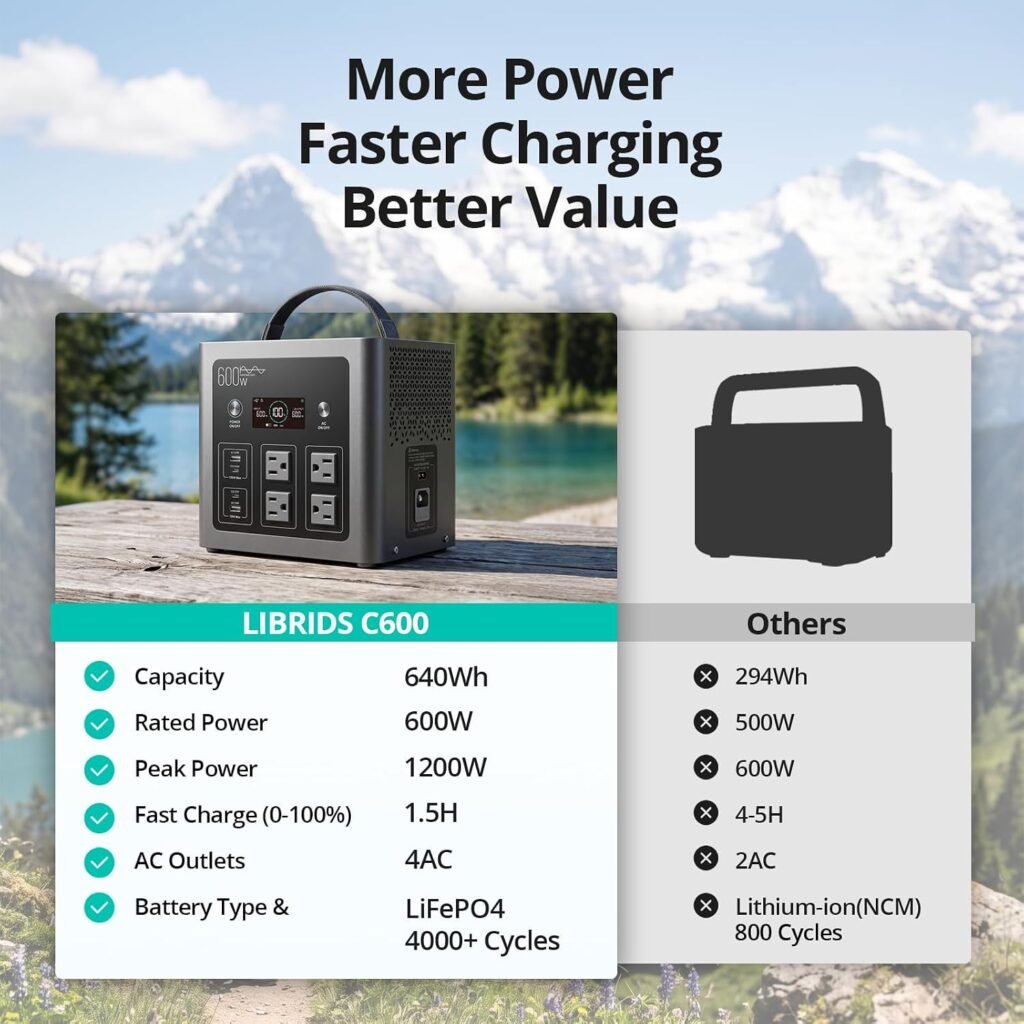
At the listed $399.99, the C600 offers a combination that is attractive on paper: 640Wh of capacity, 600W continuous output, four AC outlets, LiFePO4 chemistry, advertised UPS functionality, reinforced metal housing, and a five-year limited warranty. That package could justify the price for a shopper who values multiple AC connections and a compact form more than app controls or maximum output.
Two named alternatives worth checking are the EcoFlow RIVER Pro and BLUETTI AC70. However, the supplied product data does not provide their current prices, exact warranty terms, live stock status, or a verified like-for-like port comparison. We won’t invent those figures. Before choosing, we would compare each model’s usable capacity, continuous output, surge behaviour, recharge input, battery chemistry, port layout, UPS specification, weight, warranty, app support, and included accessories.
Headline watt-hours alone can mislead. A larger battery may be less useful if its inverter cannot run the intended appliance, while a faster-charging model may be more practical when an outage is brief. We would also confirm whether a rival includes a solar cable or only a wall charger, since adding accessories changes the real purchase cost.
The C600’s four AC outlets and compact footprint may be compelling for several small electronics. A competing model may offer better value if we need app monitoring, a higher output ceiling, a larger battery, or a more established support network. For purchasing, verify the live $399.99 price, stock status, warranty terms, and box contents before ordering because all can change.
How to Set Up the LIBRIDS C600 Safely
We would start by unpacking the station, reading the manual, and checking that the power unit, AC charging cable, and documentation are present. Charge it from an AC wall outlet before an important trip or outage, then inspect the LCD for battery percentage, input power, output power, estimated charging time, and estimated runtime.
Next, connect one low-wattage device and confirm that the relevant output works normally. Add equipment one item at a time rather than connecting a full load immediately. Keep the combined rated running load below the station’s 600W limit, and treat the listed 1200W surge figure only as brief startup allowance—not as continuous capacity. Motors, compressors, pumps, and tools deserve particular caution because their startup demand can be higher than the number printed for normal operation.
During use, place the unit on a stable, dry surface with ventilation around it. Protect it from rain, splashes, extreme temperatures, and direct exposure to conditions outside the manual’s guidance. Route cables carefully so nobody can trip over them, and avoid covering the housing while the inverter or charger is working.
Before an emergency, test each essential device and simulate UPS operation rather than discovering compatibility problems during an outage. Our final buying framework is simple: match the actual load and required runtime first, then assess recharge access, portability, battery longevity, warranty, customer evidence, and the price. The LIBRIDS C600 portable power station is most convincing when those requirements stay within its modest output class.
Pros and Cons
Pros
- 640Wh capacity with a 600W continuous AC output and 1200W listed surge rating
- Four AC outlets and eight total output ports for mixed device setups
- LiFePO4 battery rated for more than 4,000 cycles while retaining over 80% capacity
- Advertised 10ms UPS switching and pure sine wave AC output
- Compact design with integrated handle, reinforced metal housing, and five-year limited warranty
Cons
- The 600W continuous limit rules out many heaters, kettles, cooking appliances, air conditioners, and high-wattage tools
- A solar panel is not included, despite solar charging being one of the listed recharge methods
- The 1.5-hour recharge claim depends on input conditions and should not be assumed for solar or car charging
- No customer rating, review count, or buyer testing data was supplied to verify runtime, noise, UPS behaviour, or appliance compatibility
- At 16.3 pounds, it is better for short-distance transport than extended hiking
Final Verdict
Key Takeaways
- The C600 combines 640Wh capacity, 600W continuous output, four AC outlets, pure sine wave output, and an advertised 10ms UPS mode.
- Its compact design is practical for cars, RVs, campsites, and emergency storage, but the 600W ceiling limits suitability for heaters, cooking appliances, air conditioners, and many power tools.
- The 1.5-hour recharge, 1200W surge, 4,000-plus-cycle, and 10ms UPS figures are manufacturer claims that should be checked against the exact equipment and charging setup.
- A solar panel is not listed as included, and no customer rating or review count was supplied for this assessment.
- At $399.99, the C600 is worth considering when four AC outlets, LiFePO4 longevity, portability, and a five-year limited warranty match the buyer’s actual load requirements.
Frequently Asked Questions
Can the LIBRIDS C600 run a refrigerator?
It may run a small refrigerator if the appliance’s normal demand and compressor startup surge are compatible with the station’s 600W continuous and 1200W surge ratings. Check the refrigerator’s specifications and test it before relying on it during an outage.
Does the LIBRIDS C600 include a solar panel?
No solar panel is listed in the supplied box contents. The station supports solar input through an XT60 connection, but a compatible panel and any required accessories should be budgeted separately.
Is the LIBRIDS C600 suitable for CPAP use?
It may be suitable, but CPAP users should check the machine’s wattage, required runtime, humidifier settings, and manufacturer guidance about UPS operation. Test the exact overnight configuration before depending on it.
How quickly does the C600 recharge?
The manufacturer advertises a full recharge in as little as 1.5 hours. Actual time varies by charging method, input power, sunlight, battery condition, temperature, and whether connected devices are drawing power.
What warranty comes with the LIBRIDS C600?
The product description states that a five-year limited warranty backs the purchase. Review the warranty terms, exclusions, registration requirements, and support procedure before ordering.