Ad Blocker Detected
Our website is made possible by displaying online advertisements to our visitors. Please consider supporting us by disabling your ad blocker.
ANTPO 500W Portable Power Station: Quick Overview
A blackout does not have to stop a laptop, phone, CPAP machine, camera charger, or campsite light, but choosing a power station with enough output and usable battery capacity can be difficult. The ANTPO 500W Portable Power Station combines a 512Wh LiFePO4 battery with a 500W continuous pure sine wave inverter and 1000W surge capacity. Based on those supplied specifications, we see it as a promising option for light-to-moderate emergency loads, camping electronics, and small appliances rather than a whole-home backup system.
For buyers, LiFePO4 chemistry, quick AC charging, USB-C power delivery, and a useful runtime display are meaningful differentiators. This unit appears to cover those bases, although several technical details remain unspecified. Our early view is straightforward: it deserves consideration if the live price is realistic and the missing port, solar, and operating details match your intended devices.

What You Get and How the Design Works
The stated package includes the ANTPO power station, an AC charging cable, a car charging cable, and a user manual. Solar charging is advertised, but no solar panel is listed among the included accessories. Unless the current bundle says otherwise, buyers should expect to purchase a compatible panel separately.
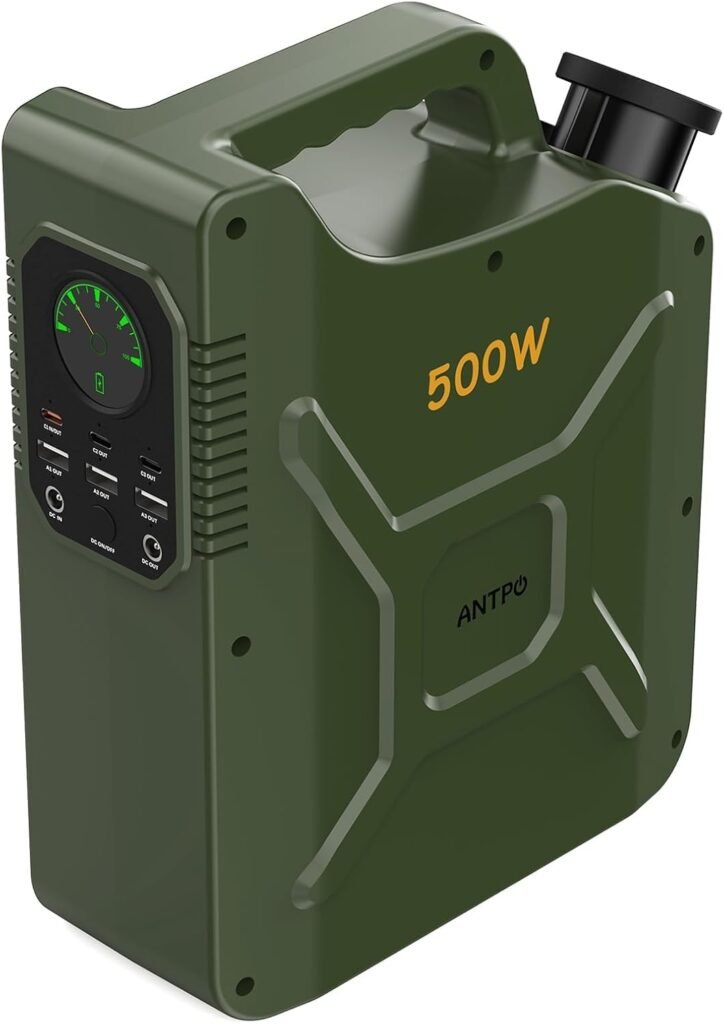
The design is deliberately different from the usual plain rectangular power station. ANTPO describes a retro oil-can or fuel-tank silhouette with a black finish and easy-grip handle. At a stated 13.2 pounds, it should be manageable for moving between a vehicle, campsite, RV, boat cabin, or emergency-storage area, although the distinctive shape may use space less efficiently than a conventional box.
We would set it up before relying on it during an outage. First, unpack the station and inspect the casing, display, outlets, and supplied cables. Next, charge it fully from AC, connect each type of device you expect to use, and confirm that the relevant output activates. Finally, keep the manual with the unit and record any unusual heat, noise, shutdown, or charging behavior.
The supplied information does not state the product’s dimensions, water-resistance certification, LED-light specifications, or operating-temperature range. Those omissions matter for outdoor storage and vehicle use, so we would verify them in the live listing or manual rather than assume the station is weatherproof or suitable for extreme temperatures.
ANTPO 500W Portable Power Station Features in Detail
The inverter is rated for 500W continuously and up to 1000W during startup surges. That distinction is central to device compatibility. A laptop, television, router, camera charger, or lighting setup may sit comfortably below the continuous limit, while a mini-fridge, pump, drill, or other motor-driven appliance can briefly demand much more when its compressor or motor starts.
Pure sine wave output is generally preferable for sensitive electronics because it more closely resembles household AC power than the modified-sine output found in some inexpensive inverters. It is a sensible feature for laptops, chargers, medical equipment, and CPAP machines, but it does not guarantee a particular runtime or ensure compatibility with every medical device. We would follow the device manufacturer’s power requirements.
The description says the station can power up to eight devices at once. That is a connection-count claim, not permission to draw 500W from every outlet. The combined load, plus any startup demand, must stay within the station’s limits, and each individual output may have its own rating that is not supplied here.
Our practical load check is simple:
- Read the wattage or amperage label on every intended device.
- Add the normal running wattages together.
- Allow extra headroom for motors, compressors, and other startup surges.
- Check the manual for the limit of each outlet rather than assuming every socket can provide the full inverter rating.
The product description mentions AC, DC, USB-A, USB-C, and car outputs, along with PD 60W and QC3.0 support, but it does not give the exact number or wattage limit of each port. We would verify the complete port table before purchase.
Battery Capacity, LiFePO4 Lifespan, and Safety
The internal battery is specified at 512Wh, but that figure describes stored battery energy rather than the exact amount delivered to connected equipment. Inverter conversion, cable losses, output electronics, and the station’s own operating needs reduce the energy available at the outlets. For a rough estimate, multiply 512Wh by a sensible efficiency allowance, then divide by the device’s watt draw; use the actual measured draw when possible.
ANTPO claims more than 3,500 charge cycles and a 10-year lifespan for the Grade-A LiFePO4 battery. These are manufacturer claims, not independently verified test results supplied with the listing. LiFePO4 cells are generally valued for long cycle life and good thermal stability compared with many conventional lithium-ion chemistries, but chemistry alone does not remove the need for careful storage and charging.
The built-in Battery Management System is described as providing temperature control, short-circuit protection, and over-voltage protection. We regard those protections as useful safeguards, not a reason to operate the station in rain, enclosed hot spaces, or direct heat. Keep it dry, leave ventilation around the casing, and avoid covering it while it is charging or powering equipment.
For long-term care, we would avoid putting the station into storage completely empty and recharge it periodically. Use the supplied cables where appropriate, inspect them before connection, and stop using the unit if the case swells, becomes unusually hot, smells abnormal, or shows impact damage. Before purchase, we would also check the low-temperature charging limit, pass-through charging behavior, and whether the 24-month warranty covers normal battery-capacity loss.
Charging Speed and Three Recharge Methods
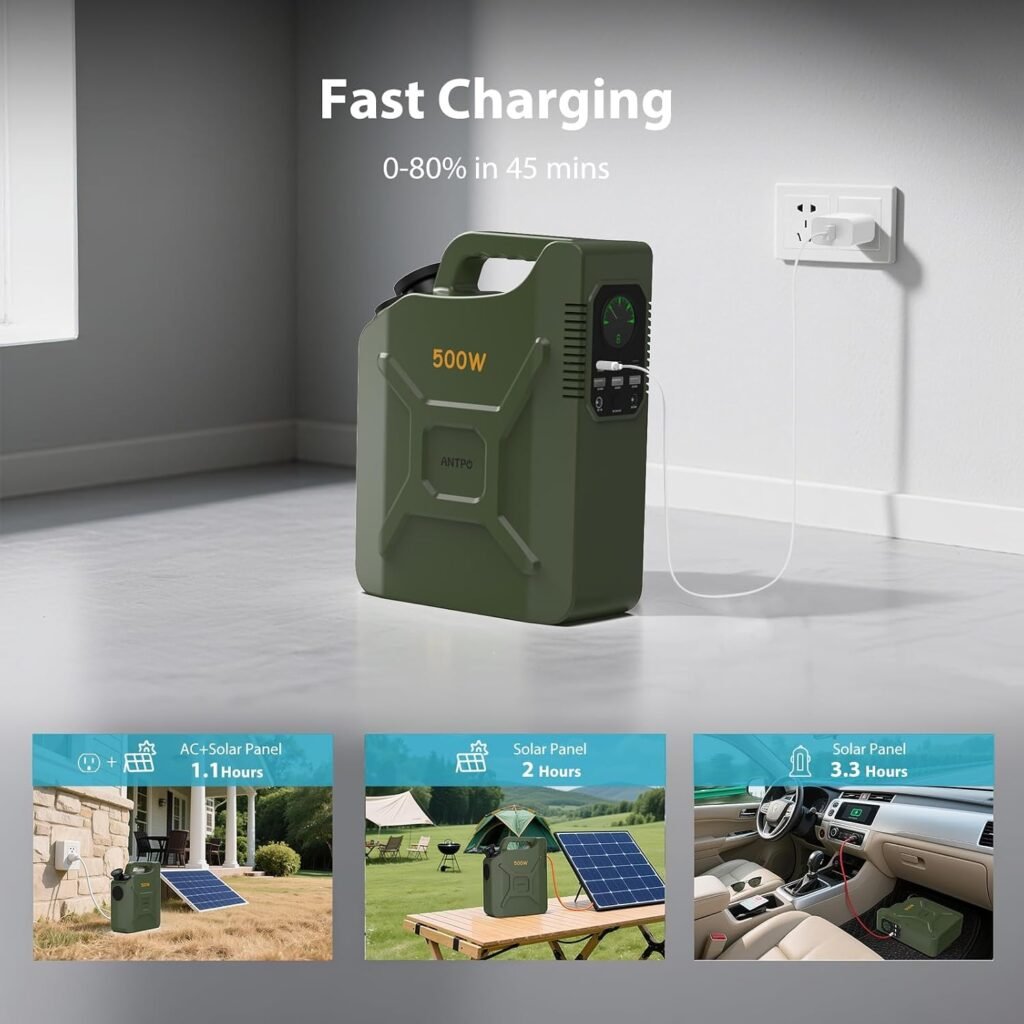
The headline charging claim is a rise from 0% to 80% in one hour through a 500W AC wall outlet. That could be particularly useful before leaving for a trip or after a short outage, since a brief charging window may restore most of the station’s indicated capacity. The final 20% may follow a different charging curve, so we would not assume that a completely empty unit reaches 100% in minutes.
Three recharge methods are advertised: AC wall charging, a 200W solar panel, and a vehicle’s 12V cigarette-lighter port. Solar input is estimated at 8 to hours under suitable conditions. That estimate depends on the panel’s actual output, sunlight strength, panel angle, shading, temperature, connector compatibility, and charging losses. Cloud cover or a poorly positioned panel can make the process considerably slower.
Because the panel is not listed in the stated package contents, we would treat solar capability as an additional equipment requirement unless the active bundle clearly includes one. We would also verify the solar connector type and maximum input before buying a panel.
Our first-use charging routine would be:
- Charge the station from AC until the display indicates full.
- Test every intended output with low-risk devices.
- Measure or observe the draw from one device at a time.
- Test car charging separately, then evaluate solar charging in unobstructed daylight.
Fast input can create additional heat, particularly when the inverter is also working. We would leave clear ventilation around the station during high-speed AC charging and avoid placing it inside a closed vehicle compartment.
Display, Outputs, and Everyday Usability
The easy-read LCD is intended to show current wattage, battery percentage, and estimated remaining runtime. That combination is more useful than a percentage alone: a battery reading of 50% means very different things when the station is powering a 10W router compared with a 60W laptop charger or a compressor that cycles on and off.
During an outage, we would connect the most important device first and observe its live watt draw. We would then turn off unused output groups, compare the estimated runtime with our planned needs, and unplug nonessential equipment before the battery becomes critically low. This approach is more dependable than treating the display’s estimate as a guaranteed countdown, especially when device loads change.
PD 60W USB-C support should be convenient for many phones, tablets, cameras, handheld consoles, and some laptops. However, a 60W port cannot replace a higher-wattage laptop charger for every model. We would compare the computer’s required input with the station’s USB-C specification and use AC output when the laptop needs more power.
Several usability details remain unknown. The supplied description does not say how readable the screen is in direct sunlight, whether outputs switch off automatically, how loud the cooling fan becomes, whether each outlet group has a separate activation button, or whether the display stays lit continuously. Those points are worth checking in the manual and recent buyer feedback before choosing it for a bedroom, tent, or quiet indoor space.

What Customers Are Saying About the ANTPO 500W Portable Power Station
We cannot responsibly summarise a customer consensus because the supplied product data contains no star rating, review count, or individual buyer comments. As a result, we cannot claim that verified buyers praise the battery life, confirm the one-hour charging result, report successful CPAP use, or complain about fan noise. Manufacturer statements should remain separate from customer evidence until the live listing provides that evidence.
When checking the active listing, we would look for repeated comments about straightforward controls, USB-C usefulness, the manageable carrying weight, distinctive styling, and dependable emergency operation. We would also search specifically for reports involving solar input, car charging, unexpected shutdowns, inaccurate runtime estimates, heat, fan noise, damaged packaging, and warranty response.
One isolated failure can have many explanations, while several recent buyers describing the same shutdown or charging problem deserves much more attention. We would read the newest critical reviews first, then compare them with newer positive reviews to see whether a design change or updated batch appears to have altered the experience.
The listing promises a 24-month warranty and lifetime U.S.-based customer service, but we have no supplied customer reports showing how claims are handled. Before committing, we would read warranty-related comments, identify exclusions for battery degradation or accidental damage, and confirm that support is available in the buyer’s region. At present, the customer evidence is insufficient to establish long-term reliability.
Who Should Buy This Power Station?
This model appears best suited to campers, tailgaters, RV users, boat owners, and households wanting short-duration power for essential electronics. Phones, cameras, laptops, lights, routers, chargers, and other modest loads fit the intended use more naturally than heating appliances. The pure sine inverter also makes it more appropriate for sensitive electronics than a basic USB battery bank.
CPAP use needs a careful calculation rather than a simple yes-or-no answer. We would record the machine’s actual watt draw, include inverter losses, account for any heated humidifier or hose, and test the complete overnight setup at home. A CPAP that works from the station in a daytime trial may consume much more with accessories enabled, so the display’s live draw should be monitored.
The ANTPO 500W Portable Power Station may appeal to shoppers who value quick AC replenishment, long claimed LiFePO4 cycle life, and a carry-friendly design more than maximum storage. It is a poor match for an electric kettle, space heater, microwave, hair dryer, air conditioner, or whole-home backup plan; these appliances commonly require far more continuous output than this class provides.
Before ordering, we would write down every device, its normal wattage, its startup wattage if applicable, and the number of hours required. Add the running loads, allow startup headroom, estimate energy use in watt-hours, and compare the result with the 500W output rating and 512Wh battery specification. If the calculation leaves little margin, choose a larger station instead.
ANTPO 500W Portable Power Station vs Alternatives
The EcoFlow RIVER Max and BLUETTI AC70 are sensible names to investigate alongside this model, but a fair comparison requires checking each current listing rather than relying on older specifications. We would compare battery chemistry, capacity, continuous and surge output, solar-input limits, weight, included cables, warranty terms, rating, review count, and current price in the same currency.
Against the EcoFlow RIVER Max, the ANTPO’s apparent strengths are its stated 512Wh LiFePO4 battery, 500W pure sine output, 1000W surge rating, 60W USB-C output, and claimed 0%-to-80% AC charge in one hour. EcoFlow may be more attractive to shoppers who prioritise an established charging ecosystem, app-based monitoring, or more detailed software support, but those competing features and the current price must be confirmed in the active listing.
The BLUETTI AC70 should be examined for output headroom, battery capacity, port selection, solar input, weight, warranty, and purchase price. If its current specification offers substantially more inverter capacity or a broader connection layout, it may suit tools and larger appliances better, though a higher price or heavier body could reduce portability.
We would not declare a winner while the ANTPO listing shows EUR0.00 and provides no verified rating or review count. The right choice depends on whether the buyer values a compact 500W design, software and support maturity, greater solar input, or additional inverter headroom.
Value Assessment and Buying Checklist
The main value drivers are the LiFePO4 battery, the claimed 3,500-plus cycles, 500W pure sine inverter, 1000W surge capacity, fast AC charging, three recharge methods, and advertised 24-month warranty. Against those benefits sit several unknowns: exact port ratings, dimensions, fan behavior, solar connector details, water resistance, low-temperature charging, pass-through behavior, and independent capacity testing.
Our purchase check would be:
- Confirm the live price, availability, delivery terms, and return window.
- Inspect the complete port table and solar-input specification.
- Compare every intended device’s running and startup wattage with the station’s limits.
- Confirm whether the AC and car cables are included and whether a panel is extra.
- Read recent one-star and three-star reviews, especially comments about support and warranty claims.
- Check warranty exclusions for capacity loss, accidental damage, low-temperature use, and accessories.
For runtime, use this formula: usable watt-hours = 512Wh × expected efficiency, then divide usable watt-hours by the device’s wattage. We would use an efficiency allowance instead of assuming the full battery rating reaches the equipment.
After delivery, charge the station by AC, check every output, observe actual device draw, and document any fault with photos or video. That evidence makes a return or warranty conversation easier. Overall, this model deserves consideration for portable electronics and modest emergency loads if the live price and missing technical details check out, but it should not be presented as whole-home backup.
Pros and Cons
Pros
- 512Wh LiFePO4 battery with manufacturer claims of more than 3,500 charge cycles and a 10-year lifespan.
- 500W continuous pure sine wave inverter with 1000W surge capacity.
- Claimed 0%-to-80% AC charging in one hour.
- Supports AC, solar, and 12V vehicle recharging.
- PD 60W USB-C and QC3.0 fast-charging support.
- LCD shows wattage, battery percentage, and estimated remaining runtime.
- Stated 13.2-pound weight and easy-grip handle suit mobile use.
- Advertised 24-month warranty and lifetime U.S.-based customer service.
Cons
- No customer rating, review count, or buyer feedback was provided for reliability assessment.
- Exact numbers and wattage limits for the AC, DC, USB-A, USB-C, and car outlets are unspecified.
- Dimensions, water-resistance certification, LED-light details, fan noise, and operating-temperature range are not supplied.
- The 60W USB-C output may not satisfy laptops requiring higher-wattage charging.
- A compatible solar panel appears to be an additional purchase unless the current bundle states otherwise.
- Manufacturer battery-life and cycle claims are not independently verified in the supplied data.
Key Takeaways
- The unit combines a 512Wh LiFePO4 battery with 500W continuous pure sine output and 1000W surge capacity, making it aimed at electronics and modest loads.
- A claimed 0%-to-80% AC charge in one hour and three recharge methods could be useful for travel and short outages.
- The listing does not supply a customer rating, review count, exact port table, dimensions, water-resistance details, or independent capacity results.
- It is worth considering for portable electronics and carefully calculated emergency use, but not for whole-home backup or high-wattage heating appliances.
Frequently Asked Questions
Can the ANTPO 500W Portable Power Station run a CPAP machine?
The pure sine wave inverter is a sensible match for sensitive equipment, but runtime depends on the CPAP’s actual watt draw, humidifier settings, hose heating, inverter losses, and battery condition. Test the complete setup at home before relying on it overnight.
Does the package include a solar panel?
The supplied package description lists the power station, AC charging cable, car charging cable, and manual. It mentions compatibility with a 200W solar panel but does not list a panel as included, so confirm the active bundle before ordering.
Can it power a microwave or space heater?
Those appliances are generally poor matches for a 500W continuous power station because their heating elements commonly exceed this output class. Check the appliance label and startup requirements rather than relying on the number of available outlets.
How long will the 512Wh battery run a device?
Use the battery watt-hours multiplied by an efficiency allowance, then divide by the device’s wattage. The result is an estimate, not a guarantee, because conversion losses, changing loads, battery condition, and the station’s own consumption affect runtime.