Ad Blocker Detected
Our website is made possible by displaying online advertisements to our visitors. Please consider supporting us by disabling your ad blocker.
When evaluating power solutions for emergencies, outdoor use, or home backup, we recognize that portable power stations and whole house batteries serve distinct roles. Each system offers unique advantages and limitations that impact their suitability for different scenarios. Understanding their technical differences, operational capabilities, and long-term implications is essential. As we consider these options, it becomes clear that selecting the appropriate backup requires a careful assessment of our energy needs and system characteristics.
Key Takeaways
- Portable power stations are mobile, lightweight, and suitable for outdoor or emergency use, while whole house batteries are stationary and designed for long-term backup.
- Portable units have limited capacity, supporting smaller loads for shorter durations; whole house batteries provide higher capacity for extended outages.
- Portable power stations support multiple charging methods (solar, car, AC), whereas whole house systems are permanently wired into the home’s electrical system.
- Whole house batteries typically have longer lifespans and higher upfront costs compared to portable units, which are more affordable but less durable.
- Both options have environmental impacts; portable units generate more waste over time, while whole house batteries involve resource-intensive manufacturing.
What Are Portable Power Stations and Whole House Battery Backups?
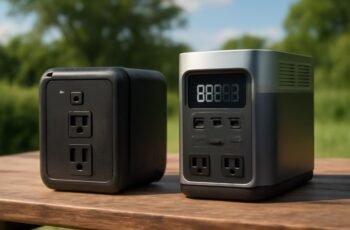
While both portable power stations and whole house battery backups serve to provide electrical energy during outages or off-grid situations, they differ considerably in design and application. Portable power stations typically employ lithium-ion or lithium-polymer batteries, utilizing specific battery chemistries that influence energy density, lifespan, and safety. These units often support multiple charging methods, including AC wall outlets, solar panels, or vehicle adapters, offering flexibility for mobile use. In contrast, whole house battery backups integrate larger, more robust battery systems designed for permanent installation, often using advanced chemistries like lithium iron phosphate for stability and longevity. Their charging methods usually involve direct connection to the grid or solar arrays, emphasizing continuous, high-capacity energy management. Understanding these distinctions helps clarify their respective roles in energy resilience.
How Do They Work and What Are Their Key Features?
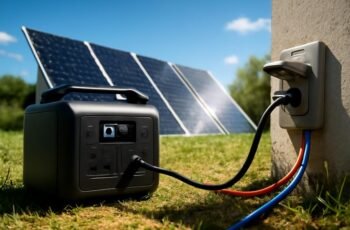
Portable power stations operate by converting stored chemical energy within their batteries into usable electrical power through an inverter, allowing them to supply AC or DC electricity directly to connected devices. Their efficiency and performance depend heavily on battery chemistry, such as lithium-ion or lithium-polymer, which influence energy density, longevity, and safety. Key features include multiple charging methods—AC wall outlets, car adapters, and solar panels—enabling versatile recharging options. The inverter’s quality determines the stability and purity of the output power, critical for sensitive electronics. Additionally, built-in protections safeguard against overcharging, overheating, and short circuits. These technical aspects guarantee reliable operation, making portable power stations adaptable for diverse scenarios, from outdoor adventures to emergency backup, while emphasizing the importance of advanced battery chemistry and flexible charging methods.
Which Option Is Better for Outdoor Use or Emergency Power?
When evaluating outdoor or emergency power solutions, portability and mobility are vital factors, as they determine how easily the system can be transported and deployed. Power capacity and duration directly impact the ability to sustain essential devices during outages or on-the-go use. Analyzing these points helps identify which option—portable power stations or whole house battery backups—best fits the specific demands of emergency or outdoor scenarios.
Portability and Mobility
Among the options, portable power stations generally excel in outdoor and emergency scenarios due to their lightweight design and integrated handles, which facilitate easy transport. Their portability allows for quick deployment in remote locations, making them ideal for outdoor activities or emergency situations. Battery lifespan is a key factor, as portable units are designed for frequent, short-term use, often with replaceable or extendable batteries. Storage flexibility is also a significant advantage; they can be stored in compact spaces and moved as needed, unlike whole house backups that require fixed installation. This mobility guarantees continuous power access without the logistical constraints of stationary systems. Overall, their design prioritizes ease of movement, making them better suited for situations demanding frequent relocation or outdoor use.
Power Capacity and Duration
Power capacity and duration are vital factors when evaluating options for outdoor use or emergency power, as they determine how long and effectively devices can operate without access to the grid. Portable power stations typically provide a limited capacity, often measured in watt-hours, which directly impacts runtime. Whole house battery backups generally offer higher capacity, supporting prolonged outages. Battery lifespan influences long-term reliability; a longer-lasting battery maintains capacity over more charge cycles. Charging speed is also essential, especially during emergency situations, as rapid recharging minimizes downtime. While portable units excel in mobility, their limited capacity may restrict extended use, whereas whole house systems are better suited for sustained backup, despite slower charging rates. Ultimately, the choice hinges on balancing capacity, duration, battery durability, and recharge efficiency.
What Are the Installation, Cost, and Maintenance Considerations?
When evaluating installation, cost, and maintenance, we must consider the technical complexity and infrastructure requirements of each system. Long-term expenses include initial investment, ongoing upkeep, and potential upgrades, which vary considerably between portable units and whole house backups. Understanding these factors helps inform the most cost-effective and sustainable choice for different applications.
Installation Complexity and Requirements
Installing a portable power station generally involves minimal setup, often limited to plugging in devices or charging via a standard outlet, which keeps costs and complexity low. The installation complexity is straightforward, requiring no specialized electrical requirements. For whole house battery backups, however, the process is more involved:
- Electrical integration: They often need a dedicated circuit or transfer switch, demanding professional installation.
- Permitting: Local codes may necessitate permits, adding to initial setup time.
- Wiring complexity: Proper wiring ensures safety and efficiency but requires technical expertise.
- System sizing: Proper assessment of electrical load is critical, influencing both cost and complexity.
Long-Term Cost and Upkeep
Long-term costs and ongoing maintenance substantially influence the overall value and practicality of both portable power stations and whole house battery backups. Portable units often have lower initial costs but may require frequent replacements due to limited lifespan, impacting long-term expenses. Whole house systems entail higher upfront investment, including installation, but benefit from durable components with reduced replacement frequency. Aesthetic design plays a role, especially in home integrations, affecting ongoing upkeep and user satisfaction. Additionally, environmental impact is a critical consideration; advanced battery chemistries with longer lifespans reduce waste and disposal costs over time. Maintenance requirements vary, with portable units generally needing minimal upkeep, whereas whole house systems demand periodic inspections to guarantee ideal performance. Ultimately, evaluating these factors helps determine long-term cost-effectiveness and sustainability.
How to Choose the Right Power Solution Based on Your Needs
Choosing the appropriate power solution hinges on accurately evaluating your energy requirements, usage patterns, and budget constraints. To optimize energy storage and power efficiency, consider these factors:
Selecting the right power solution depends on understanding your energy needs and future growth.
- Load Size: Determine your peak power needs to select a system capable of handling simultaneous device demands.
- Usage Duration: Estimate how long you require backup power to choose between short-term portable solutions and long-term whole house systems.
- Energy Consumption Patterns: Analyze daily energy usage to assess storage capacity and recharge cycles.
- Future Scalability: Evaluate whether your needs might grow, necessitating a flexible system with expandable capacity.
Comparing Limitations and Limitations of Portable Power Stations and Whole House Batteries
While both portable power stations and whole house batteries serve to provide backup energy, each presents distinct limitations that can impact their suitability for different scenarios. Portable power stations generally have shorter battery lifespans, often requiring replacement after 500-1000 charge cycles, which can affect long-term reliability. They are also limited in capacity, restricting their use to smaller loads. Whole house batteries, on the other hand, typically offer greater capacity and longer lifespans—sometimes exceeding 10,000 cycles—but involve higher upfront costs and complex installation. Regarding environmental impact, portable units tend to have a smaller manufacturing footprint but may generate more waste over time. Whole house batteries, while more durable, involve resource-intensive manufacturing processes. Both options require careful consideration of longevity and ecological effects.
Frequently Asked Questions
How Long Can Each Power Source Sustain Energy During an Outage?
We find that portable power stations typically last 4-8 hours depending on device load, influenced by battery lifespan and charging cycles, while whole house backups can sustain essential loads for days, contingent on system capacity and energy management strategies.
Are Portable Power Stations Environmentally Friendly Compared to Whole House Batteries?
Portable power stations often utilize renewable options like solar panels, reducing their carbon footprint, while whole house batteries may rely on grid power, making them less environmentally friendly. We see both as impactful, yet their eco-efficiency varies considerably.
Can Portable Power Stations Be Used as a Primary Energy Source?
We believe portable power stations can serve as primary energy sources in specific scenarios, especially with renewable integration. However, the cost comparison reveals they are less practical long-term, making whole house batteries more suitable for consistent, reliable backup needs.
What Are the Safety Concerns Associated With Each Option?
Like safe guardians of energy, we see charging safety and storage risks as essential. Portable stations demand careful handling to prevent overheating, while whole house backups require secure storage to avoid fire hazards, ensuring reliable, risk-free power solutions.
How Scalable Are These Systems for Future Energy Needs?
We find that both systems’ scalability depends on energy storage capacity and cost efficiency, with whole house backups offering larger, more expandable storage, while portable stations provide modular, cost-effective solutions for immediate, smaller energy demands.
Conclusion
In conclusion, both portable power stations and whole house batteries serve essential roles, but their suitability depends on specific needs. Notably, the global energy storage market is projected to grow at a CAGR of over 20% through 2030, highlighting the increasing importance of tailored power solutions. By analyzing capacity, installation, and long-term costs, we can select the most efficient system for our unique requirements—ensuring reliable, sustainable energy resilience in any scenario.