Ad Blocker Detected
Our website is made possible by displaying online advertisements to our visitors. Please consider supporting us by disabling your ad blocker.
Studies show that optimizing surface coatings and panel orientation can boost solar efficiency by up to 30%. As we explore ways to enhance power station performance, it’s clear that strategic surface design, precise placement, and advanced tracking systems are critical. Understanding the latest innovations and maintenance strategies can profoundly impact operational gains. The question remains: what cutting-edge technologies and practices will define the future of sustainable solar energy?
Key Takeaways
- Optimize solar panel surfaces with advanced coatings and surface engineering to maximize light absorption and minimize reflection losses.
- Properly position and tilt panels, considering shading analysis and optimal orientation, to enhance sunlight capture throughout the day.
- Implement solar tracking systems to follow the sun’s path, increasing energy capture and reducing shading effects.
- Utilize smart monitoring and predictive maintenance technologies for real-time performance optimization and early fault detection.
- Incorporate emerging advanced materials like perovskite and quantum dots to improve solar cell efficiency and operational lifespan.
How Solar Panels Maximize Sunlight Capture and Efficiency
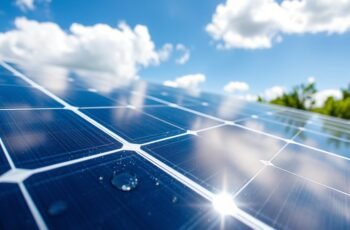
How do solar panels optimize sunlight capture to maximize efficiency? They utilize advanced solar panel coatings designed to enhance absorption and reduce reflection losses. These coatings, often hydrophobic or anti-reflective, minimize sunlight reflection, ensuring more photons reach the photovoltaic cells. By decreasing surface reflectivity, the coatings improve the overall energy conversion rate. Additionally, these coatings can help maintain panel cleanliness, preventing dirt and dust accumulation that could hinder sunlight absorption. The strategic engineering of solar panel surfaces guarantees maximum light capture across varying angles and conditions, optimizing performance throughout the day. This combination of coatings and surface design effectively boosts efficiency, making the solar panels more capable of converting incident sunlight into electrical energy with minimal loss.
Optimizing Solar Panel Placement for Better Performance
Optimizing the placement of solar panels is crucial for maximizing their performance, as strategic positioning directly influences the amount of sunlight captured throughout the day. Effective shade management is critical; even minor shading can considerably reduce energy output. We analyze shading patterns to position panels where obstructions are minimal, guaranteeing maximum exposure. Mounting techniques also play a key role; tilted mounts enhance solar incidence angles, boosting efficiency, while flush mounts may be suitable for low-slope terrains. Proper orientation—typically true south in the northern hemisphere—is indispensable for year-round performance. By combining precise shading assessments with advanced mounting techniques, we can guarantee consistent, ideal sunlight absorption, minimizing energy loss and maximizing overall power station efficiency.
Utilizing Solar Trackers to Follow the Sun’s Path
To maximize solar energy capture, implementing solar trackers that dynamically follow the sun’s path considerably enhances system efficiency. These trackers optimize the angle of solar panels throughout the day, increasing energy yield without requiring additional land area. By maintaining ideal positioning, we reduce the impact of shading analysis, which can greatly diminish output if panels are misaligned or obstructed. Additionally, trackers facilitate more effective solar panel cleaning, as panels are more accessible and easier to maintain regularly. This continuous adjustment minimizes the accumulation of dirt and debris, further improving performance. Overall, solar trackers provide a precise, adaptive approach to maximizing sunlight exposure, ensuring consistent energy generation while addressing potential shading challenges and simplifying maintenance routines.
Enhancing Efficiency With High-Quality Solar Technologies
Advancements in solar cell materials, such as perovskites and multi-junction configurations, greatly boost energy conversion efficiency. Complementing these are innovative tracking systems that optimize solar incidence angles throughout the day, and high-efficiency inverters that minimize power losses during transmission. Together, these high-quality technologies form a critical foundation for maximizing the operational performance of solar power stations.
Advanced Solar Cell Materials
Recent developments in solar cell materials have markedly enhanced the efficiency of photovoltaic systems by leveraging high-quality semiconductors and novel fabrication techniques. Quantum dots and perovskite cells exemplify this progress, offering superior light absorption and tunable bandgaps. Specifically, we observe:
- Quantum dots’ size-dependent optical properties enable targeted spectral absorption, increasing overall energy conversion rates.
- Perovskite cells demonstrate high power conversion efficiencies due to their excellent charge transport and low fabrication costs.
- Hybrid structures combining quantum dots with perovskites improve charge separation and reduce recombination losses.
- Advances in material stability and interface engineering extend operational lifespan, addressing previous durability concerns.
These innovations collectively elevate solar cell performance, pushing the boundaries of efficiency in next-generation photovoltaic technologies.
Innovative Tracking Systems
How can innovative tracking systems considerably boost the efficiency of high-quality solar technologies? By dynamically orienting solar panels toward the sun, these systems optimize energy capture throughout the day, counteracting the limitations of fixed installations. They enhance overall system performance, even under variable weather conditions, while maintaining solar panel aesthetics by integrating seamlessly into the design. However, installation challenges remain, such as increased complexity and cost. To illustrate, consider the following factors:
| Aspect | Impact |
|---|---|
| Precision of tracking | Maximizes energy yield by accurate sun alignment |
| Structural requirements | Demands robust frameworks, affecting installation logistics |
| Maintenance needs | Requires regular calibration, increasing operational complexity |
| Cost-effectiveness | Balances improved efficiency against higher upfront investment |
These factors highlight the technical benefits and challenges of adopting innovative tracking systems.
High-Efficiency Inverters
High-efficiency inverters play a pivotal role in maximizing the performance of high-quality solar technologies by optimizing power conversion processes. They enhance grid integration by ensuring stable, synchronized power delivery, reducing losses, and improving overall system reliability. Additionally, these inverters support policy incentives aimed at increasing renewable adoption through advanced features such as:
- Superior voltage regulation for grid stability
- Real-time monitoring and data analytics
- Compatibility with smart grid infrastructure
- Enhanced fault detection and response capabilities
Implementing Smart Monitoring and Maintenance Systems
Implementing smart monitoring systems enables continuous real-time performance tracking, allowing us to identify inefficiencies promptly. By integrating predictive maintenance strategies, we can anticipate component failures before they occur, minimizing downtime. This proactive approach optimizes operational efficiency and extends the lifespan of solar power stations.
Real-Time Performance Tracking
To enhance solar power station performance, deploying smart monitoring and maintenance systems enables continuous, real-time data collection and analysis. This approach improves operational efficiency by tracking key metrics such as energy storage levels and grid integration status. Specifically, we focus on:
- Monitoring inverter and module performance to detect efficiency drops.
- Tracking energy storage charge/discharge cycles for optimal capacity utilization.
- Analyzing grid interaction to ensure seamless energy flow and stability.
- Identifying anomalies promptly, allowing immediate corrective actions to minimize downtime.
These systems facilitate precise adjustments, optimize energy storage use, and ensure smooth grid integration. Real-time insights foster decision-making that maximizes energy output while maintaining system reliability and efficiency, essential for advancing solar power station performance.
Predictive Maintenance Strategies
Building on real-time performance tracking, predictive maintenance strategies leverage advanced smart monitoring systems to anticipate equipment failures before they occur. By integrating predictive analytics, we can identify patterns indicating potential malfunctions, enabling proactive intervention. This approach refines maintenance scheduling, reducing unplanned downtimes and optimizing resource allocation. Smart sensors continuously collect data on component health, temperature, vibration, and other critical parameters, feeding into predictive models that forecast failure likelihood. Implementing these strategies enhances system reliability and extends equipment lifespan. Precise maintenance scheduling based on predictive insights minimizes unnecessary interventions, lowering operational costs. Overall, predictive maintenance transforms traditional reactive approaches into a data-driven, efficient process, ensuring solar power stations operate at peak efficiency and reducing the risk of unexpected outages.
Exploring Future Innovations in Solar Power Technology
As technological advancements continue to accelerate, the future of solar power technology promises notable breakthroughs that could vastly improve efficiency and scalability. Emerging innovations include:
- Urban solar integration, leveraging building facades and rooftops to maximize space utilization.
- Perovskite solar cells, offering higher conversion efficiencies and lower manufacturing costs.
- Smart grid technologies, enhancing energy distribution and real-time system optimization.
- Enhanced solar education initiatives, fostering broader understanding and adoption of innovative solutions.
These developments will drive the evolution of solar power, making urban solar solutions more viable and cost-effective. Continued focus on research and solar education is essential to accelerating adoption, especially in densely populated areas. Future innovations will profoundly transform how we generate and utilize solar energy at scale.
Frequently Asked Questions
How Do Weather Conditions Affect Solar Panel Efficiency Long-Term?
We observe that weather patterns and seasonal variations impact long-term solar panel efficiency by causing fluctuations in sunlight exposure, temperature, and cloud cover, which reduce energy output; managing these factors improves performance consistency and system reliability over time.
What Is the Lifespan of the Most Advanced Solar Panels?
The most advanced solar panels typically have a lifespan of 25-30 years, with high panel durability. Regular maintenance reduces efficiency decline, but infrequent upkeep is sufficient to sustain peak performance over their operational life.
Can Solar Power Stations Operate Effectively in Cloudy Regions?
We find that solar power stations can operate effectively in cloudy regions, as clouds reduce sunlight by only 20-50%, with seasonal variations impacting output; advanced panels optimize efficiency despite variable cloud coverage, ensuring reliable energy generation year-round.
How Do Shading and Debris Impact Solar Energy Output?
Shade reduction markedly enhances solar energy output by minimizing light obstruction, while debris accumulation reduces efficiency by blocking sunlight; regular cleaning and strategic placement are essential to optimize performance and guarantee consistent power generation in solar stations.
What Are the Initial Costs Versus Long-Term Savings?
Think of solar investment as planting a tree: initial costs are like planting, while long-term savings grow like fruit. Our cost-benefit analysis, aided by financial incentives, shows gains outweigh upfront expenses over time, maximizing efficiency.
Conclusion
By integrating advanced coatings, ideal placement, and tracking systems, we’re fundamentally tuning our solar arrays to dance in harmony with the sun’s movement. This symphony of innovations amplifies efficiency, much like a finely tuned instrument producing a clear, powerful note. As technology evolves—embracing materials like perovskites and quantum dots—we move closer to a future where solar power is not just sustainable but also peak efficient, illuminating the path toward a greener, more resilient energy landscape.