Ad Blocker Detected
Our website is made possible by displaying online advertisements to our visitors. Please consider supporting us by disabling your ad blocker.
We notice a coincidence: many people underestimate their real energy needs until they map out every device and draw a detailed daily watt-hour budget. We’ll walk you through calculating DoD, peak draws, and runtime, then align chemistry, capacity tiers, and ports to your exact use cases, with safety and warranty in mind. This careful approach will sharpen your selection criteria and reveal what matters most, guiding you toward the right balance of reliability and cost.
Key Takeaways
- Assess use case and target capacity: 100–300 Wh for ultralight, 300–1,000 Wh for weekend, 1,000–2,500+ Wh for full home backup.
- Check battery chemistry and safety: prefer LiFePO4 for longevity and robust BMS with thermal management.
- Match outputs and charging: ensure required AC outlets, USB-C PD, 12V, and MPPT solar input with appropriate wattage.
- Consider real-world performance: account for derating, MPPT efficiency, voltage windows, and seasonal shading.
- Factor durability and total cost: verify certifications, warranty, and $/Wh plus expected cycle life.
What a Portable Power Station Is and How It Works
So, what exactly is a portable power station and how does it work? We’re describing a self-contained DC energy store with a battery pack, BMS, inverter, charge controller, and ports. The pack uses chemistry options—Li‑ion (NMC/NCA), LiFePO4 (LFP), or emerging sodium‑ion—each affecting energy density, cycle life, and safety. LFP offers 2,000–5,000+ cycles; NMC/NCA roughly 500–1,500. The BMS manages cell balance, voltage, temperature, and fault response, while the inverter delivers a pure sine wave for sensitive loads. MPPT‑based solar charging improves harvest; AC, DC, and multi‑input inputs enable flexible recharging. Output specs balance continuous and surge ratings, inverter efficiency, and THD. Don’t chase irrelevant trend metrics; read warranty terms and understand aging. A key practical point is that the overall reliability of a portable power station hinges on the quality of its cell chemistry and how the main factual point is managed by the BMS.
How to Determine Your Energy Needs (Wh, DoD, Runtime)
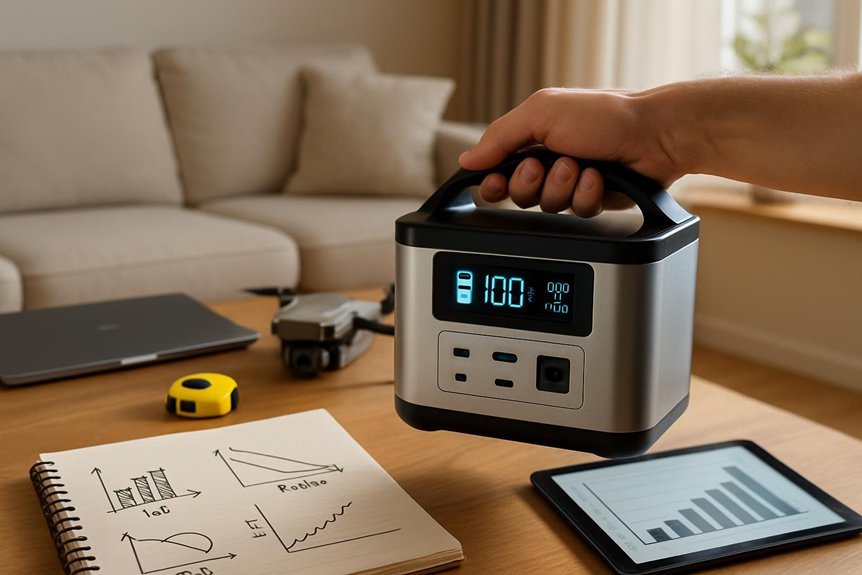
We’ll start by turning your loads into a tangible energy target. We compute daily Wh by summing device wattages times hours, including continuous and intermittent draws, converting amps to watts when needed. We apply duty cycles for cycling loads and add a 10–30% sizing margin to cover uncertainties. Usable Wh equals rated Wh times the DoD, with LiFePO4 commonly at 80% and other chemistries varying by design; we compensate for conservative DoD limits to preserve longevity. Inverter losses (85–95%), plus DC-DC and internal management, reduce usable AC Wh. Runtime follows: usable Wh divided by total load W, with a 15–25% buffer for real-world conditions. Include surge considerations for startup watts and plan energy budgeting across days and potential solar recharge.
How to Pick the Right Battery Chemistry for Your Use Case
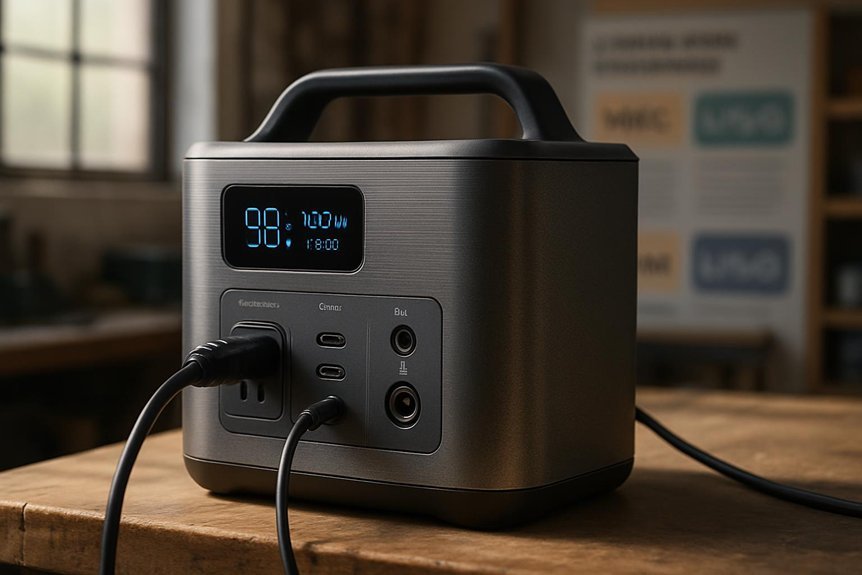
We compare battery chemistries through clear tradeoffs in longevity, safety, and energy density to match your use case. LFP offers superior thermal stability and calendar life for frequent cycling, while NMC/NCA deliver higher energy density for lightweight or space-constrained applications, at the cost of tighter thermal management and higher material risk. We’ll guide you to balance DoD, charging patterns, and pack design to optimize total cost of ownership and performance. Safety Comes First In practice, LiFePO4 chemistry is inherently more stable and less prone to violent energy release, which matters for long-term reliability in portable power applications.
Battery Chemistry Tradeoffs
Choosing a battery chemistry hinges on a clear alignment between performance needs and safety, cost, and longevity realities. We frame tradeoffs around energy density, cycle life, calendar aging, and thermal behavior. NMC/NCA deliver higher voltage and energy density, enabling lighter packs for the same Wh but demand stricter thermal and cell-balancing controls; cobalt/nickel content raises cost and supply risk. LFP emphasizes electrolyte stability and safer, lower-cost materials, with longer calendar life and broader thermal tolerance, though heavier packs result. Partial cycling favors reduced degradation for both chemistries, yet LFP gains proportionally more. Temperature accelerates aging, with NMC typically more sensitive. Irreversible chemistry risks are lower with LFP, but higher energy chemistries still dominate high‑density applications. For sub‑1–2 kWh portable use, NMC offers weight benefits; for longevity, LFP prevails.
DoD And Longevity Tips
DoD is the primary lever for longevity, so pick a chemistry that aligns your usage pattern with practical DoD targets and cycle-life expectations. We frame DoD implications around usable energy vs cycle endurance: LiFePO4 favors 80–90% usable; NMC ranges 50–80% depending on design and warranty. Operating at conservative DoD (≤50–60%) markedly extends cycle longevity versus deeper DoD. For backups, a shallow DoD (20–40%) reduces cycling stress and preserves capacity. For daily cycling, mid-range DoD (50–80%) balances energy needs with lifecycle cost per Wh. Cycle longevity declines as DoD rises; lower DoD can yield 1.5–3× more usable cycles, depending on chemistry and cell quality. Calibrate around cost-per-cycle using usable Wh per cycle at your chosen DoD. Prioritize BMS, temperature control, and moderate SOC to maintain DoD implications over time.
Size It by Your Use Case: Capacity Tiers and Examples
We size power stations by your use case, mapping capacity tiers to typical device loads, runtimes, and duty cycles. We’ll compare 100–500 Wh, 500–1,500 Wh, and 1,500–3,500 Wh categories with concrete runtimes, peak demands, and surge considerations to guide selection. Our approach emphasizes data-driven thresholds, safety margins, and practical tradeoffs for real-world scenarios.
Capacity Tier Examples
Are you sizing a portable power station by use case rather than just capacity? We frame capacity tiers to match real-world needs, not marketing buzzwords. Tier 1 Ultra‑Light (≤ 300 Wh) targets day trips, charging phones, tablets, and cameras; weight 2–8 kg supports backpacking, with 1–2 AC outlets and USB ports. Tier 2 Weekend Camper (300–1000 Wh) powers a 60 W laptop and mini fridge for multi-day use, with 500–1,500 W inverters and 100–400 W solar input. Tier 3 Multi‑Day/Family (1,000–2,500 Wh) supports CPAPs, multiple laptops, and mid‑size fridges, offering 1,000–3,000 W inverters and MPPT up to 800 W. Tier 4 Full Home Backup (2,500–6,000 Wh) enables essential circuits; parallel and transfer features rise. Tier 5 Extended Off‑Grid exceeds 6,000 Wh. Consider irrelevant metric traps and stay data‑driven.
Use-Case Matchups
Sizing by use case matters as much as capacity, so we pair the Capacity Tiers with real-world duty cycles to ensure we meet expected load, runtime, and recharging needs. We distinguish daytime solar-rechargeable use from continuous off-grid operation, prioritizing continuous output (W) for high-surges while ensuring Wh suffices. We balance solar input ceilings against battery capacity to enable realistic recharge rates during intended use, and we factor cycle life for frequent-use scenarios. Inverter efficiency (pure sine wave vs. modified) converts Wh to usable energy, typically 85–95%. For mobility, we target Wh/kg, aiming sub-10 kg units under 1000Wh and modular options for expansion. Match capacity to vehicle or site constraints, ensuring secure mounting, vibration tolerance, and IP protection for true solar storage portable power reliability.
Match Outputs and Ports to Your Devices
So how do we match outputs and ports to your devices for reliable, safe operation? We start by identifying each device’s power requirements, listing nameplate wattage or charging specs, and converting to watts when needed. Separate steady versus startup draws, and note charging protocols (USB PD, PPS, Quick Charge). Record typical daily energy use in Wh per device. Next, pair devices with native outputs: USB-A/USB-C for mobiles, 12V DC for fridges, and AC outlets for appliances; ensure USB-C PD supports required 5V/3A, 9V/3A, and 20V/5A. Check barrel/12V outputs for correct polarity. Consider special outlets for RVs or EVs. Verify AC sine quality. Allocate headroom, confirm per-port limits, and expect some ports to share capacity. Aim for power efficiency with direct-DC/PD charging and suitable charging cables.
Recharge Options and How Solar Affects the Math
We start from the solar input specs and limits we just covered to quantify how solar exposure translates into real charging the station can handle. Our approach uses MPPT efficiency, typically ~95–99% under optimal conditions, to translate panel power into usable battery input. We account for solar derating (0.6–0.85 real-world factor) to estimate delivered energy, not just rated wattage. Panel count should approach the station’s max input without significant overshoot, considering voltage window and VOC limits. Thermal and current caps can cap usable current even when wattage aligns; MPPT efficiency and derate affect charge rate, not safety. Series or parallel wiring choices must keep within voltage and amp specs. Plan for PSH variations and partial shading, aiming for predictable daily energy delivery.
Safety, Durability, and Warranty You Can Trust
Are you confident your portable power station can handle real-world safety, durability, and warranty demands? We are. Our focus combines robust safety certifications, environmental testing, and rigorous durability metrics to guide selection. LiFePO4 chemistry offers thousands of full cycles, while BMS features prevent thermal runaway and capacity loss. Inverter safety with THD under 3%, GFCI on outlets, and standard fault protections reduce risk. Mechanical design emphasizes IP65+, reinforced structure, corrosion resistance, and secure mounting for mobile use. Real-time monitoring and OTA updates enable proactive maintenance. Table summarizes traits at a glance.
| Category | Key Standard | Why it matters |
|---|---|---|
| Safety certifications | UL 1741/CSA C22.2, IEC 62109, UN38.3 | Third‑party verification |
| Environmental testing | Temperature, vibration, humidity | Predicts field reliability |
| Durability observations | IP ratings, rugged sockets | Improves long‑term performance |
How to Compare Models and Get the Best Value
Choosing a portable power station hinges on matching real-world use with measured specs, so we start by aligning capacity, output, and recharge options with your exact needs. We balance capacity (Wh) with your use-case: 1.1–1.3× inverter losses, and select a chemistry whose cycle life fits long-term needs. Compare runtime via Runtime ≈ (Wh × usable DoD) ÷ device watts, using manufacturer DoD when available. Evaluate continuous output against aggregate load, and ensure surge ≥ 2× for motors. Prioritize pure sine wave inverters and verify outlets, MPPT solar input, and derating factors. Consider discharging chemistry and inverter efficiency in overall system losses, plus multi-input recharge and expansion options. Finally compute $/Wh and $/cycle to gauge total cost of ownership.
Frequently Asked Questions
How Do I Estimate True Usable Capacity After Dod and Inverter Loss?
We estimate true capacity as Rated Wh × DoD × Inverter efficiency minus parasitics, plus surge planning for startup surges. We account for aging, temp effects, and pass-through losses to ensure safe, data-driven sizing and accurate expectations.
What Surge Capacity Do I Need for Startup-Heavy Appliances?
Surges matter more than running watts; we’d target peak capacity well above startup needs for safety. For startup-heavy loads, plan around 1.2× estimated surge, considering short term efficiency and battery aging in our calculations. We’ll stay data-driven.
Can I Upgrade a Portable Power Station in the Future?
We can upgrade options, but only within compatible ecosystems; future compatibility hinges on same-brand modular packs and firmware support, while BMS and safety requirements restrict cross-brand swaps and core hardware changes to maintain warranty and reliability.
How Important Is MPPT Efficiency Versus Battery Chemistry?
We’re joking that MPPT efficiency rules all, but battery chemistry actually shapes real gains. MPPT efficiency matters, yet Li-ion/BMS control more power retention; with poor chemistry, extra watts fade. We prioritize chemistry-aware charging alongside efficient MPPT.
What Safety Certifications Should I Look for Before Buying?
We look for safety certifications and certification standards like UL 1741/2054, IEC 62133, UN38.3, FCC/IEC EMC, RoHS, WEEE, and ISO 9001/14001, ensuring EMI compliance, safe grid interconnection, and reliable battery safety for our portable power station purchases.
Conclusion
We’ve walked through the gears, mapping your energy needs to a trusty, storm-ready power companion. Think of your station as a lighthouse: steady sine waves, clean power, and a safety net of protections guiding every startup surge. By matching capacity, chemistry, and ports to real loads, you’ll weather outages with data-driven confidence. In short, plan, verify, and review your DoD, MPPT, and BMS like a metronome—precise, safe, and ready for the next charge.